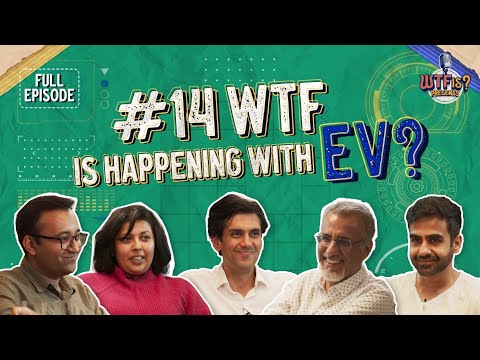
Ep# 14 | WTF is Happening with EV? Nikhil ft. Founders of Reva, Ather, Blusmart, and Ossus
Nikhil Kamath (host), Nikhil Kamath (host), Tarun Mehta (guest), Suruchi Rao (guest), Suruchi Rao (guest), Chetan Maini (guest), Tarun Mehta (guest), Suruchi Rao (guest), Tarun Mehta (guest), Nikhil Kamath (host), Nikhil Kamath (host), Nikhil Kamath (host), Nikhil Kamath (host), Punit Goyal (guest), Chetan Maini (guest)
In this episode of Nikhil Kamath, featuring Nikhil Kamath and Nikhil Kamath, Ep# 14 | WTF is Happening with EV? Nikhil ft. Founders of Reva, Ather, Blusmart, and Ossus explores eVs in India: economics, infrastructure, batteries, swapping, hydrogen, policy realities Nikhil Kamath hosts founders/leaders from BluSmart (EV ride-hailing + charging), Ossus (wastewater-to-hydrogen), Reva/SUN Mobility (India’s early EV pioneer + battery swapping), and Ather (premium electric scooters) to explain the EV landscape for students and new entrepreneurs.
EVs in India: economics, infrastructure, batteries, swapping, hydrogen, policy realities
Nikhil Kamath hosts founders/leaders from BluSmart (EV ride-hailing + charging), Ossus (wastewater-to-hydrogen), Reva/SUN Mobility (India’s early EV pioneer + battery swapping), and Ather (premium electric scooters) to explain the EV landscape for students and new entrepreneurs.
They unpack EV economics (energy cost per km, fleet utilization, financing structures), why charging infrastructure is the binding constraint, and why EVs can reduce emissions even on a coal-heavy grid due to higher end-to-end efficiency and centralized pollution control.
The conversation contrasts fast charging vs battery swapping, with SUN Mobility arguing swapping solves cost/range/throughput at scale and Ather highlighting consumer-behavior frictions (manual lifting, “my new battery” psychology) and product-premiumization constraints.
They also cover hydrogen’s near-term fit (primarily industrial feedstock, selective heavy-duty use cases), battery tech/pack assembly and thermal management, recycling as a major coming opportunity, and policy gaps like inverted GST and a flawed PLI design that disadvantages pure-play EV startups.
Key Takeaways
Charging infrastructure, not vehicles, is the real bottleneck.
BluSmart argues you can ‘write a cheque and get cars,’ but without dependable charging hubs growth stalls; they add only ~400–500 cars/month vs potential 1,000–2,000 because chargers and real estate take time to build.
Get the full analysis with uListen AI
BluSmart’s core thesis is ‘energy + mobility’ as one integrated business.
They treat EV ride-hailing as an anchor tenant that makes charging capex viable; separate subsidiaries (Charge/Fleet/Tech) coordinate cash flows so charging can be profitable earlier while ride-hailing scales toward breakeven.
Get the full analysis with uListen AI
EVs can reduce emissions even with a coal-heavy grid.
Chetan and Tarun highlight the efficiency stack: ICE drivetrains are ~20–25% efficient while electric machines are ~85–90%, and centralized power plants can be more efficient and easier to regulate than millions of tailpipes; as the grid greens, EVs automatically get cleaner over time.
Get the full analysis with uListen AI
Battery life and economics depend heavily on utilization and thermal management.
High-usage fleets can burn through ~200–250k km battery life in ~4 years, while personal scooters may ‘calendar age’ before cycle limits; pack design (cooling strategy, materials, BMS) and hot climates (e. ...
Get the full analysis with uListen AI
Battery swapping is compelling for high-utilization segments, but adoption is behavioral in personal use.
SUN Mobility cites dense networks, 1-minute refuel, better infrastructure throughput, and lower vehicle upfront cost if sold without batteries; Ather counters that many Indian personal customers won’t lift 8–10 kg modules, dislike “never getting my battery back,” and stations need attendants that break unit economics.
Get the full analysis with uListen AI
Hydrogen’s near-term best fit is industrial demand, not mainstream light mobility.
Ossus positions hydrogen as a chemical/feedstock and decarbonization lever for refineries/chemicals/steel; the panel notes converting hydrogen back to electricity is inefficient, and battery EVs tend to win on energy-cost economics for most Indian road use cases.
Get the full analysis with uListen AI
Recycling is a ‘guaranteed demand’ business with improving margins.
Tarun notes a 4 kWh pack may contain ~$240 of raw material value while recycling can be far cheaper, making profitable recovery feasible; policy direction also aims to keep critical materials (like lithium) circulating within India.
Get the full analysis with uListen AI
Policy design is supportive in intent but inconsistent in execution.
They call out PLI eligibility criteria that exclude pure-play EV makers/new entrants, GST inversion (5% on EVs vs 18% on batteries/related services), and subsidy anomalies where fixed-battery vehicles qualify but swappable-battery versions may not—distorting technology choices.
Get the full analysis with uListen AI
Notable Quotes
““This is a game of energy, and this is not a game of mobility.””
— Punit Goyal (BluSmart)
““Even if it was 100% coal-based, it will still make sense.””
— Tarun Mehta (Ather)
““You’ll be around 30% better… An ICE engine vehicle is an efficiency of around 25%. An electric machine is around 90%.””
— Chetan Maini (Reva/SUN Mobility)
““You just bought this scooter… Monday, you go to a swap station… when do I get my battery back?… ‘Never.’””
— Tarun Mehta (Ather)
““If you sell a vehicle sans the battery… the cost of the vehicle can be cheaper than [an] ICE vehicle.””
— Chetan Maini (SUN Mobility)
Questions Answered in This Episode
BluSmart: What is your current charger-to-car ratio, and how does that determine the maximum fleet you can add per month in a new city?
Nikhil Kamath hosts founders/leaders from BluSmart (EV ride-hailing + charging), Ossus (wastewater-to-hydrogen), Reva/SUN Mobility (India’s early EV pioneer + battery swapping), and Ather (premium electric scooters) to explain the EV landscape for students and new entrepreneurs.
Get the full analysis with uListen AI
BluSmart financing: What are the exact conditions a first-time founder needs to meet to access DFI-style funding (minimum fleet size, collateral, DSCR, track record)?
They unpack EV economics (energy cost per km, fleet utilization, financing structures), why charging infrastructure is the binding constraint, and why EVs can reduce emissions even on a coal-heavy grid due to higher end-to-end efficiency and centralized pollution control.
Get the full analysis with uListen AI
Charging infra: You mention the ‘anchor tenant’ concept—what utilization rate makes a charging hub profitable, and how long does it take to reach that?
The conversation contrasts fast charging vs battery swapping, with SUN Mobility arguing swapping solves cost/range/throughput at scale and Ather highlighting consumer-behavior frictions (manual lifting, “my new battery” psychology) and product-premiumization constraints.
Get the full analysis with uListen AI
Solar plants: You quoted ~18–19% post-tax returns—what assumptions (tariff, CUF, debt cost) drive that today, and where do projects most commonly fail?
They also cover hydrogen’s near-term fit (primarily industrial feedstock, selective heavy-duty use cases), battery tech/pack assembly and thermal management, recycling as a major coming opportunity, and policy gaps like inverted GST and a flawed PLI design that disadvantages pure-play EV startups.
Get the full analysis with uListen AI
Grid emissions: Can you quantify a well-to-wheel emissions comparison for an EV scooter vs petrol scooter in Delhi vs Karnataka, using the same method for both?
Get the full analysis with uListen AI
Transcript Preview
So the point of today is to talk about electric vehicles. Anybody new looking to get into the industry, [upbeat music] we want to tell them the good, the bad, the ugly. [upbeat music] Ready? Rolling.
And action!
Uh, hi, guys. Thank you for coming to Bangalore, and, uh, thanks to my friends who are already in Bangalore. So the point of today is to talk about electric vehicles in the manner that anybody new looking to get into the industry after college, or someone who wants to start a business in EV, a young entrepreneur, we want to tell them the good, the bad, the ugly, uh, which part of the industry wi- may make sense for them to focus on, and what are the skill sets they might need to inculcate to have a long career, a good career in this industry. So maybe we can start with introductions. Uh, I'm sure many people know all of you, but, uh, let's start with Puneet.
So I, uh, was born and brought up in Calcutta, and I, um, did my schooling there. Uh, I'm born in '84, so I'm thir- thirty-nine. Um, shifted to Bombay in the year 2000. Uh, went to Sydenham College for my graduation.
Where is that?
Uh, Sydenham is in Bombay.
Mm-hmm.
On Churchgate B Road. Um, then I finished my graduation in 2005. Um, then went to London School of Economics for my master's in finance. Uh, did a year of, uh, MSc in finance there. Didn't want to come back to India, and, um, so studied one more year. Went to Aston Business School for my second master's. Um, so while I was there studying at Aston Business School-
So you did two masters in?
Yeah, in the UK. Yeah, one in London, one in Birmingham. Um...
Are you married? Do you have a girlfriend? [laughing]
[chuckles] Okay. I didn't-- I was not focused.
On girls?
Yeah.
What were you focused on?
Maybe just, uh, trying to find my way out, figuring out to start a business or something.
Have things changed at thirty-nine? H-how is this not an interview? [laughing]
[laughing]
I don't like that. I feel like that. Things have changed a little bit. Um, I come from a family business background, so my, third-generation entrepreneur, so everybody was doing something in the family. So I didn't want to join my family business and was twen- wanting to start on my own, so was trying to figure out what to do. I did two or three small startups, which didn't go along well. They were in the plastic space, small, very small startups, uh, that didn't go along well. So I... Yeah, so I decided that I'll go study outside. Let's probably learn something, and while I was studying at, um, at Aston, I chanced upon... During my dissertation, I read about the role of clean energy and renewable energy. That will be-- That was game changing for me. And I came back to India, and I met some solar panel manufacturers, who at that time were manufacturing solar panels. Uh, met them in India and realized that there could be a massive opportunity to make solar panels in India and export into Europe. Europe at that time was the biggest market. Uh, they were setting up these massive solar power plants in Spain and Italy. They had that fit feeding tariff. So I then decided that we'll set up a solar panel manufacturing facility, and it was called PLG Power, my first company. PLG is the initials of my grandfather, Prashottamlal Goyal. He passed away, uh, in April 2007, at the age of seventy-eight. So I thought, "Okay, my first company that I'll f- uh, that I'll start should be with his initials." And I started that in 2007, uh, eight, uh, Jan of 2008, to manufacture solar panels. Uh, the manufacturing facility was at Nashik, at Sinnar. So that was the whole idea, to make solar panels. So did that for four years, uh, between 2008 to 2012. Uh, the idea was to go back into solar cell manufacturing, uh, further back into wafer manufacturing, and each was a larger investment. But then the market just crashed in Europe. It was very bad timing. Market just came down, you know, string of bankruptcies in, in-
Install uListen to search the full transcript and get AI-powered insights
Get Full TranscriptGet more from every podcast
AI summaries, searchable transcripts, and fact-checking. Free forever.
Add to Chrome