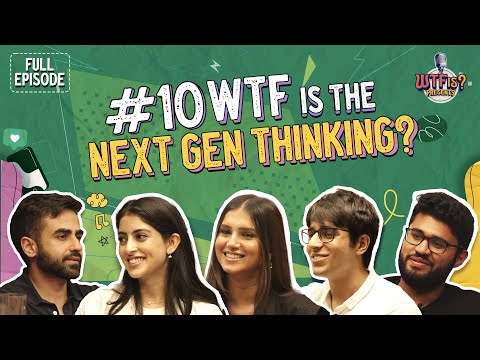
Ep #10 | WTF is the Next Gen Thinking? Nikhil w/ Navya, Tara, Aadit & Kaivalya
Nikhil Kamath (host), Aadit Palicha (guest), Tara Sutaria (guest), Kaivalya Vohra (guest), Nikhil Kamath (host), Nikhil Kamath (host), Aadit Palicha (guest), Navya Naveli Nanda (guest), Navya Naveli Nanda (guest), Tara Sutaria (guest), Nikhil Kamath (host), Nikhil Kamath (host), Kaivalya Vohra (guest), Kaivalya Vohra (guest), Aadit Palicha (guest)
In this episode of Nikhil Kamath, featuring Nikhil Kamath and Aadit Palicha, Ep #10 | WTF is the Next Gen Thinking? Nikhil w/ Navya, Tara, Aadit & Kaivalya explores gen Z, quick commerce economics, Bollywood reality, and modern identity debates Nikhil Kamath hosts Zepto co-founders Aadit Palicha and Kaivalya Vohra alongside Navya Naveli Nanda (Project Naveli) and actor Tara Sutaria to decode “next gen thinking” across business, culture, and identity.
Gen Z, quick commerce economics, Bollywood reality, and modern identity debates
Nikhil Kamath hosts Zepto co-founders Aadit Palicha and Kaivalya Vohra alongside Navya Naveli Nanda (Project Naveli) and actor Tara Sutaria to decode “next gen thinking” across business, culture, and identity.
The Zepto founders walk through their origin story—from a COVID-era WhatsApp grocery group to KiranaKart, a pivot to dark stores, and rapid fundraising—while explaining unit economics, last-mile costs, and why speed can improve profitability via higher rider throughput.
Navya discusses navigating privilege, building a purpose-led organization focused on women’s education/health/legal awareness/entrepreneurship, and argues Gen Z’s “entitlement” is often a response to inheriting big problems without enough decision-making power.
Tara reflects on her arts-first upbringing, bullying and learning challenges, Bollywood’s distribution/monetization shifts, and how relatability and OTT have changed what audiences want—while the group debates social media validation, scarcity marketing, education reform, and mental health.
Key Takeaways
Speed in delivery can reduce costs, not just increase delight.
Zepto explains last-mile cost as rider pay per hour divided by orders per hour; faster delivery often means shorter distances and higher orders/hour, pushing per-order delivery cost down.
Get the full analysis with uListen AI
Early “product-market fit” can be fake if driven by unusual conditions.
KiranaKart saw orders during lockdown, but customers admitted they’d revert offline post-lockdown; that insight drove the pivot to dark stores to control end-to-end experience.
Get the full analysis with uListen AI
Dark stores are a ‘micro-warehouse supermarket’ optimized for pick-pack, not browsing.
They describe ~3,000–3,500 sq ft locations tucked away from prime frontage, designed for picker speed and high throughput per square foot—keeping rent as a low percent of sales.
Get the full analysis with uListen AI
Quick commerce revenue isn’t mainly delivery fees; ads can matter a lot.
They describe revenue as inventory sales plus advertising and small delivery fees (free delivery above ₹199), noting ad income is high margin and increasingly meaningful.
Get the full analysis with uListen AI
Gen Z expects ‘good service at fair price’—not ‘cheap but painful.’
Aadit argues the older tradeoff (DMart-style friction for low prices) is less tolerated; value plus convenience is now table stakes, even for budget-conscious users.
Get the full analysis with uListen AI
Gen Z shopping discovery is increasingly content-led and “feels organic.”
Navya describes buying via Instagram rabbit holes and wanting to shop what she sees in videos/sets/locations; the perceived self-driven discovery reduces resistance versus overt ads.
Get the full analysis with uListen AI
Scarcity and recognition are powerful Gen Z marketing levers.
They cite limited drops (e. ...
Get the full analysis with uListen AI
UPI is the default payment rail for young consumers in India.
They argue credit cards are less central for Gen Z; UPI wins on ubiquity and merchant acceptance—from small roadside purchases to online checkout.
Get the full analysis with uListen AI
Bollywood’s audience is shifting from aspiration toward relatability—without losing the theater ‘outing’ value.
Tara ties OTT and “relatability” to writing/performance/style expectations, while still believing cinemas remain irreplaceable as a communal, escapist experience.
Get the full analysis with uListen AI
Education reform needs to start earlier and include life skills, not just test performance.
Tara links bullying and dyscalculia to rigid schooling; the group criticizes marks-centric conformity and advocates practical skills, soft skills, and personalized learning paths.
Get the full analysis with uListen AI
Founder conflicts are mitigated by role clarity, papered agreements, and deep mutual respect.
Nikhil’s Zerodha example stresses clear decision rights; Aadit emphasizes acknowledging complementary strengths and remembering the journey’s shared hardship as an ego-check.
Get the full analysis with uListen AI
Trolling/cancel culture is best handled with perspective and low engagement.
Tara frames it as transient and often untrue; Navya treats criticism as part of choosing public work and as feedback shaped by differing lived experiences.
Get the full analysis with uListen AI
Notable Quotes
““Trying to sell software to like a baniya is probably the best crash course in sales.””
— Kaivalya Vohra
““In the last 24 months, went from about zero to… north of 5,000 crores in sales.””
— Aadit Palicha
““Good service does not mean premium or luxury. Good service is now like table stakes.””
— Aadit Palicha
““I’m not chasing profit, I’m chasing purpose… I’d say I’m a social entrepreneur.””
— Navya Naveli Nanda
““We care more for relatability rather than aspiration… OTT has changed the game.””
— Tara Sutaria
Questions Answered in This Episode
Zepto: What specific operational changes (picker layout, batching, rider routing) made the biggest difference to orders-per-hour?
Nikhil Kamath hosts Zepto co-founders Aadit Palicha and Kaivalya Vohra alongside Navya Naveli Nanda (Project Naveli) and actor Tara Sutaria to decode “next gen thinking” across business, culture, and identity.
Get the full analysis with uListen AI
Zepto: You mentioned ads are meaningful and high-margin—what ad formats work best in grocery (search, banners, sponsored listings, brand stores)?
The Zepto founders walk through their origin story—from a COVID-era WhatsApp grocery group to KiranaKart, a pivot to dark stores, and rapid fundraising—while explaining unit economics, last-mile costs, and why speed can improve profitability via higher rider throughput.
Get the full analysis with uListen AI
Zepto: At what store maturity (orders/day) does a dark store typically turn profitable, and what’s the main bottleneck to get there?
Navya discusses navigating privilege, building a purpose-led organization focused on women’s education/health/legal awareness/entrepreneurship, and argues Gen Z’s “entitlement” is often a response to inheriting big problems without enough decision-making power.
Get the full analysis with uListen AI
Zepto: You claim many quick commerce players failed due to execution—what are the 2–3 execution errors that kill the model?
Tara reflects on her arts-first upbringing, bullying and learning challenges, Bollywood’s distribution/monetization shifts, and how relatability and OTT have changed what audiences want—while the group debates social media validation, scarcity marketing, education reform, and mental health.
Get the full analysis with uListen AI
Navya: In Project Naveli’s 25,000-women entrepreneur community, what are the top three recurring barriers—capital, confidence, family constraints, digital access, or something else?
Get the full analysis with uListen AI
Transcript Preview
[upbeat music] We started today trying to establish what people in your generation are thinking. [upbeat music]
All cameras rolling?
Yeah.
Let's start.
Ready? So we're gonna spend the first five minutes today talking about how kids of today, the twenty-year-old Zepto guys- [chuckles]
I think they've just reached-
can't figure out-
[chuckles] I literally think they've just- I think they've just reached.
Are they here?
I heard some noise.
It's not them, right?
No.
Okay. Oh, okay.
Then it makes sense.
Yeah.
Uh, Tara and Navya, I want to ask you guys, what is wrong with the youth of today that they can't make it to any place on time?
Navya, take it away. [chuckles] I'm a part of the youth, so I don't want to comment [chuckles] 'cause I'm one of these people. I was also late.
You were not late, really.
I was, like- You were kind of late. I mean, I wasn't as late as them-
Yeah.
-but I was a little late. Were you late? 'Cause if you were late, then I was definitely late. [laughing] We were all late, to be honest, but I think they've taken the bar a little too high- I know-
Why, why is that?
... being that late. It's unacceptable. We should stand-
Naveli, when you guys go out-
Mm.
-say, Tara and Navya are going on... going out to dinner with their respective friends.
Mm-hmm.
If that respective friend was to make you wait an hour-
Mm
... what would you do?
I would eat and leave, probably. Yeah, same.
Yeah?
I mean, I would eat. I would definitely eat as well. Yeah.
So what should we do with them? 'Cause they-
I mean, I would like to eat and then leave. [laughing] So I don't want to leave yet. Chat. Let's just do it.
Maybe we should punish them.
How so? Any ideas? Interesting.
You guys come up with it. You pick one, she'll pick another, and we'll punish them.
Mm, I'm not really good at this stuff. Hmm. Nikhil, you're the woke one. [chuckles] Maybe you can help us with this. Well, they're here, so-
I'm sorry.
And we're dressed exactly the same. [chuckles] We're not wild guys.
Nice to meet you. Hello.
Hi, nice to meet you. Hi, Navya. Nice to meet you.
Hi.
Hi, Navya. Nice to meet you.
Good to see you guys. What's up? [exhales]
Wow, everyone's really color coordinated today. Yeah.
I get, I get some- Bangalore sucks. I get some, uh, pause 'cause I got a fever, but now I'm feeling a bit better.
Oh, wow.
So it's been... Yeah. I'm feeling a bit better, but I, whole day got ruined as a result of that.
Gosh, do you want some medicine or something?
Yeah, I popped some paracetamol like before this one.
Okay.
Yeah.
I can't say anything else now.
Yeah.
Mm.
He was like- I anticipate. I anticipate.
Yeah. [laughing]
Yeah, I know, I know, I know.
He was like, "I was sick and now-"
Install uListen to search the full transcript and get AI-powered insights
Get Full TranscriptGet more from every podcast
AI summaries, searchable transcripts, and fact-checking. Free forever.
Add to Chrome