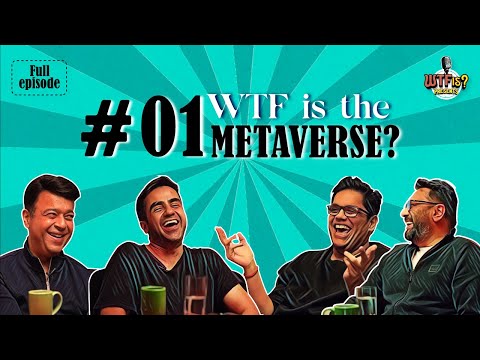
#1 WTF is Metaverse? WTF is with Nikhil Kamath ft. Tanmay Bhat, Umang Bedi & Aprameya Radhakrishna
Nikhil Kamath (host), Aprameya Radhakrishna (guest), Tanmay Bhat (guest), Tanmay Bhat (guest), Tanmay Bhat (guest), Umang Bedi (guest), Nikhil Kamath (host), Nikhil Kamath (host), Nikhil Kamath (host), Aprameya Radhakrishna (guest), Aprameya Radhakrishna (guest), Tanmay Bhat (guest), Umang Bedi (guest), Nikhil Kamath (host)
In this episode of Nikhil Kamath, featuring Nikhil Kamath and Aprameya Radhakrishna, #1 WTF is Metaverse? WTF is with Nikhil Kamath ft. Tanmay Bhat, Umang Bedi & Aprameya Radhakrishna explores demystifying the metaverse: from hype to hardware, creators, and AI Nikhil Kamath hosts Tanmay Bhat, Aprameya Radhakrishna (Koo), and Umang Bedi (Dailyhunt/Josh) to decode the metaverse beyond buzzwords, arguing that the behavior already exists in today’s “app universes,” but true immersion depends on better hardware and cheaper compute.
Demystifying the metaverse: from hype to hardware, creators, and AI
Nikhil Kamath hosts Tanmay Bhat, Aprameya Radhakrishna (Koo), and Umang Bedi (Dailyhunt/Josh) to decode the metaverse beyond buzzwords, arguing that the behavior already exists in today’s “app universes,” but true immersion depends on better hardware and cheaper compute.
They contrast centralized platform control (Web2) with creator-led, more open models (often associated with Web3), debating whether blockchain is essential or merely optional infrastructure for virtual worlds.
Concrete examples ground the discussion: VRChat as today’s standout social VR product, GTA Roleplay as a metaverse-like economy and identity layer, Unreal Engine as the critical creation stack, and Counter-Strike/Valorant skins as proof people already pay for digital status.
Later, the conversation moves to India’s first virtual influencer “Kyra,” explaining why audiences follow fictional characters and how brands monetize them, then ends with AI (ChatGPT) as a democratizing force that will reshape jobs—creating new roles like “prompt engineers.”
Key Takeaways
“Metaverse” is more behavior than a single product.
They argue we already “log into universes” via Instagram, Twitter/Koo, and other apps—metaverse-like behavior exists today, but it’s mostly 2D and less immersive.
Get the full analysis with uListen AI
Immersion will be gated by hardware comfort and network economics.
Neck strain and bulky headsets highlight form-factor limits; they predict lighter glasses-like devices, enabled by 5G and cloud/offloaded compute, are necessary for mass adoption.
Get the full analysis with uListen AI
Gaming is the most proven on-ramp to metaverse adoption.
Examples like VRChat and especially GTA Roleplay show people already maintain identity, social rules, and economic activity in persistent virtual spaces—arguably “metaverse in practice.”
Get the full analysis with uListen AI
Creation tools are the leverage point—game engines matter.
Unreal Engine and “MetaHumans” demonstrate near-photoreal avatars and drag-and-drop world building, suggesting engines and tooling may capture disproportionate value in the ecosystem.
Get the full analysis with uListen AI
Blockchain is optional; ownership/control is the real debate.
Some guests see “metaverse” as democratized ownership (NFT land, traceable assets), while others stress metaverses can run on centralized servers (AWS) and still deliver compelling experiences.
Get the full analysis with uListen AI
The first mass-scale “killer app” may be shared live events, especially sports.
They speculate that recreating stadium-level tribal experiences (IPL/FIFA) is a plausible breakthrough—if concurrency and networking constraints can be solved.
Get the full analysis with uListen AI
Virtual influencers win by storytelling, not realism.
Kyra’s creators emphasize character arcs (like Harry Potter fandom) and brand campaigns; people follow even when they know it’s fictional because narrative + consistency beats authenticity alone.
Get the full analysis with uListen AI
AI will both automate work and lower the barrier to entry for making things.
ChatGPT is framed as democratizing coding and creative work, but also creating new skills (prompt engineering) and shifting advantage to those with proprietary data and distribution.
Get the full analysis with uListen AI
Notable Quotes
““It’s a made-up word.””
— Guest (metaverse discussion)
““We’re logging into universes already, just that it is two-dimensional.””
— Aprameya Radhakrishna
“VRChat… “like Yahoo! Chat Rooms… but in virtual reality.””
— Guest (Prashant)
““Sports has this very tribalistic feeling… imagine watching the IPL… in the metaverse from your home.””
— Guest (Prashant)
““Microsoft… by miles.””
— Guest (Prashant), on who benefits most from metaverse
Questions Answered in This Episode
Aprameya framed each app as a “universe.” What specific product changes would make today’s social apps meaningfully “metaverse” (beyond just 3D UI)?
Nikhil Kamath hosts Tanmay Bhat, Aprameya Radhakrishna (Koo), and Umang Bedi (Dailyhunt/Josh) to decode the metaverse beyond buzzwords, arguing that the behavior already exists in today’s “app universes,” but true immersion depends on better hardware and cheaper compute.
Get the full analysis with uListen AI
You mention VRChat’s concurrency limits (30–40 users per room). What technical breakthroughs (netcode, edge compute, engine-level optimizations) are most needed to reach stadium-scale events?
They contrast centralized platform control (Web2) with creator-led, more open models (often associated with Web3), debating whether blockchain is essential or merely optional infrastructure for virtual worlds.
Get the full analysis with uListen AI
Several of you disagree on whether blockchain is essential. What minimum “ownership” primitives should exist in a metaverse, even if it’s not on-chain?
Concrete examples ground the discussion: VRChat as today’s standout social VR product, GTA Roleplay as a metaverse-like economy and identity layer, Unreal Engine as the critical creation stack, and Counter-Strike/Valorant skins as proof people already pay for digital status.
Get the full analysis with uListen AI
Prashant argued Meta is “screwed” after John Carmack resigned. What internal capability would Meta need to rebuild to credibly compete—hardware, engines, developer ecosystem, or creator economics?
Later, the conversation moves to India’s first virtual influencer “Kyra,” explaining why audiences follow fictional characters and how brands monetize them, then ends with AI (ChatGPT) as a democratizing force that will reshape jobs—creating new roles like “prompt engineers.”
Get the full analysis with uListen AI
If Unreal Engine is the stack, where does the durable business model sit: engine licensing, asset marketplaces, hosting/compute, identity/payment rails, or content/IP?
Get the full analysis with uListen AI
Transcript Preview
It's funny how I suddenly feel conscious when the camera is on, and I know about it, right? [laughing]
Yeah.
Like, I was so happy talking, like, before that. [laughing]
Uh, yeah. Why do you want to touch dinosaurs? Anyway, uh [laughing]
[laughing]
How do I compete with that?
[laughing] I think I made two jokes, and now he's gone on this angle, and he won't stop. [laughing]
[laughing]
We want people under the age of 18 to watch this one. [upbeat music]
First, nothing is going to work until I just maybe sleep better. So maybe I should try that thing.
Mm.
So maybe at 110, I'm going to call you, Nikhil, and be like, "Yo!" [laughing]
[laughing]
"That Wegovy thing you were talking about."
But is there a number when it changes? Like, is six not enough and eight enough? Did you have that?
Like sleep?
Yeah.
Eight. Eight is a good number.
Yeah.
Uh, you should go close enough to eight-
Mm.
... uh, and if you don't, you just make it a habit.
Bro, Nikhil, if you sleep eight hours, you are going to trade like a madman. [laughing]
Yeah. [laughing]
[laughing]
You're going to all of a sudden be like, "65% profit today!" Dude, if you slept eight hours, you would be short [censored] one week ago. [laughing] Like, you wouldn't know this shit.
[laughing]
No, it's just that some random crap on TV, some book, some game on my phone, these are the things that keep me up.
Doesn't-
It's not some fancy work.
Doesn't Nithin, like, sleep really well? He speaks a lot about health.
No, he doesn't. He, like, he gets, like, maybe six hours or seven max, pushing it.
Hmm. Goodness-
He sleeps early, wakes up early, but...
That's what I do.
Yeah.
I'm in bed by 10:30.
How much do you sleep?
I sleep, like, easy eight hours.
Really?
I don't wake up at all.
You sleep?
Yeah.
So Aprameya-
So that's-
... is a genuinely very well-rounded guy.
[laughing]
You know, everything is right about him.
[laughing]
Like, you know, the college he went to, what he did at work-
[laughing]
... his wife, his daughter. Like-
He's perfect
... generally, he's a very well-rounded guy. [laughing]
Eight hours? Like, a lot.
Eight hours, yeah.
Yeah.
Like, I sleep-
He sings. He's in a band. He has a band.
Yeah, I'll sleep at 12:00, and I'll wake up by 8:00, and I'm, I'm ready.
And how, how do you wake up, though? Like, how do you guys wake up?
Without an alarm.
Without an alarm?
With an alarm.
Without-
With many alarms.
Oh, Sebi doesn't call you to wake you up?
No, no.
[laughing]
Starts at 7:00 a.m.-
Sebi. [laughing]
[laughing]
The first alarm is 7:00, the last one is 7:45 a.m. [laughing]
[laughing]
In between that, I have 10. [laughing]
Amazing. But, uh, where- what year was this when you lost this weight?
2018.
'18.
Actually, '17, middle to 18 June.
Install uListen to search the full transcript and get AI-powered insights
Get Full TranscriptGet more from every podcast
AI summaries, searchable transcripts, and fact-checking. Free forever.
Add to Chrome