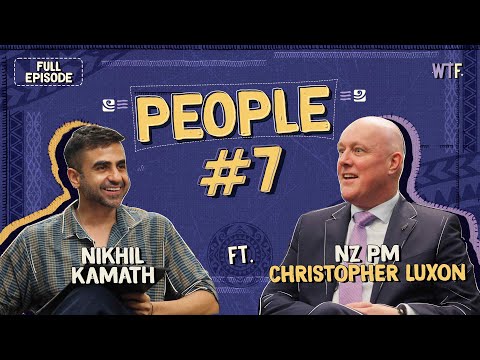
Nikhil Kamath x NZ PM Christopher Luxon | People by WTF Ep #7
Nikhil Kamath (host), Christopher Luxon (guest)
In this episode of Nikhil Kamath, featuring Nikhil Kamath and Christopher Luxon, Nikhil Kamath x NZ PM Christopher Luxon | People by WTF Ep #7 explores luxon on leadership, business-to-politics shift, and New Zealand’s priorities Christopher Luxon reflects on his India visit, emphasizing cultural diplomacy (including Māori kapa haka) and the case for deeper India–New Zealand ties through business and community connections.
Luxon on leadership, business-to-politics shift, and New Zealand’s priorities
Christopher Luxon reflects on his India visit, emphasizing cultural diplomacy (including Māori kapa haka) and the case for deeper India–New Zealand ties through business and community connections.
He explains why he entered politics after a global business career, arguing that while running a country differs from running a company, leadership fundamentals—team-building, clarity, temperament, and learning—transfer well.
Luxon discusses governing priorities (cost of living, law and order, health, education, infrastructure), advocating a customer-centric public service and more effective “problem definition.”
The conversation also touches on campaign finance limits in New Zealand, changing global order (rules→power, efficiency→resilience), and Luxon’s optimism that younger generations can improve systems by engaging directly.
Key Takeaways
Don’t anchor identity to titles; anchor it to character and relationships.
Luxon argues roles like “Prime Minister” are temporary, and people who build identity around status can struggle when it disappears; he prioritizes being a husband and father first and measures success by relationship quality over achievements.
Get the full analysis with uListen AI
Business skills transfer—but only if you accept politics is a different sport.
He frames the move as “cricket to hockey”: principles like team-building and change management carry over, but you must relearn policy depth, parliamentary process, and stakeholder complexity without assuming prior success guarantees competence.
Get the full analysis with uListen AI
Even temperament is a leadership advantage in high-noise environments.
Luxon credits steady emotional regulation—avoiding extremes in wins or losses—as a differentiator among leaders, helping maintain decision quality amid constant scrutiny.
Get the full analysis with uListen AI
Use selective attention: be informed about criticism, not consumed by it.
He treats social media as signal, not authority, insisting “not all opinions are equal” and emphasizing the pause between stimulus and response to avoid being “bounced around” by online commentary.
Get the full analysis with uListen AI
Government performance improves with ‘customer centricity’ and clearer problem definition.
Luxon says bureaucracies often skip rigorous problem definition, leading to mismatched solutions; he pushes a service-organization mindset where public servants focus on outcomes for patients, students, and commuters.
Get the full analysis with uListen AI
Campaign-finance design shapes who can realistically enter politics.
He contrasts New Zealand’s tight spending caps (e. ...
Get the full analysis with uListen AI
The global operating system is shifting from efficiency to resilience.
Luxon describes a post–COVID and conflict-prone world where lowest-cost global sourcing is less reliable, pushing nations to build resilient supply chains and pair prosperity with security planning.
Get the full analysis with uListen AI
Notable Quotes
““It’s not what you do, it’s actually who you are that matters much more.””
— Christopher Luxon
““At some point, I will no longer be Prime Minister… but I’m not defined by the job.””
— Christopher Luxon
““Everyone can have their opinions, but not all opinions are equal.””
— Christopher Luxon
““Governments don’t do problem definition well… solutions are often roaming around in search of problems to attach to.””
— Christopher Luxon
““You’re seeing a shift from rules to power… and a shift from efficiency to resilience.””
— Christopher Luxon
Questions Answered in This Episode
On ‘cricket to hockey’: What were the first 3 concrete skills you had to unlearn when entering politics, and what replaced them?
Christopher Luxon reflects on his India visit, emphasizing cultural diplomacy (including Māori kapa haka) and the case for deeper India–New Zealand ties through business and community connections.
Get the full analysis with uListen AI
You emphasize ‘problem definition’ as a government weakness—can you share an example policy area where redefining the problem changed the solution?
He explains why he entered politics after a global business career, arguing that while running a country differs from running a company, leadership fundamentals—team-building, clarity, temperament, and learning—transfer well.
Get the full analysis with uListen AI
New Zealand’s campaign caps sound strict; what enforcement mechanisms prevent indirect spending or third-party workarounds?
Luxon discusses governing priorities (cost of living, law and order, health, education, infrastructure), advocating a customer-centric public service and more effective “problem definition.”
Get the full analysis with uListen AI
You describe ‘customer-centric’ public services—how do you measure customer outcomes in health and education without incentivizing metric-gaming?
The conversation also touches on campaign finance limits in New Zealand, changing global order (rules→power, efficiency→resilience), and Luxon’s optimism that younger generations can improve systems by engaging directly.
Get the full analysis with uListen AI
The Active Investor Visa offers residency pathways—what safeguards ensure it drives productive investment rather than passive capital parking?
Get the full analysis with uListen AI
Transcript Preview
[upbeat music] Are we set, guys? [upbeat music] How should I address you? Prime Minister Chris-
Chris is fine. [chuckles]
Yeah, you sure?
Absolutely.
So, Chris, I'm not going to go the usual path of an interview. I think this is more a conversation.
Yeah.
And I went to the match recently, the India-New Zealand cricket final.
Oh, my goodness. I was hoping you wouldn't... This, this podcast was going so well-
[laughing]
... until you had to go mention that.
[upbeat music]
Hi, Chris. Thank you for doing this.
It's so awesome to be with you, and with such a celebrated entrepreneur like yourself, so it's great to be with you.
How should I address you? Prime Minister Chris-
Chris is fine. [chuckles]
Yeah, you sure?
Absolutely. Absolutely.
Uh, well, welcome to India. I saw bits of you going to different places in India. How has that been so far? I saw you with the Prime Minister, I saw you at the gurudwara-
Yeah
... at a cricket game.
Yeah. It's been absolutely magical.
Mm-hmm.
I mean, we've had a fantastic four to five days here in India. Um, and essentially, you know, India's a place that I first got to know when I was working at Unilever, and we had a very large business here called Hindustan, uh, Lever.
Mm-hmm.
And as a result, I used to come here in my probably mid to late 20s. And, you know, when I think about how it has progressed from when I first visited to, to where I am today, it's just so, so inspiring. I mean, it's such a ambitious, aspirational, can-do, positive kind of place, and you just see the trajectory that it has been on, that it is now, and then it's on now for the future, and it's just... It's all about growth, and it's all about energy and, um, drive and determination, and it's just really, really f- you know, contagious. So, uh, it's awesome to be here. I brought the biggest delegation of any prime minister on any visit-
Mm-hmm
... that we've had from New Zealand, and I had a big business delegation-
Mm-hmm
... and also a community delegation, and also, um, our indigenous kapa haka, our team, performing arts team, with us, as well.
Yeah.
So, you know, it's been a very full-on set of four or five days, but, you know, these are two great countries-
Yeah
... that should have a closer relationship-
Yeah
... and, uh, be a much deeper, broader relationship.
I saw this, uh, member of Parliament, I'd like to say, performing the haka at Parliament.
Yes. [laughing]
It looked so good.
[laughing]
Can you tell us a bit about that? What was that?
Well, look, it's really, um, you know, our kapa haka, which is our Maori performing arts.
Mm-hmm.
Maori are the indigenous people-
Yeah
... of New Zealand. Uh-
My brother has a Maori tattoo from there.
He does a tattoo. Yeah, yeah. Yeah, I mean, it's... They just-
Install uListen to search the full transcript and get AI-powered insights
Get Full TranscriptGet more from every podcast
AI summaries, searchable transcripts, and fact-checking. Free forever.
Add to Chrome