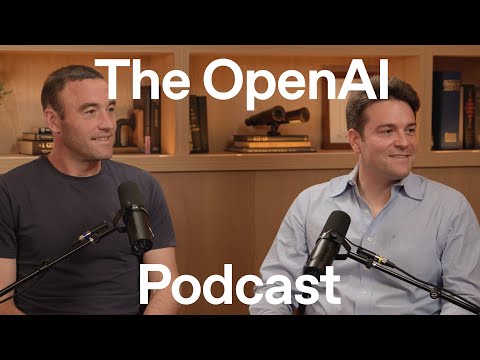
How AI is accelerating scientific discovery today and what's ahead — the OpenAI Podcast Ep. 10
Andrew Mayne (host), Kevin Weil (guest), Alex Lupsasca (guest), Alex Lupsasca (guest)
In this episode of OpenAI, featuring Andrew Mayne and Kevin Weil, How AI is accelerating scientific discovery today and what's ahead — the OpenAI Podcast Ep. 10 explores aI as a 24/7 collaborator accelerates frontier science and discovery Kevin Weil and Alex Lupsasca describe OpenAI for Science as an initiative aimed at compressing decades of discovery into just a few years by putting frontier AI models into scientists’ hands.
AI as a 24/7 collaborator accelerates frontier science and discovery
Kevin Weil and Alex Lupsasca describe OpenAI for Science as an initiative aimed at compressing decades of discovery into just a few years by putting frontier AI models into scientists’ hands.
They share concrete stories where models helped with hard theoretical physics and math tasks, plus “conceptual” literature search that finds relevant work across disciplines and languages (often missed by keyword search).
A key nuance is that frontier problems often have low pass rates: effective use requires iterative back-and-forth, warm-up problems, verification, and human judgment to separate “too hard” from “rarely right but solvable.”
They preview an upcoming multi-author paper documenting what works/doesn’t work today, including shared chat logs and several new non-trivial math results, and they forecast rapid near-term change in how science is conducted—especially as models get more “thinking time” and adoption widens.
Key Takeaways
The biggest felt impact of AGI may come through science.
Weil argues that breakthroughs in personalized medicine, scalable fusion, and other scientific advances will affect everyday life more profoundly than “AI inside a chatbot,” making science a central pathway for societal AGI benefits.
Get the full analysis with uListen AI
Acceleration isn’t only ‘better answers’—it’s parallel exploration.
Even when a scientist could eventually solve a problem, getting to test many approaches quickly (e. ...
Get the full analysis with uListen AI
AI’s most immediate superpower in research is conceptual literature search.
Models can link ideas across disciplines, terminologies, and languages—finding obscure, relevant prior work (e. ...
Get the full analysis with uListen AI
Frontier performance is ‘jagged’ for both humans and models.
Lupsasca notes simple-sounding questions can be unsolved while highly technical predictions can be extremely precise; similarly, models can fail on basics yet succeed on niche, hard tasks—often in ways complementary to human strengths.
Get the full analysis with uListen AI
Low pass-rate tasks are where the most valuable science help is today.
Weil explains that some problems are solvable by the model only occasionally (e. ...
Get the full analysis with uListen AI
Iterative ‘warm-up’ prompting mirrors real scientific practice.
Lupsasca’s black-hole symmetry example shows that starting with a simpler limiting case can ‘prime’ the model and lead to correct solutions on the harder frontier case—similar to how humans structure research.
Get the full analysis with uListen AI
More thinking time and targeted compute can materially improve outcomes.
They observe that giving models longer to reason (tens of minutes to hours) boosts pass rates on hard problems; allocating larger compute budgets to expert scientists could unlock disproportionate gains.
Get the full analysis with uListen AI
Notable Quotes
““Maybe the most profound way that people are going to feel AGI in their lives is through science.””
— Kevin Weil
““The acceleration that is going to come from these tools is going to change science.””
— Kevin Weil
““It had to go and find this special identity… published in one paper from the 1950s in a Norwegian Journal of Mathematics.””
— Alex Lupsasca
““These are the worst AI models that we will ever use for the rest of our lives.””
— Kevin Weil
““Human and AI together are much more powerful than human alone or AI alone.””
— Kevin Weil
Questions Answered in This Episode
In Lupsasca’s pulsar/Legendre-polynomial story, what specific verification steps did he use to catch the “silly typo,” and what best practices does that imply for checking AI-derived derivations?
Kevin Weil and Alex Lupsasca describe OpenAI for Science as an initiative aimed at compressing decades of discovery into just a few years by putting frontier AI models into scientists’ hands.
Get the full analysis with uListen AI
What does a “conceptual-level literature search” look like in practice—what input format (notes, equations, plain-English descriptions) most reliably retrieves cross-discipline prior work?
They share concrete stories where models helped with hard theoretical physics and math tasks, plus “conceptual” literature search that finds relevant work across disciplines and languages (often missed by keyword search).
Get the full analysis with uListen AI
You mention low pass-rate frontier problems (e.g., 5%). What product or workflow changes could help researchers detect ‘solvable but low pass-rate’ versus ‘truly too hard’ without brute-force reruns?
A key nuance is that frontier problems often have low pass rates: effective use requires iterative back-and-forth, warm-up problems, verification, and human judgment to separate “too hard” from “rarely right but solvable.”
Get the full analysis with uListen AI
In the upcoming paper’s math section, what qualifies the results as “new non-trivial” (e.g., new lemmas, tighter bounds, new constructions), and how were they validated independently of the model?
They preview an upcoming multi-author paper documenting what works/doesn’t work today, including shared chat logs and several new non-trivial math results, and they forecast rapid near-term change in how science is conducted—especially as models get more “thinking time” and adoption widens.
Get the full analysis with uListen AI
How should graduate programs adapt training if ‘warm-up problem decomposition’ and iterative model collaboration become core research skills?
Get the full analysis with uListen AI
Transcript Preview
Hello, I'm Andrew Mayne, and this is the OpenAI Podcast. Today, my guests are Kevin Weil, head of OpenAI for Science, and Alex Lupsasca, who is an OpenAI research scientist and professor of physics at Vanderbilt University. We're gonna be discussing how AI is impacting science, an upcoming research paper, and where science may be headed in the next five years.
Maybe the most profound way that people are going to feel AGI in their lives is through science.
With ChatGPT, I can just launch it in that direction, in that direction, that direction.
The acceleration that is going to come from these tools is going to change science.
[upbeat music] So you're running the OpenAI for Science initiative. Could you explain what that's about?
Yeah, the, the mission of OpenAI for Science is to accelerate science. So the, the question is, can we help scientists do the next, say, twenty-five years of scientific research and scientific discovery in five years instead? Science underpins so much of, of, you know, what we do and how we live, and if we can make progress go faster by putting our most advanced models into the hands of the best scientists in the world, we should do that, and that's what we're trying to do. The, the-- you could ask, like, why now? Why didn't we do this a year ago? Why aren't we doing this a year from now? One of the big reasons is we're just starting to see our frontier AI models being able to do novel science. So we're starting to see examples where GPT-5 can actually prove new things. Maybe not yet things that humans could not do-
Mm-hmm.
-but things that humans have not done. So the- these are, like, these little existence proofs of GPT-5 being able to break out past the frontier of human knowledge and into the unknown. And if there's one thing that I've learned from now, uh, you know, a year and a half or so at OpenAI, it's that you go very quickly from the model can't do something, to the model can just barely do something, and it's not great at it yet, but you see these, these, these early examples, and then, you know, six months later, twelve months later, all of a sudden, you couldn't imagine doing this thing without AI. And I think science is in that initial phase where we're seeing real acceleration for scientists that are using AI, sometimes novel, uh, you know, n- not yet maybe large breakthroughs, call them small breakthroughs, and that just says that there's so much potential in this space.
We've seen examples of, let's say, AI helping with mathematical proofs. Could you give me an example of how it might do things in some other areas, like physics or whatever kind of things we might see in the short term?
Yeah, I mean, we're seeing examples every day, and they're across the, the range of, of sort of the scientific frontier. You see examples in mathematics, in physics, uh, astronomy, life sciences, like biology. Uh, Alex, I mean, you've, you've worked on some of these. Maybe, maybe it's a good time to talk about some of the physics stuff that you've seen.
Install uListen to search the full transcript and get AI-powered insights
Get Full TranscriptGet more from every podcast
AI summaries, searchable transcripts, and fact-checking. Free forever.
Add to Chrome