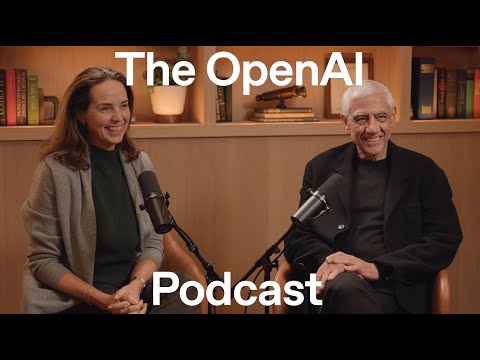
State of the AI Industry — the OpenAI Podcast Ep. 12
Andrew Mayne (host), Sarah Friar (guest), Vinod Khosla (guest), Andrew Mayne (host)
In this episode of OpenAI, featuring Andrew Mayne and Sarah Friar, State of the AI Industry — the OpenAI Podcast Ep. 12 explores aI in 2026: agents mature, compute scales, new business models emerge Vinod Khosla and OpenAI CFO Sarah Friar argue that 2026 is about closing the “capability gap”: moving from chatbot Q&A toward agentic systems that complete real tasks for consumers and enterprises.
AI in 2026: agents mature, compute scales, new business models emerge
Vinod Khosla and OpenAI CFO Sarah Friar argue that 2026 is about closing the “capability gap”: moving from chatbot Q&A toward agentic systems that complete real tasks for consumers and enterprises.
They frame demand for AI as fundamentally compute-limited today, with strong price elasticity and expanding use cases—making “bubble” narratives less meaningful than actual usage (e.g., API calls).
Healthcare is highlighted as a major, high-stakes domain already seeing massive usage, but held back by regulation and institutional constraints, even as clinicians increasingly adopt AI tools.
They outline OpenAI’s strategy to scale compute in line with revenue, expand product surfaces and business models (subscriptions, enterprise SaaS, credits, commerce/ads, licensing), and explain where startups can still build durable value—especially around proprietary data, workflows, and permissioning/identity for agents.
Key Takeaways
2026 is positioned as the year agents become visibly useful.
They predict maturation of multi-agent systems that can execute end-to-end tasks (e. ...
Get the full analysis with uListen AI
Most users are barely tapping AI’s current capabilities.
Khosla estimates only a single-digit percentage of users utilize even ~30% of what AI can do; the next decade is framed as a learning/adoption journey, not just a model-improvement story.
Get the full analysis with uListen AI
Healthcare impact is already large, but regulation is the bottleneck.
Friar cites 230M weekly health questions and 66% of US physicians using ChatGPT; Khosla argues prescriptions/diagnosis face FDA/AMA constraints even if AI performance is strong.
Get the full analysis with uListen AI
OpenAI treats compute as a direct driver of revenue and product velocity.
Friar describes a tight compute-to-ARR relationship (200MW→$2B ARR; 600MW→$6B; 2GW→$20B+) and emphasizes being compute-constrained today while needing to commit years ahead for data center capacity.
Get the full analysis with uListen AI
“Bubble” should be measured by real usage, not valuations.
Khosla argues stock/valuation swings reflect investor psychology; the meaningful metric is underlying demand (e. ...
Get the full analysis with uListen AI
Enterprise value is showing up as concrete productivity gains and job redesign.
Examples include contract review/rev-rec workflows automated by agents, “people plus agents” org charts (1:5), and cases like a company with ~$150M ARR operating with only one accounting person due to AI-native ERP.
Get the full analysis with uListen AI
Ads and commerce are presented as access-enablers—if trust and choice are preserved.
Friar says a free tier is mission-critical (95% of consumer users are free), but any ads must be clearly labeled, never degrade answer quality (“best answer, not paid-for answer”), and there should be an ad-free option.
Get the full analysis with uListen AI
Startups can win by building around unique data, workflows, and governance layers.
They suggest moats emerge where data sits behind firewalls and where workflows require permissioning, identity, and complex approvals (e. ...
Get the full analysis with uListen AI
Notable Quotes
““We’ve handed them the keys to the Ferrari, but they are only learning how to take it out on the road for the first time.””
— Sarah Friar
““Demand is limited not by anything other than availability of compute today.””
— Vinod Khosla
““I always look at bubbles should be measured by the number of API calls.””
— Vinod Khosla
““It’s like we’ve just turned electricity on in the home.””
— Sarah Friar
““Sometime probably towards the end of the next decade, you’ll see a massively deflationary economy, because labor will be near free.””
— Vinod Khosla
Questions Answered in This Episode
On agents: What specific capabilities need to mature for “multi-agent” systems to reliably complete end-to-end consumer tasks like trip planning without user micromanagement?
Vinod Khosla and OpenAI CFO Sarah Friar argue that 2026 is about closing the “capability gap”: moving from chatbot Q&A toward agentic systems that complete real tasks for consumers and enterprises.
Get the full analysis with uListen AI
On measurement: If API calls are the bubble metric, what other usage-quality metrics matter (task completion rate, retention, error/hallucination rates, time-to-value) and how should they be tracked?
They frame demand for AI as fundamentally compute-limited today, with strong price elasticity and expanding use cases—making “bubble” narratives less meaningful than actual usage (e. ...
Get the full analysis with uListen AI
On healthcare regulation: What is the most realistic pathway for AI to become an approved medical device for diagnosis or prescribing, and what evidence thresholds would regulators require?
Healthcare is highlighted as a major, high-stakes domain already seeing massive usage, but held back by regulation and institutional constraints, even as clinicians increasingly adopt AI tools.
Get the full analysis with uListen AI
On compute strategy: How does OpenAI decide when to allocate scarce compute to training frontier models vs. serving inference demand vs. launching new multimodal products?
They outline OpenAI’s strategy to scale compute in line with revenue, expand product surfaces and business models (subscriptions, enterprise SaaS, credits, commerce/ads, licensing), and explain where startups can still build durable value—especially around proprietary data, workflows, and permissioning/identity for agents.
Get the full analysis with uListen AI
On monetization and trust: How would OpenAI technically and policy-wise enforce “best answer, not paid-for answer” in an ad-supported ChatGPT experience?
Get the full analysis with uListen AI
Transcript Preview
Hello, I'm Andrew Mayne, and this is the OpenAI Podcast. Today, our guests are Sarah Friar, CFO of OpenAI, and legendary investor, Vinod Khosla of Khosla Ventures. In this discussion, we're going to talk about the state of the AI ecosystem, whether or not we're in a bubble, and how startups and investors can succeed as AI progresses.
Unlike something like Netflix, where they're running so many hours in the day, I think of it much more like infrastructure, like electricity.
Demand is limited, not by anything other than availability of compute today. I think the conversation we need to have is: what will people do?
2025 was about agents and vibe coding. Now it's 2026. What's the story of 2026?
I think we matured in vibe coding in 2025. I don't think we've matured in agents. So agents, especially multi-agentic systems, will mature to the point of having real visible impact. Whether you're an enterprise and you have a multi-agent systems doing full tasks, like running an ERP system for you, um, you know, doing all the reconciliation every day, accruals every day, work-- tracking contracts every day. I think that on the enterprise side. But today, uh, on the consumer side, you know, it's still a hassle to ma-- plan a trip. That's a multi-agentic thing that looks across a lot of different things, from your food preferences, to the restaurant reservation, to airline schedules, to your personal calendar. Uh, those will start to mature, I think, a year from now. Um, so I'm pretty excited about that. I think models in robotics and real-world models that go beyond, well beyond robotics, like general intuition, uh, will all start to happen in, in the next year. So I think that, that-- those are areas to look for. There's usual functions, like memory in LLMs, um, continual learning in LLMs, um, redu- uh, reduction of the impact of hallucinations. Those are all areas I could go on. There's half a dozen areas in which AI doesn't do as well today that will be-- start to be addressed.
Yeah. And I think at its baseline, what Vinod is saying is '26 is the beginning of closing this capability gap. So what we know is we've handed people massive intelligence, right? We've handed them the keys to the Ferrari, but they are only learning how to take it out on the road for the first time. Um, we need to give consumers more and more easy ask, uh, easy ways to go from ChatGPT as just a chatbot, call and response. Most people use it today just to ask questions. But how do we take it towards being a true task worker, that, that books that trip for them, or helps them get a second opinion on what they just heard from their doctor, or enables them to create a menu for their diabetic child, right? How do we help them really move from simple questions into actual outcomes that make my life better? And then on the enterprise side, it's that same continuum. How do we close the capability gap, right? One of the things we know from our state of the enterprise, AI and the enterprise report that our chief economist put out at the end of last year, is on the frontier versus just even the median corporation. The, the average number of messages or the median is about six X, which will tell you that's six X the usage from a company that's already on the frontier, and we know that frontier isn't even pushed to its max. So for us, it's this focus of how do we help consumers move along that continuum to true agentic task working? And then for enterprises, how do we create a much more sophisticated, vertically specialized outcome for enterprises that allows them to go from maybe a very simple ChatGPT implementation, the whole way to something that's transforming the most important part of their business? For a healthcare provider, it might be their drug discovery process. For a hospital, it might be the time to admit a patient to get that patient back into the community. For, um, a really large retailer, it might be just larger basket sizes, higher conversion rates, and much happier customers. So it's the basics of closing that capability gap.
Install uListen to search the full transcript and get AI-powered insights
Get Full TranscriptGet more from every podcast
AI summaries, searchable transcripts, and fact-checking. Free forever.
Add to Chrome