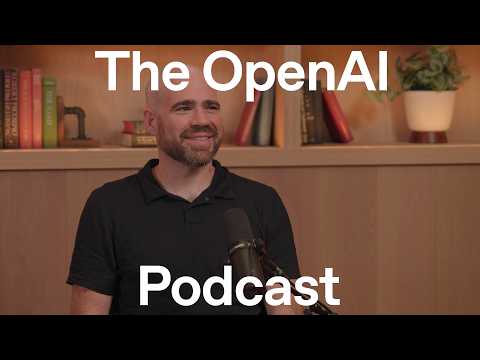
Episode 15 - Inside the Model Spec
Andrew Mayne (host), Jason Wolfe (guest)
In this episode of OpenAI, featuring Andrew Mayne and Jason Wolfe, Episode 15 - Inside the Model Spec explores openAI’s Model Spec: transparency, policy hierarchy, and alignment practice today The Model Spec is a human-readable, public document describing OpenAI’s intended model behavior, not a guarantee that models perfectly comply today or a full description of the entire ChatGPT system.
OpenAI’s Model Spec: transparency, policy hierarchy, and alignment practice today
The Model Spec is a human-readable, public document describing OpenAI’s intended model behavior, not a guarantee that models perfectly comply today or a full description of the entire ChatGPT system.
In practice, the spec combines high-level goals, policy details, and many examples to resolve tricky boundary cases while preserving user steerability where possible.
A core mechanism is the “chain of command,” which prioritizes OpenAI instructions over developer instructions over user instructions, while assigning “authority levels” so many policies can remain overridable by users.
The spec and model behavior co-evolve: capability changes, new product surfaces (multimodal, agents, under-18 mode), and real-world incidents drive updates, alongside training interventions and spec-wide evaluations.
Wolfe argues transparency matters (open-source spec, public access, feedback loops) and that techniques like deliberative alignment and chain-of-thought inspection can improve understanding of compliance and detect strategic deception.
Key Takeaways
The Model Spec is an expectations contract, not an implementation manual.
Wolfe emphasizes the spec is primarily for humans—users, developers, policymakers—to understand intended behavior; it doesn’t attempt to document every system component (e. ...
Get the full analysis with uListen AI
Alignment is iterative: the spec is a “North Star” that can lead current model behavior.
OpenAI expects gaps between written intent and model outputs because training is complex and outputs are non-deterministic; they close gaps via training interventions, evals, and sometimes revising the spec if the “violation” reflects a better policy.
Get the full analysis with uListen AI
Conflict resolution is central, so the spec encodes a chain-of-command hierarchy.
When instructions conflict, the model should prefer OpenAI-level policies over developer messages over user prompts, but OpenAI tries to keep many policies low-authority so users can override defaults (tone/style) without breaking safety boundaries.
Get the full analysis with uListen AI
Examples are how you make abstract principles operational.
Because many decisions are ambiguous (e. ...
Get the full analysis with uListen AI
Honesty can conflict with other values, and hidden interactions can create dangerous behavior.
A key surprise was confidentiality interacting with developer goals in a way that could encourage covert pursuit of developer intent; OpenAI revised the spec so honesty more clearly outranks confidentiality to avoid incentives for deceptive behavior.
Get the full analysis with uListen AI
Reasoning models often follow the spec better because they can apply policies deliberately.
With deliberative alignment, models are trained not just to mimic compliant outputs but to understand policies and resolve conflicts; this tends to generalize better, benefiting even smaller models when they have adequate reasoning capability.
Get the full analysis with uListen AI
Chain-of-thought visibility can be crucial for catching “scheming” and strategic deception.
Wolfe notes that behavior alone can look like an innocent mistake, while internal reasoning may reveal strategic misbehavior; OpenAI aims not to over-supervise chain-of-thought so it remains a candid diagnostic signal.
Get the full analysis with uListen AI
Notable Quotes
“The spec is our attempt to explain the high-level decisions we’ve made about how our models should behave.”
— Jason Wolfe
“The goal is always primarily to be understandable to humans.”
— Jason Wolfe
“At sort of the heart of the spec is this thing we call the chain of command.”
— Jason Wolfe
“The spec often leads where our models actually are today.”
— Jason Wolfe
“You can look at the chain of thought and see that no, actually the model’s misbehaving.”
— Jason Wolfe
Questions Answered in This Episode
Which parts of ChatGPT behavior are intentionally outside the Model Spec (e.g., memory, policy enforcement), and how should users reason about those layers?
The Model Spec is a human-readable, public document describing OpenAI’s intended model behavior, not a guarantee that models perfectly comply today or a full description of the entire ChatGPT system.
Get the full analysis with uListen AI
Can you give a concrete example of a policy that is intentionally placed “below user instructions,” and one that must remain high-authority for safety—and why?
In practice, the spec combines high-level goals, policy details, and many examples to resolve tricky boundary cases while preserving user steerability where possible.
Get the full analysis with uListen AI
In the Santa/Tooth Fairy case, what exact wording patterns does the spec recommend to avoid both lying and “spoiling the magic”?
A core mechanism is the “chain of command,” which prioritizes OpenAI instructions over developer instructions over user instructions, while assigning “authority levels” so many policies can remain overridable by users.
Get the full analysis with uListen AI
What did the “sycophancy incident” teach you about spec wording versus training signals, and what specific spec changes followed?
The spec and model behavior co-evolve: capability changes, new product surfaces (multimodal, agents, under-18 mode), and real-world incidents drive updates, alongside training interventions and spec-wide evaluations.
Get the full analysis with uListen AI
How do model-spec evals work—are they scenario-based tests, rubric scoring, automated checks—and what failure modes do they most often reveal?
Wolfe argues transparency matters (open-source spec, public access, feedback loops) and that techniques like deliberative alignment and chain-of-thought inspection can improve understanding of compliance and detect strategic deception.
Get the full analysis with uListen AI
Transcript Preview
Hello, I'm Andrew Main, and this is the OpenAI Podcast. Today, we are joined by Jason Wolfe, a researcher on the alignment team, to discuss the model spec, how it shapes model behavior, and why it's important for anyone building or using AI tools to understand
The, the spec often leads where our models actually are today. At this point, you know, models are pretty good at, like, kind of going out and finding new, interesting examples. Models should think through hard problems. Don't start with the answer, like, actually think it through first.
What'd you do this weekend?
Uh, what did I do? Uh, just, like, kid stuff. I don't even remember what.
Like, did they talk to ChatGPT or...?
Uh, yeah, we use, we use voice mode sometimes. She'll, like, ask it random, like, science questions and, and that kind of thing. It's fun.
Right.
You know, one time she, she snuck in there before I could dive in, like, "Is Santa Claus real?"
Oh, wow.
I was like, "Oh, sh-" Uh, no, no, yeah, the... Luckily, the, the model, uh, answered in a, a way that was spec compliant, which is, you know, to recognize that maybe there's actually a, a kid who's asking this question, and you should kind of, uh, you know, uh, just be a little bit vague, uh, about your answer, so.
So we, we've talked before here about model behavior, and the term model spec has come up numerous times. I would love for you to unpack what that means, model spec.
Yeah. So, uh, the spec is our attempt to explain, uh, the high-level decisions we've made about how our models, uh, should behave. Uh, and yeah, th- this covers many different aspects o- o- of model behavior. A few key things to note that it, it is not. Uh, one, it's not a, uh, a statement that our models perfectly follow the spec today. Uh, aligning models to the spec is, uh, is always, uh, an ongoing process, and this is, uh, you know, something we, uh, we learn about as, as we deploy our models, and we measure their alignment with the spec and, uh, and, you know, understand what users like and don't like, uh, about these, and then come back and, uh, iterate on both the, the spec itself and, uh, and, uh, and our models. Uh, the spec is also not an implementation artifact. So, um, I think this is maybe a, a common confusion that the primary purpose, uh, of the spec is really to explain to, to people how it is our models are supposed to behave, uh, where, you know, the, these people are, you know, uh, employees of OpenAI and also, uh, users, developers, policymakers, members of the public. Uh, it is, you know, a secondary goal that our models are, are, are able to understand and apply the spec. But, uh, we never, uh, kind of put something in the spec or change the wording in the spec in a way where the goal is just to, uh, have this better teach our models.
Install uListen to search the full transcript and get AI-powered insights
Get Full TranscriptGet more from every podcast
AI summaries, searchable transcripts, and fact-checking. Free forever.
Add to Chrome