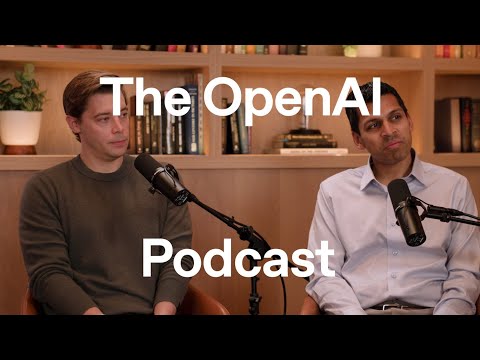
Brad Lightcap and Ronnie Chatterji on jobs, growth, and the AI economy — the OpenAI Podcast Ep. 3
Andrew Mayne (host), Brad Lightcap (guest), Ronnie Chatterji (guest)
In this episode of OpenAI, featuring Andrew Mayne and Brad Lightcap, Brad Lightcap and Ronnie Chatterji on jobs, growth, and the AI economy — the OpenAI Podcast Ep. 3 explores how OpenAI sees AI reshaping jobs, growth, and education worldwide The conversation frames AI—especially ChatGPT—as a platform shift driven as much by interface and deployment as by raw model capability, turning “blank canvas” AI into a broadly usable conversational tool.
How OpenAI sees AI reshaping jobs, growth, and education worldwide
The conversation frames AI—especially ChatGPT—as a platform shift driven as much by interface and deployment as by raw model capability, turning “blank canvas” AI into a broadly usable conversational tool.
Lightcap and Chatterji argue AI will primarily raise output per person, enabling small teams to achieve outsized results and expanding demand for knowledge services as the “price of intelligence” falls.
They explore where AI will hit first (software, professional services, science) and why regulated sectors (healthcare, education) may adopt more slowly, even as education becomes one of ChatGPT’s fastest-growing segments.
A major theme is complementarity: as technical tasks become more accessible, human judgment, agency, EQ, and critical thinking grow in value—along with a need for better indicators to understand sector and geographic disruption.
Key Takeaways
The chat interface was a major adoption unlock, not just model strength.
Lightcap describes how users “hacked the playground” to make models conversational; ChatGPT’s instruction-following interface made AI immediately legible to mainstream users and enabled scale adoption even on GPT‑3.5.
Get the full analysis with uListen AI
OpenAI’s “deployment” focus is about making intelligence usable across contexts safely.
Lightcap frames his role as adapting products to different countries, industries, and workflows—bundling capability with safeguards, compliance, and integrations into the tools where work actually happens (IDE, inbox, lab software).
Get the full analysis with uListen AI
AI can raise productivity by multiples, especially in software engineering.
They expect tooling to move beyond incremental gains to 5–10x productivity for engineers, while also letting non-coders build useful software—creating both democratization and expert amplification effects.
Get the full analysis with uListen AI
Science is a prime near-term beneficiary because AI expands exploration breadth and speeds handoffs.
Chatterji likens research to an “endless corridor of doors”; AI can peek behind more doors faster. ...
Get the full analysis with uListen AI
Human judgment, leadership, and EQ become more valuable as AI handles more cognition.
Chatterji cites research suggesting great team leaders may also be great “agent leaders. ...
Get the full analysis with uListen AI
Agents require a high reliability bar: autonomous execution of novel, complex work.
Lightcap defines an agent as a system you can hand complex tasks to that it can execute proficiently—even on work it hasn’t seen—spanning examples from coding+testing to sales lead qualification workflows.
Get the full analysis with uListen AI
Falling intelligence costs may expand markets and increase downstream demand for human experts.
Lightcap notes internal data: when model prices drop, usage increases disproportionately. ...
Get the full analysis with uListen AI
Regulation and institutional inertia shape adoption speed more than capability alone.
Chatterji expects faster change in less-regulated sectors, while healthcare and education move slower due to privacy/compliance—though education usage is already surging because teachers and students find high practical value.
Get the full analysis with uListen AI
AI could broaden economic participation by providing coaching/mentoring where it’s scarce.
They highlight “missing middle” small businesses globally, agricultural extension in Africa, and access gaps in counseling/behavioral health. ...
Get the full analysis with uListen AI
Economic forecasting needs sector and geography indicators—and better public translation.
Chatterji’s priorities are to identify which industries shift first, where disruption concentrates geographically (to avoid “scarring” like prior transitions), and to communicate insights beyond academic papers so people can plan.
Get the full analysis with uListen AI
Notable Quotes
“AI is a tool that kind of lets people do things that they had no business or ability to do otherwise.”
— Brad Lightcap
“They have the world's smartest brain at their fingertips to solve hard problems.”
— Ronnie Chatterji
“Agents… [must] be reliably handed complex work… autonomously… where it hasn't seen that work before.”
— Brad Lightcap
“Education's been, for us, the fastest growing segment that uses ChatGPT and other OpenAI tools.”
— Brad Lightcap
“When we cut the price of our models… we see a disproportionate increase in demand.”
— Brad Lightcap
Questions Answered in This Episode
On ChatGPT’s origin: What specific “playground hacks” signaled the need for a conversational interface, and what usage metrics confirmed it after launch?
The conversation frames AI—especially ChatGPT—as a platform shift driven as much by interface and deployment as by raw model capability, turning “blank canvas” AI into a broadly usable conversational tool.
Get the full analysis with uListen AI
On jobs: If software engineering productivity rises 5–10x, what leading indicators would you track to distinguish “fewer dev jobs” from “more software + new firms”?
Lightcap and Chatterji argue AI will primarily raise output per person, enabling small teams to achieve outsized results and expanding demand for knowledge services as the “price of intelligence” falls.
Get the full analysis with uListen AI
On agents: What concrete reliability thresholds (error rates, auditability, sandboxing) must be met before OpenAI calls something an agent in regulated domains?
They explore where AI will hit first (software, professional services, science) and why regulated sectors (healthcare, education) may adopt more slowly, even as education becomes one of ChatGPT’s fastest-growing segments.
Get the full analysis with uListen AI
On science: Which step in the drug development pipeline is most likely to bottleneck even with AI—wet lab, clinical trials, regulation, or something else?
A major theme is complementarity: as technical tasks become more accessible, human judgment, agency, EQ, and critical thinking grow in value—along with a need for better indicators to understand sector and geographic disruption.
Get the full analysis with uListen AI
On emerging markets: What would an AI-powered agriculture extension agent need (local languages, offline access, sensor data, agronomy validation) to be trusted and effective?
Get the full analysis with uListen AI
Transcript Preview
Hello, I'm Andrew Mayne, and this is the OpenAI Podcast. There's a lot of conversation and debate about the future of AI when it comes to labor and work. To talk about this, my guests are Brad Lightcap, who's the Chief Operating Officer of OpenAI, and Ronnie Chatterji, who is the Chief Economist. We're gonna find out the kind of research OpenAI is doing, the conversations they've been having, and hopefully get a glimpse of where they think the future is headed. [upbeat music]
We had a lot of people coming back to us and saying, "Yeah, you know, actually, this is, I think, one of the best things that has maybe ever happened to this, this industry." AI is a tool that lets people do things that they had no ability to do otherwise.
They have the world's smartest brain at their fingertips to solve hard problems.
So, Brad, you're the Chief Operating Officer, you're the Chief Economist. Explain what your roles are.
My role probably boils down mostly to [clears throat] what we call deployment. So zooming out, OpenAI is a research and deployment company, and when we think about our mission, what we really think about is not only building AI and doing the research that underpins the building of AI, but how do you actually take it out into the world and have people use it, and have it be beneficial, uh, for people, have it be safe for people? Uh, how is it used in one country versus another country, one industry versus another industry? So I spend a lot of time trying to figure that out, uh, which means working with customers, working with partners, uh, spending a lot of time with our users, and just kind of studying kind of how people-- uh, what people want from OpenAI and our products, how people actually use the technology, and then as the technology changes, how that pattern of use changes.
It, it seems like 'cause OpenAI started primarily as a research org and wasn't even sure if they were gonna do product or even put things that were sort of public-facing, and so how much has this changed rapidly for you?
It's changed really quickly. I think ChatGPT, uh, in November '22, was kind of the pivotal moment, and it was the first time that we really saw AI used at scale.
Mm-hmm.
Uh, and I think, you know, what we kind of... A- and it's interesting, almost, the, the story of how we actually learned that a- and, and how we made the decision to do ChatGPT, um, which was we had previously built an API for developers, and we had a thing, uh, you'll remember, Andrew, in our API, uh, that was, uh, the playground-
Yeah
... where you could basically try prompts out and see how the model would complete the prompt, and this was back in the days of, like, the models just being purely completions-based-
Mm
... where they take an input, and they kind of continue the text on, uh, predicting the next word, uh, and the next token in the sequence. And people were trying to, like, hack the playground, uh, to figure out how to get it to talk to them, and they almost-- you could tell people kind of wanted this conversational interface. And so we kind of learned from that, and we built ChatGPT as the first version of a conversational interface, where we taught the model how to instruction-follow to be more responsive to what people wanted to talk about. Uh, and that, you know, very much surprised us and became, I think, the kind of dominant paradigm of what we call the first era of AI, which was these kind of chatbots, uh, that, you know, really were good enough to, to, uh, to be engaging for people and be helpful for people.
Install uListen to search the full transcript and get AI-powered insights
Get Full TranscriptGet more from every podcast
AI summaries, searchable transcripts, and fact-checking. Free forever.
Add to Chrome