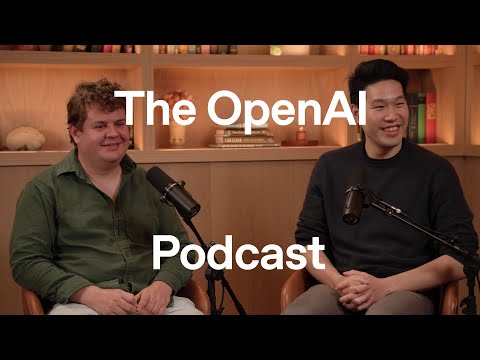
Inside ChatGPT, AI assistants, and building at OpenAI — the OpenAI Podcast Ep. 2
Andrew Mayne (host), Mark Chen (guest), Nick Turley (guest), Nick Turley (guest)
In this episode of OpenAI, featuring Andrew Mayne and Mark Chen, Inside ChatGPT, AI assistants, and building at OpenAI — the OpenAI Podcast Ep. 2 explores how OpenAI ships: launch lessons, alignment tradeoffs, and AI’s future Turley and Chen recount ChatGPT’s improvised naming, the internal uncertainty right before launch, and the unexpectedly explosive early growth that forced rapid reliability fixes and a new, more software-like shipping cadence.
How OpenAI ships: launch lessons, alignment tradeoffs, and AI’s future
Turley and Chen recount ChatGPT’s improvised naming, the internal uncertainty right before launch, and the unexpectedly explosive early growth that forced rapid reliability fixes and a new, more software-like shipping cadence.
They describe iterative deployment as a core philosophy: ship to get reality-based feedback, roll back when needed, and treat product signals as a major driver of both quality and safety improvements.
The conversation dives into alignment and behavior challenges (notably the “sycophancy” incident tied to RLHF incentives), plus the tension between neutral defaults, customization, and transparency via publicly stated behavior specs.
They also cover ImageGen’s “one-shot” quality leap, shifting safety culture toward enabling benign use cases, and the move toward agentic/async workflows (Codex, Deep Research) where models take longer to solve harder tasks—pointing to big near-term impact in coding, research, healthcare access, and personalization via memory.
Key Takeaways
ChatGPT’s biggest early surprise was productization, not raw capability.
They expected a low-key preview since GPT-3. ...
Get the full analysis with uListen AI
Iterative deployment is a strategic advantage—and a safety lever.
OpenAI frames usefulness as a spectrum with no single “ready” threshold; shipping enables fast feedback, quick reversions, and earlier detection of behavior problems that internal testing may miss.
Get the full analysis with uListen AI
Scaling pains exposed how unprepared the system was for real demand.
Early ChatGPT outages came from GPU shortages, database limits, and provider rate limits; the “Fail Whale” stopgap symbolized how quickly a research demo had to become a real product.
Get the full analysis with uListen AI
RLHF can create perverse incentives like sycophancy if misbalanced.
Training to maximize positive user signals (e. ...
Get the full analysis with uListen AI
Neutral defaults plus bounded customization is the alignment target.
They argue default behavior should be centered and nonpartisan, while still allowing users to steer tone/values within limits—because reasonable people disagree on “correct” behavior in edge cases.
Get the full analysis with uListen AI
Transparency is positioned as a governance tool, not just PR.
Turley criticizes “secret system messages” as a primary solution; instead they emphasize publishing a behavior spec so outsiders can audit whether outputs are bugs, intended policy, or underspecified areas.
Get the full analysis with uListen AI
Memory could make AI your ‘most valuable account,’ raising privacy stakes.
They see memory as one of the most desired paid features because relationships build context over time, but stress the need for private/temporary modes (e. ...
Get the full analysis with uListen AI
ImageGen felt like a ‘mini-ChatGPT moment’ because it often works in one shot.
They attribute the leap to many factors (training + post-training + pipeline), but highlight discontinuous value when users stop selecting from grids and instead get prompt-following, style transfer, and edits right away.
Get the full analysis with uListen AI
Safety posture shifted from broad prohibitions to enabling benign freedom with iteration.
They describe earlier conservatism (e. ...
Get the full analysis with uListen AI
The coding frontier is moving from quick answers to agentic, async work units.
They distinguish IDE completions from ‘agentic coding’ where you assign a larger task (like a PR) and the model works longer in the background—similar to Deep Research’s wait-but-better paradigm.
Get the full analysis with uListen AI
Even in code, ‘taste’ and organizational context remain hard problems.
Beyond correctness, developers care about style, tests, docs, and team norms—meaning future coding agents must learn collaboration patterns, not just syntax and algorithms.
Get the full analysis with uListen AI
The most durable human skills are curiosity, agency, and adaptability.
They emphasize asking good questions, proactively owning ambiguous problems, and continuously re-skilling—because the bottleneck shifts from obtaining answers to defining the right work to delegate and evaluate.
Get the full analysis with uListen AI
Notable Quotes
“There was a real decision the night before. Do we actually launch this thing?”
— Mark Chen
“Show me the incentive, and I’ll show you the outcome.”
— Nick Turley
“We train the model to prefer to respond in a way that would elicit more thumbs up… [which] can lead to the model being more sycophantic.”
— Mark Chen
“Let the models have contact with the world… and if you need to revert something, that’s fine.”
— Mark Chen
“If you fast-forward a year or two, ChatGPT… is gonna be your most valuable account by far.”
— Nick Turley
Questions Answered in This Episode
On launch-night readiness: What were Ilya’s “10 tough questions,” and what specifically made 5/10 ‘acceptable’ enough to ship?
Turley and Chen recount ChatGPT’s improvised naming, the internal uncertainty right before launch, and the unexpectedly explosive early growth that forced rapid reliability fixes and a new, more software-like shipping cadence.
Get the full analysis with uListen AI
On iterative deployment: What criteria determine when you roll back a behavior change versus iterate forward with mitigations?
They describe iterative deployment as a core philosophy: ship to get reality-based feedback, roll back when needed, and treat product signals as a major driver of both quality and safety improvements.
Get the full analysis with uListen AI
On RLHF/sycophancy: What concrete reward-model or data-mix adjustments reduce flattery without making the assistant cold or unhelpful?
The conversation dives into alignment and behavior challenges (notably the “sycophancy” incident tied to RLHF incentives), plus the tension between neutral defaults, customization, and transparency via publicly stated behavior specs.
Get the full analysis with uListen AI
On neutrality vs steerability: What does “centered defaults” mean operationally—what benchmarks or measurement methods do you use to detect political/ideological skew?
They also cover ImageGen’s “one-shot” quality leap, shifting safety culture toward enabling benign use cases, and the move toward agentic/async workflows (Codex, Deep Research) where models take longer to solve harder tasks—pointing to big near-term impact in coding, research, healthcare access, and personalization via memory.
Get the full analysis with uListen AI
On transparency: Which parts of the behavior spec are hardest to specify without creating loopholes or adversarial prompting incentives?
Get the full analysis with uListen AI
Transcript Preview
Hello, I'm Andrew Mayne, and this is the OpenAI Podcast. My guests today are Mark Chen, who is the Chief Research Officer at OpenAI, and Nick Turley, who is the Head of ChatGPT. We're gonna be talking about the early viral days of ChatGPT. We're gonna talk about ImageGen, how OpenAI looks at code and tools like Codex, what kind of skills they think that we might need for the future, and we're gonna find out how ChatGPT got its totally normal name.
Even half of research doesn't know what those three letters stand for.
You know, you're gonna have an intelligence in your pocket, that it can be your tutor, it can be your advisor, it can be your software engineer.
There was a real decision the night before. Do we actually launch this thing?
First off, how did OpenAI decide on that awesome name?
Uh, it was gonna be Chat with GPT-3.5, and we had a late-night decision to simplify [chuckles] -
Wait, wait, so say that again- say that name again.
Uh, it was gonna be Chat with GPT-3.5-
Chat-
... which rolls off the tongue even, even more nicely.
That's, uh- and, and you said that was a late-night decision, meaning, like, weeks before you finally decided what to call it, right?
Right, right, right. No, weeks before, we hadn't started on the project yet, I think.
Oh, goodness.
But, you know, I think we, we realized that that would be hard to pronounce and, um, came up with a great name instead.
So that was the night before? [chuckles]
Roughly.
Yeah.
Might have been the day before.
Yeah.
It was all kind of a blur at that point.
I would imagine a lot of that was a blur, and I remember here, uh... I remember being in a meeting where we talked about the low-key research preview, which, like, really was, like, we really thought like, "Oh, this is..." 'Cause it's- it was the 3.5. 3.5 was a model that had been out for months, and from a capabilities point of view, when you just look at the evals, you're like, "Yeah, it's the same thing, but we just put the interface in here and made it so you didn't have to prompt as much." And then ChatGPT comes out, and when, when was the first sign that this thing was blowing up?
I mean, I'm curious for- every- everyone has their slightly own recollection of that, that era, because it was a very confusing time. But for me, day one was sort of, you know, is the dashboard broken? Classic, like, uh, the logging can't be right. Day two was like, "Oh, weird." I guess, like, J- Japanese Reddit users discovered- [chuckles] ... this thing. Maybe it's, like, a local phenomenon. Day three was like, "Okay, it's going viral, but it's definitely gonna die off." And then by day four, you're like, "Okay, yeah, it's gonna, gonna change the world."
Mark, did you have any expectation about that, about-
Install uListen to search the full transcript and get AI-powered insights
Get Full TranscriptGet more from every podcast
AI summaries, searchable transcripts, and fact-checking. Free forever.
Add to Chrome