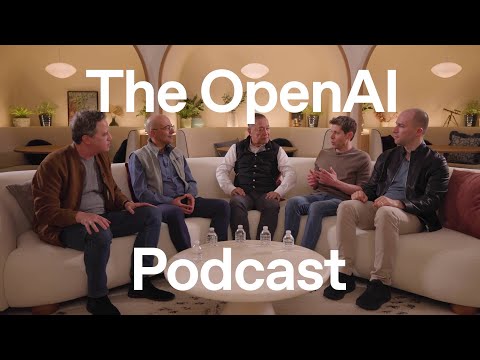
OpenAI x Broadcom — The OpenAI Podcast Ep. 8
Andrew Mayne (host), Sam Altman (guest), Hock Tan (guest), Greg Brockman (guest), Charlie Kawwas (guest), Charlie Kawwas (guest)
In this episode of OpenAI, featuring Andrew Mayne and Sam Altman, OpenAI x Broadcom — The OpenAI Podcast Ep. 8 explores openAI and Broadcom build custom chips for massive AI scaling OpenAI and Broadcom announce a partnership to co-design a custom chip and an integrated system (chip, racks, networking, and software) optimized specifically for OpenAI’s AI workloads.
OpenAI and Broadcom build custom chips for massive AI scaling
OpenAI and Broadcom announce a partnership to co-design a custom chip and an integrated system (chip, racks, networking, and software) optimized specifically for OpenAI’s AI workloads.
They plan to begin deploying roughly 10 gigawatts of additional data-center capacity starting late next year, rolling out rapidly over the following three years—on top of existing infrastructure partnerships.
A central thesis is that end-to-end vertical integration can increase “intelligence per watt,” lowering cost per token and unlocking new products (e.g., always-on personal agents) that would otherwise be compute-prohibitive.
Speakers frame AI infrastructure as a civilization-scale utility requiring global collaboration, open standards, and continuous specialization of hardware for distinct workloads like training vs. inference.
Key Takeaways
They are building a full-stack “transistor-to-token” platform, not just a chip.
Altman emphasizes optimizing across chip design, rack architecture, networking, and algorithms to gain major efficiency improvements that translate into faster, cheaper inference and better product performance.
Get the full analysis with uListen AI
10 gigawatts is enormous—and still insufficient for the long-term vision.
The group positions 10 GW as a major near-term expansion but “a drop in the bucket” relative to future demand if AI becomes an always-available utility for billions of people and increasingly capable agentic systems.
Get the full analysis with uListen AI
Inference demand is expected to expand faster than efficiency gains.
Altman notes a repeated pattern: a 10× optimization can trigger 20× demand, implying that cost reductions and latency improvements will be rapidly absorbed by new use cases (code, video, automation, agents).
Get the full analysis with uListen AI
Specialized silicon will diverge by workload: training vs inference needs differ.
Tan highlights that training favors high compute throughput (TFLOPS) and networking for clustered scaling, while inference often benefits more from memory capacity and bandwidth per unit compute.
Get the full analysis with uListen AI
AI is already helping design the next generation of AI hardware.
Brockman describes using OpenAI models to propose optimizations and reduce chip area and schedule risk—often surfacing expert-known ideas faster, enabling teams to keep iterating up to deadlines.
Get the full analysis with uListen AI
Networking and packaging innovations are treated as first-class enablers of scale.
Kawwas stresses that cluster performance depends on scale-up/scale-out networking and points to multi-die approaches, 3D stacking, and integrated optics (e. ...
Get the full analysis with uListen AI
The partnership is framed as infrastructure for a global “critical utility.”
Broadcom leaders compare AI infrastructure to railroads and the internet—requiring open standards and ecosystem collaboration—arguing it may become a foundational utility for billions, shaping a “next-generation operating system” for civilization.
Get the full analysis with uListen AI
Notable Quotes
““[The AI infrastructure build-out] is the biggest joint industrial project in human history.””
— Sam Altman
““We’re defining civilization’s next generation operating system.””
— Hock Tan
““Ten gigawatts… is a drop in the bucket compared to where we need to go.””
— Greg Brockman
““[Think] from… etching the transistors all the way up to the token that comes out when you ask ChatGPT a question.””
— Sam Altman
““What we want is the most intelligence we can get out of each unit of energy.””
— Sam Altman
Questions Answered in This Episode
What does “10 gigawatts of racks/systems” translate to in practical terms (data centers, number of accelerators, expected tokens/sec, or users served)?
OpenAI and Broadcom announce a partnership to co-design a custom chip and an integrated system (chip, racks, networking, and software) optimized specifically for OpenAI’s AI workloads.
Get the full analysis with uListen AI
Which parts of the stack are being co-designed (chip ISA/accelerator, memory subsystem, interconnect, rack topology, software compiler/runtime), and what’s owned by which partner?
They plan to begin deploying roughly 10 gigawatts of additional data-center capacity starting late next year, rolling out rapidly over the following three years—on top of existing infrastructure partnerships.
Get the full analysis with uListen AI
How are you deciding what to optimize for in the first version—latency, cost per token, throughput, energy, or reliability—and what tradeoffs are you making?
A central thesis is that end-to-end vertical integration can increase “intelligence per watt,” lowering cost per token and unlocking new products (e. ...
Get the full analysis with uListen AI
You mention separate optimization for training vs inference; will this program produce multiple chips (or chiplets) and how will workloads be routed between them?
Speakers frame AI infrastructure as a civilization-scale utility requiring global collaboration, open standards, and continuous specialization of hardware for distinct workloads like training vs. ...
Get the full analysis with uListen AI
Greg described using OpenAI models to optimize chip design—what specific EDA tasks are you automating (floorplanning, routing, power analysis), and how do you validate correctness/safety?
Get the full analysis with uListen AI
Transcript Preview
Hello, I'm Andrew Mayne, and welcome to the OpenAI Podcast. Today, we're excited to be breaking some news involving Broadcom and OpenAI. Joining me from OpenAI is Sam Altman and Greg Brockman, and from Broadcom, Hock Tan and Charlie Kawwas.
[upbeat music] A lot of ways that you would look at the AI infrastructure build-out right now, you would say it's the biggest joint industrial project in human history.
We're defining civilization's next generation operating system.
Like, that is a drop in the bucket compared to where we need to go. That's a big drop, but [laughing] ...
So what are we talking about today? What brought you all together?
So today we're announcing a partnership between Broadcom and OpenAI. We've been working together for about the last eighteen months, designing a new custom chip. Uh, more recently, we've also started working on a whole custom system. These things have gotten so complex, you need the whole thing. And we will be starting in late next year, deploying ten gigawatts of these racks, of these systems, and our chip, which is a gigantic amount of computing infrastructure, to serve the needs of the world to use advanced intelligence.
So this is going to entail both compute and chip design and scaling out?
This is, uh, this is a full system. So we worked-- we closely collaborated for a while on designing a chip that is specific for our workloads. When it became clear to us just how much capacity, inference capacity the world was going to need, we began to think about: Could we do a chip that was meant, uh, just for that kind of a, a very specific workload? Broadcom is the best partner in the world for that, obviously. And then, to our great surprise, this was not the way we started, um, but as we realized that we were going to really need the whole system together to support this as these- as it's gotten more and more complex, it turns out Broadcom is also incredible at helping design systems. Um, so we are working together on that entire package, and this will be, uh-- this will help us even further incre- uh, increase the amount of capacity we can offer for our, our services.
So, Hock, how did this come about? You know, when did this start? When did you guys first talk about working together on this?
Well, other than the fact that Sam and Greg are great people to work with, it's a natural fit because OpenAI has been doing, continues to do the most advanced models, frontier models in generative AI out there. And but as part of it, you need, you need- you continue to need compute capacity, the best, latest compute capacity as you progress in a roadmap towards a better and better frontier model and towards super intelligence. And compute is key part, and that comes with on semiconductors, and as Sam indicated, more than semiconductors. And we are, even though I say it myself, probably the best semiconductor company out there. And more than that is AI is a very, very exciting opportunity for us in terms of we, we are-- my engineers are pushing the innovation envelope and newer and newer generations of tech- of, uh, semiconductor technology. So for us, com, uh, com- collaborating with the best generative AI company out there is a natural fit.
Install uListen to search the full transcript and get AI-powered insights
Get Full TranscriptGet more from every podcast
AI summaries, searchable transcripts, and fact-checking. Free forever.
Add to Chrome