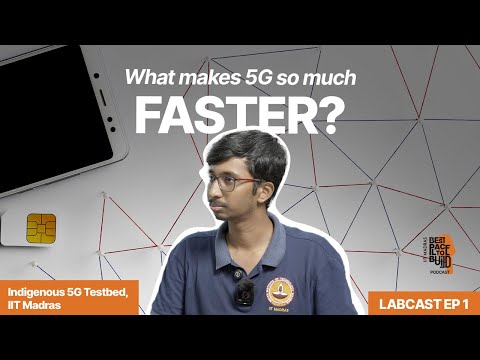
How does 5G work? | A RARE look inside the 5G testbed facility @IITM | BP2B Labcast Ep 1
In this episode of Best Place To Build, How does 5G work? | A RARE look inside the 5G testbed facility @IITM | BP2B Labcast Ep 1 explores inside IIT Madras’ indigenous 5G testbed: radios, core, future The video breaks down the 5G signal chain from phone-to-antenna (radio unit) to baseband processing and into a software-based 5G core that authenticates users, manages mobility, and routes traffic.
Inside IIT Madras’ indigenous 5G testbed: radios, core, future
The video breaks down the 5G signal chain from phone-to-antenna (radio unit) to baseband processing and into a software-based 5G core that authenticates users, manages mobility, and routes traffic.
It explains why 5G can be faster than 4G by using many more antenna elements (massive MIMO) and beamforming, while highlighting the calibration and synchronization challenges this creates.
The IIT Madras testbed implements open interface standards (O-RAN 7.2 split) to define how processing is divided between the radio and baseband so multi-vendor components can interoperate.
Researchers recount the April 2022 milestone of India’s first official 5G phone call on a completely indigenous stack, and the subsequent year of work to harden it for field reliability.
The discussion connects current 5G work (mobility optimization, receiver/transmitter algorithms) to forward-looking 6G themes like AI/ML-driven positioning and reducing reference-signal overhead while scaling to massive IoT connectivity.
Key Takeaways
5G speed gains are tightly linked to more antennas and smarter directionality.
Moving from a handful of antenna elements in typical 4G deployments to 16/32/64-element arrays in 5G enables beamforming and higher spatial multiplexing, concentrating energy toward users instead of broadcasting everywhere.
Get the full analysis with uListen AI
More antenna elements increase performance, but they also multiply calibration complexity.
Each antenna chain must be fine-tuned without disrupting live traffic, and calibration frequency depends on environment, temperature, aging, and how fast channel conditions change.
Get the full analysis with uListen AI
Channel estimation is a continuous, ultra-fast process in real networks.
The lab describes channel estimation happening about every 0. ...
Get the full analysis with uListen AI
Precise timing sync is foundational to dense cellular deployments.
A GNSS/GPS antenna provides a common time reference so neighboring base stations remain synchronized, reducing interference and enabling coordinated transmission/reception behavior.
Get the full analysis with uListen AI
Open standards like O-RAN enable mixing vendors by defining processing splits.
By implementing the O-RAN 7. ...
Get the full analysis with uListen AI
5G cores are increasingly software-first, making scale a deployment choice.
Unlike many 4G cores that relied on custom hardware, a 5G core can run on general-purpose compute; a laptop could serve a small demo, while carrier-scale infrastructure supports thousands to millions of users.
Get the full analysis with uListen AI
6G research is already shaped by today’s 5G pain points and new use cases.
The team highlights reducing reference-signal overhead (which consumes bandwidth for estimation/control) and preparing for huge numbers of low-power IoT nodes, plus AI/ML approaches for problems like centimeter-level positioning in factories.
Get the full analysis with uListen AI
Notable Quotes
“This happens with a periodicity of about point five milliseconds.”
— Jeeva (IITM lab)
“Till 4G, this core network was typically deployed in a custom hardware... But for 5G, it is completely a software-based deployment.”
— Jeeva (IITM lab)
“It was only in April 2022 that we made the first official 5G call.”
— Jeeva (IITM lab)
“We have implemented something called as O-RAN seven point two split.”
— Jeeva (IITM lab)
“So one issue is there is a lot of overhead on the reference signals.”
— Jeeva (IITM lab)
Questions Answered in This Episode
What specific algorithms or procedures does the team use to calibrate many antenna elements without disrupting active transmissions?
The video breaks down the 5G signal chain from phone-to-antenna (radio unit) to baseband processing and into a software-based 5G core that authenticates users, manages mobility, and routes traffic.
Get the full analysis with uListen AI
In your O-RAN 7.2 split implementation, what trade-offs did you face (latency, fronthaul bandwidth, compute placement) versus other functional splits?
It explains why 5G can be faster than 4G by using many more antenna elements (massive MIMO) and beamforming, while highlighting the calibration and synchronization challenges this creates.
Get the full analysis with uListen AI
You mention channel estimation every ~0.5 ms—what factors determine that periodicity in practice, and how does it change for high-mobility users?
The IIT Madras testbed implements open interface standards (O-RAN 7. ...
Get the full analysis with uListen AI
What were the exact “power parameters” adjusted the day before the first successful 5G call, and how did logs point to that root cause?
Researchers recount the April 2022 milestone of India’s first official 5G phone call on a completely indigenous stack, and the subsequent year of work to harden it for field reliability.
Get the full analysis with uListen AI
How does the IITM campus core network setup compare architecturally to a city-scale operator core (network functions, redundancy, observability, security hardening)?
The discussion connects current 5G work (mobility optimization, receiver/transmitter algorithms) to forward-looking 6G themes like AI/ML-driven positioning and reducing reference-signal overhead while scaling to massive IoT connectivity.
Get the full analysis with uListen AI
Transcript Preview
a Jio telecom user and a Airtel telecom user. This happens with a periodicity of about 0.5 milliseconds. So this is our first, uh, fi- call on the indigenous 5G system from a commercial 5G phone. Here, this core network, we manage the traffic from all the deployments in the IIT Madras campus deploy.
As far as I know, it took about four years-
Yeah
... to finally finish up the test bed.
Correct. [upbeat music] Hi, and welcome to The Best Place To Build Labcast. Today, in the very first episode, we're gonna be visiting the 5G testbed facility of IIT Madras, the place where India's first-ever 5G phone call was made. Stay tuned, because we are gonna look at what they are building, how do they do it, and what are they building now that 5G is everywhere? Before we see what happens there, let's first understand how 5G transmission works. See, whenever you try to connect, your phone sends and receives radio signals to an antenna, the same things you see around you on towers. It processes these signals into digital signals and sends them to a baseband unit to handle the connection request. The BBU then forwards your traffic into the 5G core, which authenticates you, manages mobility, and routes your data to the Internet or another user. And now, let's have a look at it in more detail with Jeeva from the lab. So this radio unit is responsible for transmitting and receiving the radio signals. So this is the component that is actually exposed, and when our mobile phone actually connects to something, it sends the radio waves. The number of radio elements have significantly increased. Typical 4G deployments will have one to four antenna elements, but in a 5G, if you see, there'll be 16, 32, and 64 antenna elements that are present over there.
So why, why do you need such complexity? Why do you need to keep adding more antenna elements?
So when I speak to you, I look at you and speak, but when a radio unit is talking to you, it doesn't know exactly where you are, or it cannot rotate itself. So what it does is, a typical radio unit, it'll broadcast the signal in all the directions. When I have multiple antennas, it is possible for me to direct my energy into the, uh, direction where a user is present, where it is required, so that I don't waste the energy which is going on other directions. Having said that, the catch is that every antenna element here has to be fine-tuned and calibrated, and this is not a simple calibration process. That, uh... This involves a lot of algorithms. And this radio unit, where does it sit? Somewhere on a tall tower, so it is not possible for anyone to actually go over there and calibrate it every time. So this has to happen-
And how often do you need to calibrate it?
So it depends on the algorithm, and very important part about calibration is it should not disturb an actual transmission and reception that is happening. We decide that as well based on the changing channel scenarios, where do you deploy it, how often the scenario is changing. It depends on the varying temperature as well, and aging as well... lot of parameters.
Install uListen to search the full transcript and get AI-powered insights
Get Full TranscriptGet more from every podcast
AI summaries, searchable transcripts, and fact-checking. Free forever.
Add to Chrome