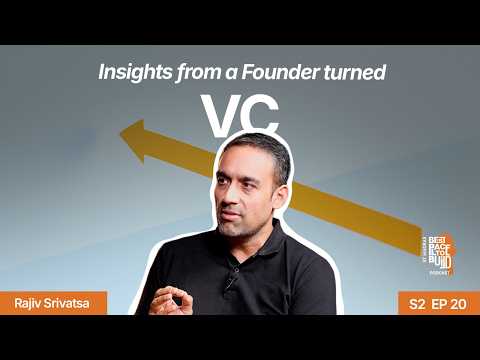
From Urban Ladder to Antler India: Insights from a Founder turned VC | Rajiv Srivatsa | BP2B S2E20
Rajiv Srivatsa (guest)
In this episode of Best Place To Build, featuring Rajiv Srivatsa, From Urban Ladder to Antler India: Insights from a Founder turned VC | Rajiv Srivatsa | BP2B S2E20 explores founder Rajiv Srivatsa on building, culture, and day-zero investing Rajiv frames “building” as creating something from nothing that delivers measurable impact, evaluated by both depth (meaningfulness) and scale (reach).
Founder Rajiv Srivatsa on building, culture, and day-zero investing
Rajiv frames “building” as creating something from nothing that delivers measurable impact, evaluated by both depth (meaningfulness) and scale (reach).
He describes Antler India as a day-zero platform that combines content, community, residency, and capital to help people move from employee to founder with less ambiguity.
He lays out four stages of building a company: ship-and-iterate with customer feedback, scale via people and culture, master money and business economics, and build an institution that can outlast the founder.
Using Urban Ladder as a case study, he recounts idea iteration, choosing “home” as a large passionate market, and learning that furniture e-commerce required product, digital, service, and experience excellence simultaneously.
He argues that founder motivation and resilience matter more than prestige outcomes, contrasting “missionary” vs “mercenary” paths and advising builders to detach from outcomes while staying true to their core joys and values.
Key Takeaways
Building is defined by impact, not by format.
Rajiv broadens “builder” beyond products to content, community, coaching, courses, services, and experiences—so long as something is created from scratch and improves a customer’s life.
Get the full analysis with uListen AI
Use the depth-vs-scale lens to choose what you build next.
Content can reach many but often has low lasting impact, while coaching has deep impact but limited scale; products/services can move you toward high depth and high scale if executed well.
Get the full analysis with uListen AI
Antler’s differentiator is reducing ‘minus one to zero’ ambiguity for founders.
Before fundraising and even before incorporation, Antler uses community (Before Day Zero), co-founder matching, and a structured residency to help founders pick sectors, co-founders, and MVP paths.
Get the full analysis with uListen AI
Stage 1 mastery is customer obsession plus rapid iteration.
He argues builders must enjoy shipping, measuring, and listening; if you dislike user feedback loops and metrics, building (in any form) becomes unsustainable.
Get the full analysis with uListen AI
Scaling requires shifting from product building to people-and-alignment building.
Urban Ladder taught him that vision, values, hiring, performance alignment, and culture are not “soft”—they’re core systems needed to scale beyond a small, talented core team.
Get the full analysis with uListen AI
Money is a stage of building, not a byproduct you can ignore.
Sustainability demands pricing, cashflow, P&L discipline, and choosing the right capital source (bootstrapping, VC, debt, grants), while recognizing only a small fraction of businesses need venture scale.
Get the full analysis with uListen AI
The highest stage is institution-building that survives the founder.
Beyond product/people/money, long-term companies must stand for something in society and operate without the original builder, which becomes the real test of durability.
Get the full analysis with uListen AI
Your Ikigai ‘traversal order’ shapes your career trade-offs.
He contrasts the common money→skill→enjoyment→meaning path with the builder path meaning(world needs)→passion→skill→money, and notes both can work depending on personality and goals.
Get the full analysis with uListen AI
Missionary vs mercenary founder styles are real—and mismatching is costly.
Rajiv suggests these are deep personality traits: missionaries start from purpose and may fail along the way, while mercenaries start from opportunity and may find passion later; forcing the opposite pattern can backfire.
Get the full analysis with uListen AI
Urban Ladder can be ‘customer-successful’ yet financially disappointing—both can be true.
He calls the Reliance distress sale a poor investor outcome while still viewing Urban Ladder as impactful and enduring as a brand, highlighting that success depends on which stakeholder lens you use.
Get the full analysis with uListen AI
Notable Quotes
“The one genesis of any builder is he or she creates something from nothing, and that something from nothing has some impact on some customer.”
— Rajiv Srivatsa
“If you don’t want to listen to consumers, if you don’t love the joy of looking at metrics, don’t be a builder.”
— Rajiv Srivatsa
“Only 5% of businesses need to be venture scale.”
— Rajiv Srivatsa
“The people who really have changed the world… don’t care about what gives them most money. They care about what the world wants.”
— Rajiv Srivatsa
“You try your best, but detach from the outcome.”
— Rajiv Srivatsa
Questions Answered in This Episode
Antler invests at ‘day zero’—what concrete signals (founder traits, market clues, early proof) most often decide whether you invest after the residency?
Rajiv frames “building” as creating something from nothing that delivers measurable impact, evaluated by both depth (meaningfulness) and scale (reach).
Get the full analysis with uListen AI
In Before Day Zero / Co-Founder Club, what are the most common co-founder mismatch patterns you see, and how do you help people detect them early?
He describes Antler India as a day-zero platform that combines content, community, residency, and capital to help people move from employee to founder with less ambiguity.
Get the full analysis with uListen AI
Your depth-vs-scale model suggests content is often low-depth—what content formats have you seen produce genuinely high depth over time, and why?
He lays out four stages of building a company: ship-and-iterate with customer feedback, scale via people and culture, master money and business economics, and build an institution that can outlast the founder.
Get the full analysis with uListen AI
You said stage one is shipping and feedback—what are 3 metrics you’d recommend for an idea-stage team before product-market fit, and what are common metric traps?
Using Urban Ladder as a case study, he recounts idea iteration, choosing “home” as a large passionate market, and learning that furniture e-commerce required product, digital, service, and experience excellence simultaneously.
Get the full analysis with uListen AI
Urban Ladder became ‘four mini companies’ (physical product, digital, service, experience)—what decision forced that realization, and what would you architect differently if starting today?
He argues that founder motivation and resilience matter more than prestige outcomes, contrasting “missionary” vs “mercenary” paths and advising builders to detach from outcomes while staying true to their core joys and values.
Get the full analysis with uListen AI
Transcript Preview
I built the largest personal website at Infosys. I used to get, this was 2001.
Okay.
Stage one-
Okay.
-build something, get feedback, go iterate on it. We actually built something called Next Hundred, where we get the best ideas at a particular point in time. Second is the community. We actually have something called Before Day Zero, and within that, something called the Co-Founder Club. I think for me, the joy actually started at IIT Madras, where I built a version of Carmen Sandiego, the Indianized version of Carmen Sandiego. [chuckles]
I have this amazing story with Flipkart where 2009, '10, we bought a bunch of stuff, and they canceled our order-
Mm-hmm.
-for a 60, 70,000 order.
Talks through the Ikigai circles in a particular way. Psychology, founder personalities. There are two very clear sort of distinctive personalities. One who's a missionary-
Hi, this is Amrit. We are at IIT Madras, my alma mater, and India's top university for people who like to build. We are here to meet some builders, ask them: What are you building? What does it take to build? And what makes IIT Madras the best place to build? [upbeat music] Hello, and welcome to The Best Place to Build Podcast. Today, we are sitting with Rajiv Srivatsa. He was the co-founder of Urban Ladder, and then now the founding partner of Antler India. So, and he's been a builder for a really long time, so I'm very excited to talk to him about what building means to him. Hi, welcome to the podcast, Rajiv.
Thanks so much for having me. It's great to be in campus.
Yes, um, you're here for your reunion, right? Uh, which year reunion is this?
This is the 25th year reunion, the silver jubilee.
Okay. Um, so I, I want to quickly understand your current role, and we'll... And I have some questions around that. Um, we haven't had too many guests in the VC side of things, investing side of things, so want to understand a little bit about how that works and, uh, your particular view of that.
Sure. Um, I think the VC industry is br- pretty broad-based that way, and for me, the role that I play is very close to being that of a builder. Because Antler's prerogative is to fund, uh, startups across sectors on day zero, and literally at the idea stage. So for me, it allows Antler, more than just writing a cheque, to be actually a temporary co-founder of sorts to the founder. And I don't see personally myself any other way, because, uh, if you see, generally, you know, there's late-stage private equity, there is sort of mid-early stage venture capital, but the earliest stage is really where there's just a lot of fun. There's a lot of challenge also, and I just wanted to sort of continue my building journey of sorts. And when I was looking at what next to do right after Urban Ladder, around COVID, um, this opportunity came up. And for me, building a platform, building an institution, which sort of stands for being your first believer on day zero, was very exciting. I had never invested in my life before. And, uh, the moment I sort of took that on, over the last five years, what we've made Antler is, uh, at least your de facto platform. Whenever you think of wanting to become a founder, it doesn't matter if you're a college student, if you are working in a startup, if you're in a big company, Antler should be the de facto place. And we have done a bunch of stuff to make sure that whether it's deep tech, whether it's consumer, whether it's SaaS, enterprise, fintech, it doesn't matter which sector, Antler should be your first port of call to be your helping partner. Not just a capital partner, but your sparring partner, to even think through, you know, who should be your right co-founder? What should be the idea? Should you go path A, path B? And that's what Antler's role is. We have now funded 110 startups. We operate a $75 million or a 600 crore fund focused on India. Of course, Antler India itself is part of a larger global platform, uh, of Antler. Antler, funnily, in itself is a startup. It's only seven years old, uh, globally. It's four and a half years old in India. And today, we manage, uh, $1.2 billion across the world, so it's sort of mushroomed like a startup more than like a VC firm. And, uh, being part of a global platform also offers founders and the startups that we fund a much bigger sort of canvas, either whether to sort of get intelligence globally or whether to launch globally. So that's what Antler is, and I can get into any other specific aspects of what Antler is.
Install uListen to search the full transcript and get AI-powered insights
Get Full TranscriptGet more from every podcast
AI summaries, searchable transcripts, and fact-checking. Free forever.
Add to Chrome