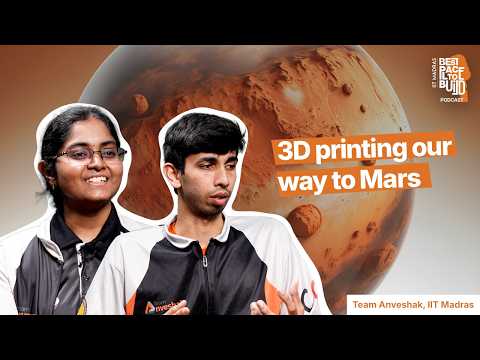
This IIT Madras team is building rovers & drones for MARS EXPLORATION | BP2B: Student Edition! Ep.05
Adithi (guest)
In this episode of Best Place To Build, featuring Adithi, This IIT Madras team is building rovers & drones for MARS EXPLORATION | BP2B: Student Edition! Ep.05 explores iIT Madras students build Mars rovers, drones, and science payloads. Team Anveshak builds prototype Mars rovers and a complementary drone module to expand exploration reach beyond what humans or ground rovers alone can access.
IIT Madras students build Mars rovers, drones, and science payloads.
Team Anveshak builds prototype Mars rovers and a complementary drone module to expand exploration reach beyond what humans or ground rovers alone can access.
Their rover “Isaac” is semi-autonomous, combining remote teleoperation, onboard perception, and operator-approved path planning to navigate rugged, Mars-like competition terrains.
Mechanical design is iterated yearly with innovations like steering and extensive in-house 3D printing (including wheels and gearboxes) to reduce weight, improve reliability, and cut costs.
The electronics/software stack uses multi-sensor perception (stereo camera, LiDAR, GPS, IMU) on an NVIDIA Jetson Orin Nano plus custom PCBs and motor drivers to improve robustness under competition failure modes.
An astrobiology module turns the rover into a mobile lab by drilling and analyzing soil with a low-cost, in-house 3D-printed spectrometer and targeted chemical tests to detect potential biosignatures.
Key Takeaways
Redundancy and robustness matter more than perfect runs.
A topple onto the antenna didn’t end the mission because the rover was built to survive mishaps and resume quickly—mirroring real-world priorities where repairs aren’t possible.
Get the full analysis with uListen AI
“Small” mechanical mistakes can decide competition outcomes.
A single loose bolt created wheel resistance that cascaded into motor failure symptoms and cost an entire mission, reinforcing the need for rigorous pre-flight checks and fast fault isolation.
Get the full analysis with uListen AI
3D printing can be a performance tool, not just a prototype shortcut.
By moving ~30% of the rover to 3D-printed parts (wheels, arm elements, gearboxes, gripper), the team reduced weight and unlocked faster iteration cycles while cutting costs by ~20–30%.
Get the full analysis with uListen AI
Earth-built rovers must balance Mars-inspired design with terrestrial constraints.
Competition rovers mimic rugged terrain but don’t face Mars temperatures/regolith, so materials and manufacturing choices (e. ...
Get the full analysis with uListen AI
Practical autonomy for planetary rovers is typically ‘supervised autonomy.’
The rover plans paths using onboard sensors and compute, sends the plan to an operator for approval, then executes slowly with local re-planning around unforeseen obstacles—reducing risk when comms and visibility are limited.
Get the full analysis with uListen AI
Custom electronics improve reliability under real operational failures.
Designing in-house PCBs and motor drivers helps prevent common competition-killers like reverse polarity and fragile off-the-shelf components, making the rover more fault-tolerant.
Get the full analysis with uListen AI
Science payloads can be cost-engineered without losing mission intent.
An in-house 3D-printed spectrometer (~₹30k vs ~₹1 lakh off-the-shelf) plus chemical assays and ML-based rock/soil selection creates a credible mobile ‘science lab’ workflow within student-team budgets.
Get the full analysis with uListen AI
Notable Quotes
“During the mission, we tried to climb up a 70-degree slope… the rover ended up toppling over… But when we turned the rover back onto its wheels, everything was completely fine.”
— Adithi
“There’s almost $50 billion worth of material up there, and you don’t want to accidentally drive it into a ditch.”
— Soham
“We have built a 3D-printed in-house spectrometer… we search for signs of life, like protein or carbohydrate, in the soil.”
— Abhishek
“What the team learned was how small things actually matter. One screw not tight… could actually… cost you a lot of things.”
— Ayush
“Focus on what you like more than what other people would probably think about you.”
— Adithi
Questions Answered in This Episode
What specific design changes in ‘Isaac’ (10th iteration) most improved reliability versus earlier rovers, and how did you validate them in testing?
Team Anveshak builds prototype Mars rovers and a complementary drone module to expand exploration reach beyond what humans or ground rovers alone can access.
Get the full analysis with uListen AI
You said the rover is semi-autonomous with operator approval—what latency/communication assumptions do you design around in competitions, and how would that change for a real Mars-like delay?
Their rover “Isaac” is semi-autonomous, combining remote teleoperation, onboard perception, and operator-approved path planning to navigate rugged, Mars-like competition terrains.
Get the full analysis with uListen AI
Your wheels and cycloidal gearbox are 3D printed—what materials, print parameters, and post-processing steps made them durable enough for muddy, rocky terrain?
Mechanical design is iterated yearly with innovations like steering and extensive in-house 3D printing (including wheels and gearboxes) to reduce weight, improve reliability, and cut costs.
Get the full analysis with uListen AI
Soham mentioned drones acting as a comms relay—what would the networking stack look like (protocols, redundancy, failure handling) if you attempted true rover–drone cooperation?
The electronics/software stack uses multi-sensor perception (stereo camera, LiDAR, GPS, IMU) on an NVIDIA Jetson Orin Nano plus custom PCBs and motor drivers to improve robustness under competition failure modes.
Get the full analysis with uListen AI
In the Turkey incident, a loose bolt led to a mission-ending failure—what checklist or design-for-assembly changes did you implement to prevent recurrence?
An astrobiology module turns the rover into a mobile lab by drilling and analyzing soil with a low-cost, in-house 3D-printed spectrometer and targeted chemical tests to detect potential biosignatures.
Get the full analysis with uListen AI
Transcript Preview
during the mission, we tried to climb up a 70-degree slope, and the rover ended up toppling over, and it fell, like, right on its back on the antenna. But when we turned the rover back onto its wheels, everything was completely fine.
There's almost $50 billion worth of material up there, and you don't want to accidentally drive it into a ditch.
We have built a 3D-printed in-house spectrometer. So using that spectrometer, what we do is that we search for signs of life, like protein or carbohydrate, in the soil.
Found out that there was one bolt which was very loose. It just came out and was causing resistance to the rotation of the wheel. What the team learned was how small things actually matter. One screw not tight and, or one wiring going wrong could actually, you know, cost you a lot of things. [upbeat music]
Hi, and welcome to Best Place To Build: Student Edition. I'm Vidhi, a fifth-year engineering design student at IIT Madras, and we're here today with IIT Madras' very own space robotics team, Team Anveshak. If you've ever watched The Martian and wondered how close are we to technology like that, you're in the right space. To learn more, I'm here with their team lead, Adithi. Hi, Adithi. Which year and branch are you from?
Hi, Vidhi. I am, uh, Adithi. I'm from fourth-year BTech Mechanical Engineering.
So Adithi, could you give me a little idea on what Anveshak does? Space robotics is a very broad domain. What are you guys focused on?
Okay, so, uh, as Team Anveshak, we make prototype Mars rovers, and we have also introduced our very own drone module to complement the rover's, uh, operation. So, uh, what we do is we build robust, uh, land rovers, where, uh, we are essentially trying to achieve the same level of operations as the, uh, well-known Perseverance and Curiosity Mars rovers that's made by NASA, and also similar to the missions like Chandrayaan 3, that was recently start- done by ISRO. So, uh, our main goal is to, uh, basically help out in these kind of explorations, build on, uh, similar space technologies and, uh, yeah, just overall fuel that, um, curiosity of whether there is extraterrestrial life out there.
Great! And how does a rover and a drone partnership here help us in knowing more about extraterrestrial terrains and life on other planets?
Okay, so, uh, the rover in general can reach into places that generally a human astronaut cannot reach into. So the rover in itself is a very big, I, I could say, boon for space exploration, and to complement that with drone is to reach the parts where even the, uh, rovers cannot reach into. So to be able to, uh, bring about that connection between rovers and drones, that would, in my opinion, just expand, like, vast regions into space exploration.
That's very interesting. And you mentioned Mars specifically, and I've heard of Anveshak earlier being known as the Mars Rover Team. So what is it about Mars that makes it so interesting?
Install uListen to search the full transcript and get AI-powered insights
Get Full TranscriptGet more from every podcast
AI summaries, searchable transcripts, and fact-checking. Free forever.
Add to Chrome