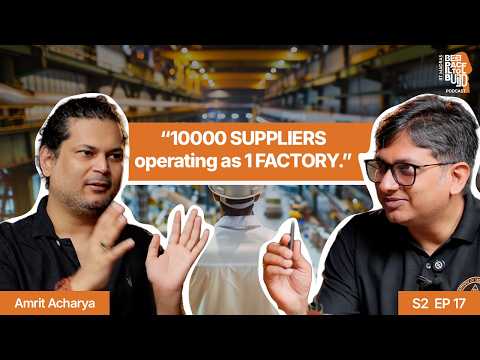
How Zetwerk's founders raised a unicorn in 3 years! | Amrit Acharya, BP2B S2 E17
Amrit Acharya (guest), Amrut (host), Amrut (host), Amrut (host), Amrut (host)
In this episode of Best Place To Build, featuring Amrit Acharya and Amrut, How Zetwerk's founders raised a unicorn in 3 years! | Amrit Acharya, BP2B S2 E17 explores zetwerk’s software-led manufacturing playbook for scaling industrial supply chains fast Zetwerk provides Manufacturing as a Service by converting customer designs into production-ready specs, selecting capable suppliers, and project-managing delivery with transparency and reliability.
Zetwerk’s software-led manufacturing playbook for scaling industrial supply chains fast
Zetwerk provides Manufacturing as a Service by converting customer designs into production-ready specs, selecting capable suppliers, and project-managing delivery with transparency and reliability.
The company began as a B2B software pitch but pivoted when software selling proved difficult in India, using the software internally to run a transaction-first manufacturing business.
Zetwerk’s differentiation comes from software-enabled visibility across thousands of suppliers plus hard-won operational know-how, making the model extremely difficult to replicate at scale.
Growth has been accelerated by macro tailwinds (GST-enabled national supply chains, China+1, India’s industrialization) and by focusing on customer “growth constraints” (capacity/backlogs) rather than only cost savings.
Amrit discusses Zetwerk’s capital strategy (raising ~$750M), category deepening (e.g., transformers), leadership layering with industry CEOs, and considerations for an eventual IPO.
Key Takeaways
Reliability is the product, software is the enabler.
Zetwerk wins by delivering on-time quality with proactive root-cause visibility; the software layer makes execution measurable across thousands of concurrent contracts and shareable with customers to build trust.
Get the full analysis with uListen AI
In India, software-only sales can fail; attach software to outcomes.
Early customers liked the idea but resisted paying for software; demand existed for new suppliers and execution, so Zetwerk embedded software into a transactions-first manufacturing business where value is undeniable.
Get the full analysis with uListen AI
Solve customers’ growth bottlenecks before chasing cost optimization.
Zetwerk’s strongest wedge is expanding production capacity (e. ...
Get the full analysis with uListen AI
Replication risk is lower than it looks because operations don’t scale linearly.
Coordinating 70M parts/year across ~7,000 suppliers triggers constant edge cases (tariffs, quality escapes, delays); the accumulated playbooks, data, and vendor/customer trust are hard to copy quickly.
Get the full analysis with uListen AI
Macro timing mattered: GST and supply-chain re-wiring created an entry window.
As firms moved from regional to national supply chains post-GST, they were more open to new partners who could unlock capacity and simplify procurement, enabling Zetwerk to break into conservative enterprise accounts.
Get the full analysis with uListen AI
Platforms eventually need category depth to unlock the next S-curve.
After building a horizontal network, Zetwerk is going deeper into specific bottlenecks (e. ...
Get the full analysis with uListen AI
High growth in manufacturing often requires capital because scale lowers costs.
Zetwerk chose a high-CAGR path (vs. ...
Get the full analysis with uListen AI
Notable Quotes
“We are a business of producing physical parts. That’s the business, but we do it in a very software-led approach.”
— Amrit Acharya
“SAP was only a transaction recording tool… there was two months of work that goes before issuing a purchase order, and there’s two months of work that goes after.”
— Amrit Acharya
“It is Murphy’s law at scale. You know, everything that can go wrong, goes wrong.”
— Amrit Acharya
“Our North Star is: How do I shrink… hours in the whole manufacturing process?”
— Amrit Acharya
“Don’t start a company without Srinath… or equivalent of Srinath.”
— Amrit Acharya
Questions Answered in This Episode
What exactly does Zetwerk’s “underwriting” process look like when matching a new drawing to suppliers who haven’t made that part before?
Zetwerk provides Manufacturing as a Service by converting customer designs into production-ready specs, selecting capable suppliers, and project-managing delivery with transparency and reliability.
Get the full analysis with uListen AI
You mentioned 30% production is now in-house—what criteria determines whether a job is routed to Zetwerk plants versus partner plants?
The company began as a B2B software pitch but pivoted when software selling proved difficult in India, using the software internally to run a transaction-first manufacturing business.
Get the full analysis with uListen AI
Which software primitives mattered most early on: supplier discovery, quality workflows, milestone tracking, documentation automation, or logistics visibility?
Zetwerk’s differentiation comes from software-enabled visibility across thousands of suppliers plus hard-won operational know-how, making the model extremely difficult to replicate at scale.
Get the full analysis with uListen AI
In the transformer push, what are the specific engineering/automation investments (e.g., automated tank manufacturing) that meaningfully reduce lead times?
Growth has been accelerated by macro tailwinds (GST-enabled national supply chains, China+1, India’s industrialization) and by focusing on customer “growth constraints” (capacity/backlogs) rather than only cost savings.
Get the full analysis with uListen AI
How did Zetwerk structure contracts to handle shocks like tariffs, and what did you change after the ‘six-month chaos’ period?
Amrit discusses Zetwerk’s capital strategy (raising ~$750M), category deepening (e. ...
Get the full analysis with uListen AI
Transcript Preview
There's a music in every factory-
Yeah
- which is unique. Like, it's how the parts get produced.
Yeah.
We raised the investment and we built the software, but we realized in India it's very hard to sell software. And I think the DNA helped. Honestly, we have scaled a lot. Today, this year we'll do close to $2 billion of, like, revenue. We are a business of producing physical parts. That's the business, but we do it in a very software-led approach. And, uh, the, the- it is Murphy's law at scale. You know, everything that can go wrong, goes wrong. [upbeat music]
Hi, this is Amrit. We are at IIT Madras, my alma mater, and India's top university for people who like to build. We are here to meet some builders, ask them: What are you building? What does it take to build? And what makes IIT Madras the best place to build? [upbeat music] Hello, and welcome to The Best Place to Build podcast. Uh, today I'm sitting with Amrit Acharya. He's the CEO and co-founder of Zetwerk. It's a unicorn in the manufacturing space. Uh, he was also a student here from 2006 to 2010, so we'll get to learn a little bit about what Zetwerk does, and his journey so far. Welcome to the podcast.
Thanks, Amrit. Should mention the time, it's 7:20 in the, in the morning.
Yeah. [chuckles]
Very early. Yeah.
It's 7:20 in the morning, um, and, uh, I'm very grateful. We do shoot very early in the morning because the place we shoot, the Center for Innovation, is an active lab.
Mm.
Uh, and so what happens is that students come, and they drill, and they cut-
Yeah
... and, uh, it's not possible to shoot at that time. Uh, thank you so much. Okay, so Amrit, uh, the Zetwerk, you're of course, four co-founders, so the- together you have created a behemoth in just six years. I have this memory- [chuckles]
[chuckles]
... of walking into your office in, uh, in 2019 maybe.
Yeah.
You were just 20 people, edges of a small office, and now you have- you are this behemoth company which is everywhere. So walk me through what happened, like, how did it, uh, move from there to here?
Yeah, I think you're one of the few people who've actually seen us in our first office.
Mm.
So it was a apartment turned into an office. Um, so we started a company in 2018, um, and, uh, yeah, it's been seven years, roughly, for us. Um, so we... What we do is, we, we offer Manufacturing as a Service, um, to industrial clients. Our customers would be, like, Siemens, Schneider, GE. They want to make some product, uh, they give us the designs, we do fine-tune engineering of that design, convert it into a detailed spec that can be shared with the factory, and then we select, uh, factories who can actually produce that part. And then we will project manage the whole thing to make sure everything is delivered on time, quality is excellent, uh, we offer full transparency, and, uh, essentially, it sums up to reliability. Like, our customers like us because we are reliable, they can give us the order and forget about it. And we have graduated over time. Today, we make wind turbines, we make solar panels, we make transformers, uh, heavy-duty engin- engineering goods. We also make a lot of devices. So we make, like, smart meters, we make, uh, laptop components, we make washing machine components. Um, but, uh... And over the period of time, we realized that, look, we can't have a pure third-party model where we just work with, uh, third-party factories. So today we do roughly one-third of production in-house. We have- operate our own plants, both in India, US, and Europe, and we partner with 5,000 plants across India, Vietnam, and Mexico. Uh, the whole point is, we have built a lot of software so that all of these distributed net- network, which is 5,000 third-party plants and 20 of our own in-house plants, in a way, operate like one plant. Um, so which is just behaving consistently on time, uh, no quality escapes, uh, complete transparency to the customer, and just being, like, a very reliable partner to these large companies.
Install uListen to search the full transcript and get AI-powered insights
Get Full TranscriptGet more from every podcast
AI summaries, searchable transcripts, and fact-checking. Free forever.
Add to Chrome