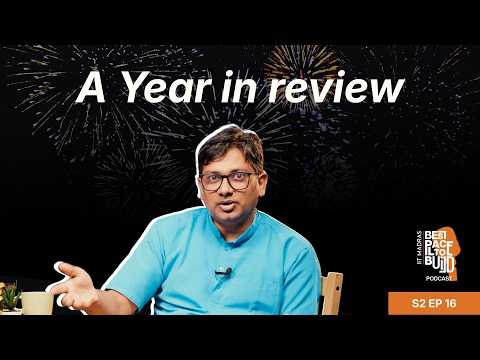
The year 2025 from the Best Place to Build Podcast! Revisiting your favourite moments! | BP2B S2E16
Sharan (cameo), Kamakoti (cameo)
In this episode of Best Place To Build, featuring Sharan and Kamakoti, The year 2025 from the Best Place to Build Podcast! Revisiting your favourite moments! | BP2B S2E16 explores best Place to Build revisits 2025’s standout insights, stories, lessons The host curates standout moments from 2025 episodes, emphasizing a deliberate shift toward technical depth and “science-curious” conversations rather than optimizing for short attention spans.
Best Place to Build revisits 2025’s standout insights, stories, lessons
The host curates standout moments from 2025 episodes, emphasizing a deliberate shift toward technical depth and “science-curious” conversations rather than optimizing for short attention spans.
Recurring themes include embracing failure as a credential, building difficult “crazy” things (chips, rockets, satellites), and using setbacks as fuel for resilience and career clarity.
Multiple guests illustrate how context shapes technology choices, from ophthalmology access in India to indigenous 5G milestones and sovereign AI ambitions.
The episode also highlights the human side of builders—origin stories, humor, and formative personal experiences—alongside practical realities of running a podcast (scheduling, brand approvals, and production failures).
The season expands its format with lab shoots and a student-hosted “student edition,” underscoring the show’s mission to spotlight builders across academia, industry, and campus teams.
Key Takeaways
Treat technical depth as a feature, not a risk.
Professor Sathya’s willingness to go deep (economics, batteries, imaging stacks) helped set the show’s tone: assume the audience is curious and reward them with real substance.
Get the full analysis with uListen AI
Failure is both a diagnostic tool and a badge of effort.
Sharan distinguishes between productive stubbornness (“one more attempt”) and the wisdom to stop when something truly doesn’t work; Professor Mahesh adds that “failed startup” now often strengthens a CV.
Get the full analysis with uListen AI
Put your sails up—luck only helps prepared builders.
Srinath’s sailing metaphor reinforces a builder’s job: keep the capability and readiness in place so policy shifts or market openings (like India’s space sector) can be seized immediately.
Get the full analysis with uListen AI
Context should drive the technology roadmap.
Professor Mohan Shankar’s cataract story shows why “cool tech” can miss the real bottleneck—India’s challenge wasn’t surgery cost but access—so solutions must start from ground truth constraints.
Get the full analysis with uListen AI
Indigenous systems breakthroughs are built on unglamorous iteration.
The first official 5G call narrative highlights day-to-day lab grind (logs, parameters, power tuning) and real-world chaos (crowds blocking signals), not just celebratory headlines.
Get the full analysis with uListen AI
Big-company guests require operational maturity, not just good questions.
The Swiggy co-founder episode demonstrates how compliance/brand teams and policies shape what’s possible; production teams must plan for approvals, chaperones, and scheduling friction.
Get the full analysis with uListen AI
Student success needs wellbeing infrastructure, not only ambition.
Sriram’s “Happiness, Habits, and Success” frames pressure and loneliness as systemic issues; optimism and support networks measurably improve performance and make achievement sustainable.
Get the full analysis with uListen AI
“Admission is the beginning” is a critical reframe for young engineers.
Victor argues JEE coaching sells a “half-truth”: getting in isn’t the finish line; institutions should actively counsel students on exploration, building, and long-run growth after entry.
Get the full analysis with uListen AI
Representation in STEM hinges on mid-career expectation shocks.
Professor Prabha suggests early education support exists, but societal expectations around ages 20–21 can steer women away from long training paths (master’s/PhD) that gatekeep niche technical fields.
Get the full analysis with uListen AI
Notable Quotes
“Wear that failure proudly, and go forth.”
— Professor Mahesh
“You have to be a special, uh, grade of mental... to be able to want to make silicon in today's world.”
— Sharan
“It will come when you make it.”
— Professor Kamakoti (recounted by Sharan)
“Always put the sails out and wait. Wind may come, may not come. How does that matter?”
— Srinath (Agnikul)
“The problem is one of access.”
— Professor Mohan Shankar
Questions Answered in This Episode
What specific moment in Professor Sathya’s episode convinced you to prioritize technical depth over “light” conversations, and how did it change your prep process?
The host curates standout moments from 2025 episodes, emphasizing a deliberate shift toward technical depth and “science-curious” conversations rather than optimizing for short attention spans.
Get the full analysis with uListen AI
Sharan describes stubbornness as both an asset and a weakness—how do you personally decide when to persist versus pivot on a hard problem?
Recurring themes include embracing failure as a credential, building difficult “crazy” things (chips, rockets, satellites), and using setbacks as fuel for resilience and career clarity.
Get the full analysis with uListen AI
In the Gallaxay segment, how exactly do SAR and hyperspectral/visible imaging get “juxtaposed” with deep learning—what’s a concrete use case where this fusion beats either sensor alone?
Multiple guests illustrate how context shapes technology choices, from ophthalmology access in India to indigenous 5G milestones and sovereign AI ambitions.
Get the full analysis with uListen AI
Professor Mohan Shankar reframes blindness as an access problem after cost was reduced—what are the highest-leverage interventions that improve access (logistics, screening, devices, staffing)?
The episode also highlights the human side of builders—origin stories, humor, and formative personal experiences—alongside practical realities of running a podcast (scheduling, brand approvals, and production failures).
Get the full analysis with uListen AI
For the Swiggy episode, what were the main brand/compliance constraints, and what questions (if any) did you have to reword or avoid?
The season expands its format with lab shoots and a student-hosted “student edition,” underscoring the show’s mission to spotlight builders across academia, industry, and campus teams.
Get the full analysis with uListen AI
Transcript Preview
failure and the ability to handle failure. What do I mean by that? Let me split it into two parts.
Wear that failure proudly, and go forth.
We are the world's only satellite company that's mixing what's called the synthetic aperture radar.
And you're mentioning them because Google were PhD students who-
Yeah, so we, we are- we were in the same, uh, co- cohort, uh, in the, in the computer science program with Sergey and Larry and all that.
I think this is around, uh, school time. Uh, I think I got dumped by my girlfriend back then, and I was very angry, and obviously the next logical thing to do is-
If there's a counseling that's done right when students come in to tell them that, "Look, you were sold a lie." [chuckles]
Half-truth.
Yeah, a half-truth.
So always put the sails out and wait. Wind may come, may not come. How does that matter?
Welcome to the Best Place to Build Podcast. Today is the last episode for the year 2025, and as you can see, there is no guest. Our plan for today is to take you through some of the best moments, as per us, of the podcast of the last year. One of the first few episodes we did was with Professor Ravindran, and [chuckles] early on, uh, in the episode, I tell him the story about how we gave him a Best Place to Build sticker, and he immediately ripped it off and put it on his laptop, which was, you know, quite cool. And, um, [chuckles] Professor R- Ravindran recounts it in that episode and says, "Yeah, of course. What else will I do?"
I remember that I had given you the Best Place to Build sticker that day, and you immediately put it on your, uh, laptop.
Yeah.
Yes. That was amazing.
Because I strongly believe that this is the best place to build.
Immediately after, I think we met Professor Sathya from the Aerospace Department. And I have a note here. Um, at the time, we were very early in that podcast and, um, we were also trying to figure out how much do people want to listen to, and, you know, this is the low-attention generation. So should we keep it very light? Should we keep it more conversational, or should we actually go into the technical depth? And I think in Professor Sathya's episode, he goes in. He doesn't sugarcoat it, he just goes in. He- whether it's the economics of what he's doing or the technology of what he's doing, or the battery of what he's doing, or bunch of other things, he just, um, got into it, and I appreciated that. He didn't treat me like, um, a podcast host, [chuckles] and he didn't treat you like the podcast audience.
And the tech is, you know, crafted for the best business case. That's a, that's a, that's a paradigm. So, uh, if you look at Galaxay, we are the world's only satellite company that's mixing what's called the synthetic aperture radar, that can cut through cloud cover or image during nighttime when there is no solar illumination, as well as a, a multispectral or a hyperspectral camera that will image in the visible spectrum that our eyes can see, and juxtapose them, uh, with deep learning algorithms to figure out if I don't have the illumination or if I'm seeing through cloud cover and there is an obscuration of the visible spectrum camera, um, how can I actually render the, uh, SAR images as if they are visible?
Install uListen to search the full transcript and get AI-powered insights
Get Full TranscriptGet more from every podcast
AI summaries, searchable transcripts, and fact-checking. Free forever.
Add to Chrome