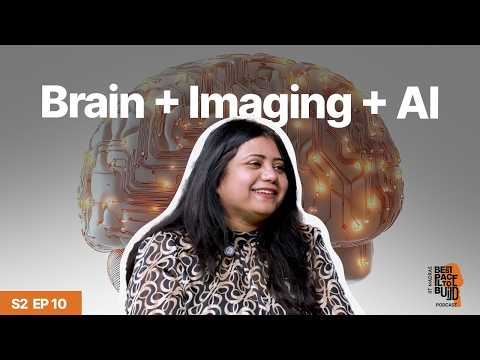
World’s largest fetal-brain mapping dataset is being built here in India! | Dr Richa Verma on S2E10
Dr. Richa Verma (guest)
In this episode of Best Place To Build, featuring Dr. Richa Verma, World’s largest fetal-brain mapping dataset is being built here in India! | Dr Richa Verma on S2E10 explores inside IIT Madras’ Dharani atlas: cell-level fetal brain mapping revolution Brain mapping is framed as building a “Google Maps”-like atlas of the brain, moving from region-level views to cell-level resolution across the whole organ to create reference maps for health and disease.
Inside IIT Madras’ Dharani atlas: cell-level fetal brain mapping revolution
Brain mapping is framed as building a “Google Maps”-like atlas of the brain, moving from region-level views to cell-level resolution across the whole organ to create reference maps for health and disease.
The Brain Centre’s mission is to map the human brain across the lifespan—from prenatal stages to 100 years—while also studying developmental disorders, stroke/ischemia, neurodegeneration, and aging.
Their flagship open-access release, the Dharani atlas, is described as the largest and most detailed second-trimester developing human brain map, enabling global researchers to explore cellular anatomy and 2D/3D reconstructions.
Achieving whole-brain, cellular-resolution imaging requires extensive engineering innovation in freezing, slicing, transferring large delicate sections, staining, scanning at 0.5 micron, and building software to manage and navigate the resulting data.
The project is expensive (about ₹2 crore per brain in consumables) and relies on philanthropic and institutional funding, plus major compute/visualization collaborations (e.g., NVIDIA) to handle petabyte-scale datasets and tools like Neurovoyager.
Key Takeaways
Cell-level whole-brain maps act as “reference standards” for disease research.
By mapping normal brains at specific ages, researchers can compare diseased or atypical brains against a baseline to localize what changed—regions, cell types, counts, or cortical/gray-matter thickness—before investigating mechanisms.
Get the full analysis with uListen AI
The core technical leap is closing the “volume vs. resolution” gap.
Clinical MRI provides whole-brain coverage but typically around ~1 mm resolution, while histology provides cellular detail but usually only for small regions; the Brain Centre’s pipeline targets both whole-organ scale and cellular detail.
Get the full analysis with uListen AI
Whole-brain histology at scale is primarily an engineering and process-control problem.
Freezing a large water-rich organ without cracks or artifacts, slicing ~10–20 micron sections at large area (e. ...
Get the full analysis with uListen AI
Open datasets are only useful if they’re navigable, not just downloadable.
With ~10,000 slices per adult brain and multi-modal stains, the viewer/software layer (zooming, browsing series, 2D-to-3D context, modality switching) is essential to make the atlas practical for remote researchers.
Get the full analysis with uListen AI
Compute and visualization are now as critical as wet lab methods.
Digitizing 10,000 slices at 0. ...
Get the full analysis with uListen AI
High-quality tissue acquisition depends on hospital partners and postmortem timing.
The “postmortem interval” and rapid preservation are emphasized as vital to minimize deterioration and preserve cellular structure, making clinical collaboration foundational to the entire mapping pipeline.
Get the full analysis with uListen AI
Interdisciplinary training and mindset matter more than strict degree lanes.
The Centre hires across mechanical/electrical/computational engineering, life sciences, radiology, histotech, and imaging, and encourages early-career members to explore multiple workflows before locking into a single ‘project’ identity.
Get the full analysis with uListen AI
Notable Quotes
“We are able to go equivalent of that house level within the brain, which is at cell level, but across the whole brain.”
— Dr. Richa Verma
“That’s currently the largest, most detailed brain map of the developing human brain in second trimester… made freely open-access datasets.”
— Dr. Richa Verma
“It sounds simple to say imaging of a human brain… but it’s a huge engineering challenge.”
— Amrit (Host)
“Each brain would cost you… close to two crores per brain… just talking the consumable.”
— Dr. Richa Verma
“As we generate these atlases, you can overlay the cellular information on the MRI, and then create different models to predict what you are seeing in MRI, what would happen at cell level.”
— Dr. Richa Verma
Questions Answered in This Episode
Dharani is second-trimester: what specific gestational weeks are included, and how representative is the dataset across individuals and regions?
Brain mapping is framed as building a “Google Maps”-like atlas of the brain, moving from region-level views to cell-level resolution across the whole organ to create reference maps for health and disease.
Get the full analysis with uListen AI
What are the exact staining modalities released in Dharani (e.g., Nissl, myelin, immunomarkers), and how do you decide the ‘standard’ stains vs question-specific markers?
The Brain Centre’s mission is to map the human brain across the lifespan—from prenatal stages to 100 years—while also studying developmental disorders, stroke/ischemia, neurodegeneration, and aging.
Get the full analysis with uListen AI
Where does the largest failure rate occur in the pipeline (freezing artifacts, section tearing, staining variability, scanner drift), and what QA metrics do you use at each stage?
Their flagship open-access release, the Dharani atlas, is described as the largest and most detailed second-trimester developing human brain map, enabling global researchers to explore cellular anatomy and 2D/3D reconstructions.
Get the full analysis with uListen AI
You mentioned overlaying cellular maps onto MRI: what alignment/registration strategy bridges postmortem histology with in-vivo MRI coordinates reliably?
Achieving whole-brain, cellular-resolution imaging requires extensive engineering innovation in freezing, slicing, transferring large delicate sections, staining, scanning at 0. ...
Get the full analysis with uListen AI
Given the claim ‘largest in the world,’ what benchmarks are you comparing against (datasets, resolution, brain count, modalities), and what dimensions make Dharani uniquely “largest”?
The project is expensive (about ₹2 crore per brain in consumables) and relies on philanthropic and institutional funding, plus major compute/visualization collaborations (e. ...
Get the full analysis with uListen AI
Transcript Preview
we are able to go equivalent of that house level within the brain, which is at cell level, but across the whole brain.
It sounds simple to say imaging of a human brain.
Yep.
Uh, and but it's a huge engineering challenge.
Yes. Currently, the largest, most detailed brain map of the developing human brain in second trimester.
So the Dharani dataset for each brain, we'll be able to track these eighty billion odd neurons?
It's in the largest collection in the world.
Hi, this is Amrit. We are at IIT Madras, my alma mater, and India's top university for people who like to build. We are here to meet some builders, ask them: "What are you building? What does it take to build? And what makes IIT Madras the best place to build?" [upbeat music] Hello, and welcome to the Best Place to Build Podcast. Today, we have with us Dr Richa Verma, chief scientific officer of the Sudha Gopalakrishnan Brain Centre at IIT Madras, which does brain imaging. We'll learn about it. It does brain imaging at point five micron level or cellular level. The research group has a wet lab, an engineering lab, an optics lab, an imaging lab, a software team, and an ana- analytics team. So it's a large team, multidisciplinary. Um, Dr Richa, welcome to the podcast.
Thank you, Amrit. Thanks for having me here.
Uh, Doctor, I have to ask you, what is brain mapping, uh, what is brain imaging, and why do we need it?
Okay, that's, uh, good and something good to start this conversation with. When we talk about human brain, or any brain for that matter, it's an organ which is very heterogeneous, which means, uh, it has different cell types, there are different regions. So to understand the brain, you want to know how these cells are organized and how each of these organization makes different brain regions. So just like world map, you identify different countries, states, towns, and cities, and you then create maps, right? And then you put different countries map together to create the big atlas. If you remember in your school, you would have, in geography, the atlas-
Mm
... which would comprise maps of different countries. So same way, we are creating human brain maps, where we have detailed information about different brain regions, and we-- when we put all of this together, what we are doing is generating brain atlases.
Nice. You gave me the analogy earlier of, uh, moving from an atlas to something like Google Maps.
Yes-
Uh, so-
Or the other way around. [chuckles]
Right.
Okay. [chuckles]
So in, in, in, in the sense, what I want to understand is... I mean, in the introduction, I read that it's at a point five micron level. How much does the impact of the resolution matter?
Okay, so the closest analogy, which works with a lot of people, we have had world maps for centuries, right? People used to navigate from one country to the other, and those maps have also evolved over a period of time. Now, if you compare the world map two hundred years ago versus what you see in Google Map-
Install uListen to search the full transcript and get AI-powered insights
Get Full TranscriptGet more from every podcast
AI summaries, searchable transcripts, and fact-checking. Free forever.
Add to Chrome