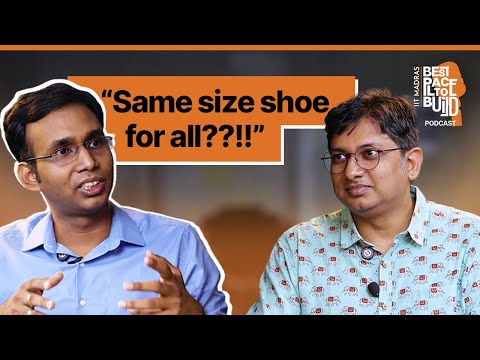
Swostik Sourav Dash | How NeoMotion's CEO is Building "Freedom" for Everyone | Ep. 2 | IIT Madras
Swostik Sourav Dash (guest)
In this episode of Best Place To Build, featuring Swostik Sourav Dash, Swostik Sourav Dash | How NeoMotion's CEO is Building "Freedom" for Everyone | Ep. 2 | IIT Madras explores neoMotion’s CEO on building personalized mobility and lasting impact systems NeoMotion reframes wheelchairs as personal mobility vehicles that restore independence by simplifying everyday travel for wheelchair users and the elderly.
NeoMotion’s CEO on building personalized mobility and lasting impact systems
NeoMotion reframes wheelchairs as personal mobility vehicles that restore independence by simplifying everyday travel for wheelchair users and the elderly.
A core problem in India is the one-size-fits-all wheelchair market, which creates discomfort, secondary health complications, and poor self-propulsion ergonomics.
Shark Tank served primarily as category awareness and credibility-building, helping NeoMotion educate the market on what “good” mobility devices should be.
Dash argues that being for-profit is essential for long-term impact because it keeps incentives aligned with end users rather than sponsors and forces operational efficiency.
NeoMotion’s origin story runs through IIT Madras’s CFI and R2D2 (Rehabilitation Research and Device Development) lab pipeline, with the company choosing a lean, grant-and-debt-funded path over VC to prioritize longevity and sustainable market creation.
Key Takeaways
Customization isn’t a premium feature in wheelchairs—it’s a health requirement.
Dash compares one-size wheelchairs to forcing everyone to wear size-14 shoes, arguing poor fit causes discomfort, harms posture, and creates secondary complications over long daily usage.
Get the full analysis with uListen AI
The hardest part is not building the device; it’s teaching the market how to buy it.
Consumers often choose wheelchairs by looks, fabric feel, and price rather than measurable fit and performance, so NeoMotion must educate users on the right evaluation criteria.
Get the full analysis with uListen AI
Shark Tank’s biggest value is category awareness and trust, not instant mass sales.
NeoMotion doesn’t sell a fast-moving consumer product; the show helped people discover the category, validate credibility, and trigger serious inquiries and sponsorship conversations.
Get the full analysis with uListen AI
For-profit structures can make impact solutions more durable than philanthropy-led models.
Dash argues that sponsor-driven buying can ignore user preferences and vanish when donor priorities shift, while a for-profit model keeps the user-market feedback loop central.
Get the full analysis with uListen AI
Assistive tech opportunity will grow as India ages and caregiving becomes scarcer.
He frames the problem as a looming national need: longer life expectancy and weaker support systems will require robust indigenous mobility and daily-living solutions to avoid import dependence.
Get the full analysis with uListen AI
IIT Madras’s builder pipeline turns prototypes into companies by design.
CFI builds hands-on confidence and networks, while labs like R2D2 generate research and devices; NeoMotion reflects a broader shift toward taking academic work to commercialization.
Get the full analysis with uListen AI
NeoMotion chose longevity over hype by avoiding VC pressure early on.
They prioritized becoming self-sustaining, using grants and working-capital debt, believing money alone can’t compress market-creation timelines in a behavior-change category.
Get the full analysis with uListen AI
Notable Quotes
“Imagine slapping a shoe of size 14 to everybody, like all of you wear a shoe of size 14 and start walking.”
— Swostik Sourav Dash
“If NeoMotion has to bring a change, unless NeoMotion is there for next 100 years, it will not happen.”
— Swostik Sourav Dash
“It’s not that if there is more money, we founders take more money home… it’s more money in the company to do investment in R&D, create market creation.”
— Swostik Sourav Dash
“India is a fantastic test market. We want the best or pay the least.”
— Swostik Sourav Dash
“Just maybe six or seven months before we accepted that we don’t know sales. We don’t know marketing.”
— Swostik Sourav Dash
Questions Answered in This Episode
What specific measurements or parameters does NeoMotion use to ‘custom fit’ a wheelchair, and how do they translate into better health outcomes?
NeoMotion reframes wheelchairs as personal mobility vehicles that restore independence by simplifying everyday travel for wheelchair users and the elderly.
Get the full analysis with uListen AI
You mentioned secondary complications from poor-fit chairs—what are the most common complications you’ve observed in the field, and how does your design prevent them?
A core problem in India is the one-size-fits-all wheelchair market, which creates discomfort, secondary health complications, and poor self-propulsion ergonomics.
Get the full analysis with uListen AI
How did your 2016 travel across ~40 locations and ~200 wheelchair users directly change the product roadmap (what did you drop or add)?
Shark Tank served primarily as category awareness and credibility-building, helping NeoMotion educate the market on what “good” mobility devices should be.
Get the full analysis with uListen AI
Shark Tank boosted inquiries—what operational changes did you make to handle the surge without compromising customization and service quality?
Dash argues that being for-profit is essential for long-term impact because it keeps incentives aligned with end users rather than sponsors and forces operational efficiency.
Get the full analysis with uListen AI
Where do CSR/NGO-sponsored purchases work well, and where do they distort incentives compared to direct user purchasing?
NeoMotion’s origin story runs through IIT Madras’s CFI and R2D2 (Rehabilitation Research and Device Development) lab pipeline, with the company choosing a lean, grant-and-debt-funded path over VC to prioritize longevity and sustainable market creation.
Get the full analysis with uListen AI
Transcript Preview
Hi, my name is Amrit. We've heard that IIT Madras is the best place to build. [upbeat music] So we've come down to the Sudha and Shankar Innovation Hub. We want to meet some people. These are builders. We want to talk to them about their work, and also ask them what makes IIT Madras the best place to build? [upbeat music]
Imagine it like it's built for me. Like, for example, your shoe is your shoe, it's built for you. It's our responsibility to start building things so that when the time comes, we're not struggling and say, "Can we fix it?" And then we start importing a bunch of things. So it's basically larger the gap, larger you are at risk in actually solving the long-term issue. [upbeat music]
Hi, welcome to the Best Place to Build podcast. Today we are sitting with Swostik from NeoMotion. Hi, Swostik.
Hi, Amritash.
Um, let's start with talking about what NeoMotion is and what NeoMotion does. Why don't you go ahead?
NeoMotion is all about making everyday mobility simple for persons with disability or elderly. For you and me, if we have to go out, we just simply go, wear our shoes, and walk out. But imagine for a person on a wheelchair, it's a very complicated task. They have to think, plan, take help, uh, take help for shifting, transferring. How will I go? So much of planning that needs to be done, and in the process, what typically ends up happening is they don't go out, uh, because they're always feeling that, "I am dependent." And at NeoMotion, we're just trying to solve... make this entire process easy, where a person on a wheelchair doesn't really need to think so much, and make the entire process very simple. So we have a, a, a customized wheelchair and an add-on which converts the chair to a bike. So you just go out, attach it, your two-wheeler is ready, and you can go out. It's powered by battery. You can go on roads, go to your office, mall, uh, go to the grocery market, and actually enjoy life, live life to the fullest.
It's damn cool. You didn't explain your pro- your company as we make wheelchairs or... And you went through this idea that you're making a mobility. How did you des- how do you do that? Like, how do you describe this?
Yeah, so we, we call it like a personal mobility vehicle.
Mm-hmm.
I mean, uh, so it's something... Imagine it like it's built for me. Like, for example, your shoe is your shoe, it's built for you. Your specs are your specs, it's made for you. Now, every human being is different, so the mobility device that needs to be used for them, and specifically when it comes to persons with disability, is uniquely built for them. So we call it personal mobility device, and it, it's a mix of what you sit on, where you're sitting for the long time, and what is helping you move. It's a combination of this entire, uh, thing.
Install uListen to search the full transcript and get AI-powered insights
Get Full TranscriptGet more from every podcast
AI summaries, searchable transcripts, and fact-checking. Free forever.
Add to Chrome