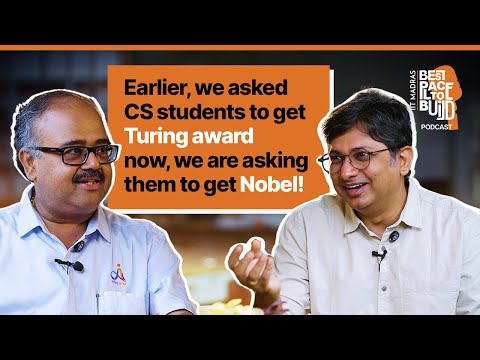
Prof. Ravindran on The IIT Madras Playbook for Building AI Leaders | BP2B S1 Ep. 6
Balaraman Ravindran (guest)
In this episode of Best Place To Build, featuring Balaraman Ravindran, Prof. Ravindran on The IIT Madras Playbook for Building AI Leaders | BP2B S1 Ep. 6 explores iIT Madras’ AI playbook: interdisciplinary learning, labs, and responsibility focus Ravindran traces AI’s rise at IIT Madras from tiny early reinforcement learning classes to massive on-campus and online programs, crediting rigorous fundamentals and NPTEL’s global reach.
IIT Madras’ AI playbook: interdisciplinary learning, labs, and responsibility focus
Ravindran traces AI’s rise at IIT Madras from tiny early reinforcement learning classes to massive on-campus and online programs, crediting rigorous fundamentals and NPTEL’s global reach.
He demystifies reinforcement learning through intuitive examples—sparse feedback, multi-armed bandits, and the exploration–exploitation dilemma—to show how RL differs from supervised learning.
He argues “AI is the new CS,” claiming AI has matured enough to become its own discipline with deep roots in psychology, control, economics, and other fields.
He details IIT Madras’ institution-building playbook: interdisciplinary centers (Bosch Centre, iBSC), a consolidated School of Data Science & AI, and the newer Center for Responsible AI to guide safe public deployment.
He connects AI’s societal impact to changing work and relationships, warning about misinformation and hyper-personalization while emphasizing that AI literacy will be essential across professions.
Key Takeaways
RL is about learning from sparse evaluation, not labeled answers.
Ravindran contrasts supervised learning’s input→label mapping with cycling/swimming-style feedback where you’re told only if outcomes are good/bad; RL formalizes learning under this limited guidance.
Get the full analysis with uListen AI
The exploration–exploitation dilemma is the core difficulty in RL—and in real decisions.
You must try options to learn their payoff (exploration) but also commit to the best-known choice (exploitation); switching too early locks in suboptimal behavior, switching too late wastes reward.
Get the full analysis with uListen AI
Interdisciplinary structure isn’t a slogan; it’s an operational design choice.
IITM’s AI ecosystem intentionally spans departments (e. ...
Get the full analysis with uListen AI
Building AI institutions resembles building startups in team formation and fundraising—plus guaranteed attrition.
He notes success depends on motivated teams and external funding, but academia’s “workforce” (students) is designed to leave; outputs are culture, research, and capability rather than a single product.
Get the full analysis with uListen AI
Responsible AI needs non-technologists at the table, especially for public deployment.
Concerned about governments adopting AI in law enforcement and public services without understanding pitfalls, he helped launch CeRAI to incorporate sociologists, economists, and lawyers alongside engineers.
Get the full analysis with uListen AI
AI is becoming foundational infrastructure like spreadsheets—use skill matters more than fear of replacement.
He argues most jobs won’t vanish overnight; instead, jobs will be performed differently, and workers who can use AI effectively will outcompete those who cannot.
Get the full analysis with uListen AI
An AI-first undergraduate curriculum must be designed from scratch, not “CS + a few AI electives.”
IITM’s BTech AI & Data Analytics emphasizes math (probability, optimization, linear algebra) and heavy programming/labs for building deployable systems, aiming to produce stronger AI engineers than retrofit curricula.
Get the full analysis with uListen AI
Notable Quotes
““AI is not going to take your job away, but somebody who knows how to use AI to do your job is gonna take your job away.””
— Balaraman Ravindran
““Exploration is essential… But… when do I switch from exploration to exploitation? …That is the dilemma.””
— Balaraman Ravindran
““AI is the new CS… [it’s time] for AI to pull away from computer science and become a discipline in its own right.””
— Balaraman Ravindran
““We were literally doing all the jobs that the department was doing without the department.””
— Balaraman Ravindran
““AGI is… a misnomer… there is nothing called general intelligence.””
— Balaraman Ravindran
Questions Answered in This Episode
In your RL examples, what’s the simplest mathematical formalism you’d teach first to connect “sparse feedback” to value functions and policies?
Ravindran traces AI’s rise at IIT Madras from tiny early reinforcement learning classes to massive on-campus and online programs, crediting rigorous fundamentals and NPTEL’s global reach.
Get the full analysis with uListen AI
For multi-armed bandits, which practical bandit strategy do you find most teachable (UCB, Thompson sampling, ε-greedy), and why?
He demystifies reinforcement learning through intuitive examples—sparse feedback, multi-armed bandits, and the exploration–exploitation dilemma—to show how RL differs from supervised learning.
Get the full analysis with uListen AI
You say “AI is the new CS”—what should AI departments require that traditional CS programs systematically under-teach (math, systems, evaluation, deployment, ethics)?
He argues “AI is the new CS,” claiming AI has matured enough to become its own discipline with deep roots in psychology, control, economics, and other fields.
Get the full analysis with uListen AI
CeRAI focuses on responsible deployment in government: what are the top 3 failure modes you’ve observed (bias, hallucinations, feedback loops, procurement issues), and how do you mitigate them?
He details IIT Madras’ institution-building playbook: interdisciplinary centers (Bosch Centre, iBSC), a consolidated School of Data Science & AI, and the newer Center for Responsible AI to guide safe public deployment.
Get the full analysis with uListen AI
Bosch Centre became a template others copied—what were the biggest “mistakes we made” that IIT Delhi asked you to help them avoid?
He connects AI’s societal impact to changing work and relationships, warning about misinformation and hyper-personalization while emphasizing that AI literacy will be essential across professions.
Get the full analysis with uListen AI
Transcript Preview
So I was at this, uh, AI conference in, in Macau, right? And then one Chinese student who was sitting there looks at me, that- he gets up, bows to me, and said, "I learned ML from your videos," and gave me his seat. But AI is not going to take your job away, but somebody who knows how to use AI to do your job is gonna take your job away. Then Director Professor Anand, he never believed in this artificial boundaries of, uh, departments and subjects and things like that. People were just, you know, teaching subjects, and students used to can, you know, put together their curriculum based on what they are interested in learning. [upbeat music]
Hi, my name is Amrit. We've heard that IIT Madras is the best place to build. [upbeat music] So we've come down to the Sudha and Shankar Innovation Hub. We want to meet some people. These are builders. We want to talk to them about their work, and also ask them, "What makes IIT Madras the best place to build?" [upbeat music] Hello, and welcome to the Best Place to Build Podcast. Today, we are sitting with Professor Ravindran, who is the head of the Wadhwani School of Data Science and AI at IIT Madras. Professor, welcome to the podcast. Uh, we know each other for a while now. We traveled together to Bangalore to meet JEE aspirants earlier this year. That was a great experience. What I remembered from it, though, is that both of us drink black coffee now because we can't digest milk very well.
Sure.
Um, and, uh, and also I remember that I had given you the Best Place to Build sticker that day, and you immediately put it on your, uh, laptop. Yeah.
Yes.
That was amazing.
Because I strongly believe that this is the best place to build.
Yes, sir. Um, and I, I, I also... It's amazing how popular you are among the student community. Your classes are taken by, uh, hundreds, 200, 300 of students. And, um, I want to start with the question that: Was it always like this? In the sense that, was AI this popular?
Sure. So, um, I have been with IIT Madras since 2004, right? And in 2004, I started teaching the course on, uh, reinforcement learning, right? At that time, people had not heard of reinforcement learning, so whenever I say reinforcement learning... And my office used to be in the Building Science block, so people thought I worked in concrete.
[chuckles]
Right? So, uh-
Because reinforced concrete.
[chuckles] So, uh, at the first time I taught this class, there were about six students in the class.
That's right.
And ironically, in the early days, there used to be more non-computer science students were taking my reinforcement learning class than there were computer scientists. Because, uh, uh, reinforcement learning, it's such a wonderful subject. It has motivations from control theory, it has motivations from, uh, uh, neuroscience, uh, and cognitive psychology, and so on and so forth. So I used to have people doing PhD in neuroscience in my class, and so on and so forth, but the class used to be so small, five, six students. I think up to, up until about 2012, the largest reinforcement learning class I had was about 16. Now, the smallest class is about 130, right? So year on year now, we get about 180 students who take it, and then the first assignments and the first quiz rolls around, and then I'm left with about 110, 120 students. About 50 drop the class after that, but it's still a very popular class. It's not always been like this, but I'm happy that we are.
Install uListen to search the full transcript and get AI-powered insights
Get Full TranscriptGet more from every podcast
AI summaries, searchable transcripts, and fact-checking. Free forever.
Add to Chrome