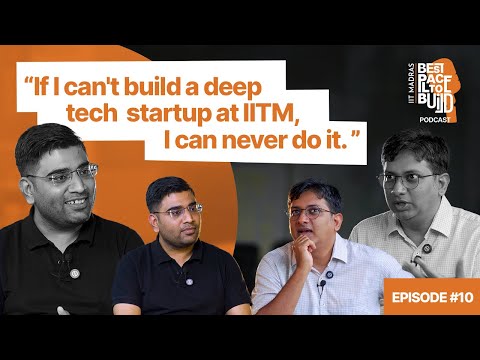
Suyash Singh, GalaxEye | "If I can't build a deep tech startup at IITM, I can never do it." | Ep. 10
Unknown Host (host), Suyash Singh (guest)
In this episode of Best Place To Build, featuring Unknown Host and Suyash Singh, Suyash Singh, GalaxEye | "If I can't build a deep tech startup at IITM, I can never do it." | Ep. 10 explores building GalaxEye from IIT Madras: hyperloop roots to satellites Suyash’s path from mechanical engineering and corporate research to IIT Madras led him to start Avishkar Hyperloop, which became a formative deep-tech, team-building experience and a bridge between BTech and MTech innovation cultures.
Building GalaxEye from IIT Madras: hyperloop roots to satellites
Suyash’s path from mechanical engineering and corporate research to IIT Madras led him to start Avishkar Hyperloop, which became a formative deep-tech, team-building experience and a bridge between BTech and MTech innovation cultures.
GalaxEye positions itself as a data company that acquires Earth observation imagery from its own satellites, aiming to solve the core bottleneck of inconsistent optical imagery due to clouds and nighttime limitations.
The startup’s technical differentiator is fusing Synthetic Aperture Radar (microwave, cloud-penetrating, night-capable) with multispectral imaging (visible/near-IR, intuitive interpretation) to make imagery both available and usable for mainstream applications.
Suyash outlines a rigorous satellite development lifecycle (idea → concept → PDR → CDR → AIT → launch), including risk management via space-proven components and extensive environmental testing, while using ISRO’s POEM as an in-orbit validation step.
He argues India’s 2020-era space privatization reforms catalyzed a new wave of private space startups, and that IIT Madras’ network, advisors (ex-ISRO/DRDO), and investor ecosystem collectively reduce execution friction for deep-tech founders.
Key Takeaways
Consistency is the unlock for a “Google Maps moment” in Earth imaging.
GalaxEye’s thesis is that many downstream SaaS applications (agri, rail, infrastructure, risk) stall because imagery delivery is unpredictable; improving availability and revisit reliability can enable whole new categories of products.
Get the full analysis with uListen AI
SAR solves availability; multispectral solves interpretability—fusion targets both.
Optical imagery is intuitive but blocked by clouds/night, while SAR works through clouds and at night but looks like “X-ray” noise; combining them aims to create imagery that is both frequent and easy for non-experts to use.
Get the full analysis with uListen AI
Deep-tech execution depends on disciplined systems engineering, not just ideas.
Suyash frames satellite building as a staged process (idea→concept→PDR→CDR→AIT) with mass/power/volume budgeting, supply-chain design, and harsh-environment testing (thermal-vac, vibration) to avoid “debugging in orbit.”
Get the full analysis with uListen AI
De-risking hardware can happen before space via aerial testbeds.
Instead of flying an unproven payload, GalaxEye miniaturized its sensor stack for drones/aircraft/HAPS and ran 400+ flights to mature algorithms and architectures before committing to orbital deployment.
Get the full analysis with uListen AI
ISRO’s POEM provides a pragmatic “0-to-1” stepping stone for startups.
POEM lets teams fly and validate a critical subsystem in orbit on a shared ISRO platform, reducing technical uncertainty and giving founders hands-on experience with launch integration workflows.
Get the full analysis with uListen AI
India’s post-2020 reforms shift the ecosystem from “upstream-only” to end-to-end opportunity.
Suyash argues ISRO made India world-class in upstream (launch/satellites), but private policy reforms are enabling midstream infrastructure and downstream applications—accelerating startup formation (he cites 83 registered).
Get the full analysis with uListen AI
In India, talent strategy must be aptitude-first and advisor-amplified.
Because “VP-of-radar” style hiring pools are thin, GalaxEye hires for learning ability and structured thinking, then bridges experience gaps with a hands-on advisory layer of ex-ISRO/DRDO experts.
Get the full analysis with uListen AI
Notable Quotes
“If I can't build a deep tech project here, I can never do it in my life.”
— Suyash Singh
“We are a data company. We acquire data from space.”
— Suyash Singh
“Earth is covered by clouds around 70%… during the nighttime, your cameras can't… click pictures.”
— Suyash Singh
“Radar is available, but not intuitive… it is like X-ray.”
— Suyash Singh
“India space… walked so far, and we will now run.”
— Suyash Singh
Questions Answered in This Episode
GalaxEye’s core promise is “consistent imagery delivery”—what specific SLA do you aim for (revisit rate, latency, cloud-free probability) once the 6–8 satellite network is deployed?
Suyash’s path from mechanical engineering and corporate research to IIT Madras led him to start Avishkar Hyperloop, which became a formative deep-tech, team-building experience and a bridge between BTech and MTech innovation cultures.
Get the full analysis with uListen AI
On the fusion side, what does “marrying SAR and multispectral” mean in practice: co-registered pixels, ML-based translation (SAR→optical-like), or joint feature products for specific industries?
GalaxEye positions itself as a data company that acquires Earth observation imagery from its own satellites, aiming to solve the core bottleneck of inconsistent optical imagery due to clouds and nighttime limitations.
Get the full analysis with uListen AI
You described SAR bands (L vs X) as penetration vs urban detail—what band choices are you making for Drishti, and what tradeoffs forced that decision (antenna size, power, cost, resolution)?
The startup’s technical differentiator is fusing Synthetic Aperture Radar (microwave, cloud-penetrating, night-capable) with multispectral imaging (visible/near-IR, intuitive interpretation) to make imagery both available and usable for mainstream applications.
Get the full analysis with uListen AI
How do you decide which subsystems must be space-proven versus where you’ll accept COTS/industrial-grade risk, and how do you quantify that risk before launch?
Suyash outlines a rigorous satellite development lifecycle (idea → concept → PDR → CDR → AIT → launch), including risk management via space-proven components and extensive environmental testing, while using ISRO’s POEM as an in-orbit validation step.
Get the full analysis with uListen AI
POEM is used to test a critical subsystem—what exactly are you validating in orbit (performance, thermal stability, radiation effects, deployment mechanics), and what would trigger a redesign?
He argues India’s 2020-era space privatization reforms catalyzed a new wave of private space startups, and that IIT Madras’ network, advisors (ex-ISRO/DRDO), and investor ecosystem collectively reduce execution friction for deep-tech founders.
Get the full analysis with uListen AI
Transcript Preview
I am sitting in one of the best institutes in the country, ranked one in many ways. If I can't build a deep tech project here, I can never do it in my life. So I think we will be launching six to eight satellites after this first one in the next four to five years. India space, in my opinion, walked so far, and we will now run. [upbeat music] Hi, my name is Amrit. We've heard that IIT Madras is the best place to build. [upbeat music] So we've come down to the Sudha and Shankar Innovation Hub. We want to meet some people. These are builders. We want to talk to them about their work and also ask them, "What makes IIT Madras the best place to build?" [upbeat music] Hi, hello, and welcome to the Best Place to Build Podcast. Today, we are sitting with Suyash Singh. He's the co-founder and CEO of GalaxEye, one of India's hottest space startups. Hi, Suyash, welcome to the podcast.
Hey, Amrit. Thanks for having me.
Suyash, the first thing that I've noticed about you, and I've met you a couple of times by now, is that you're always smiling. It's amazing. I also want to say that I can imagine how difficult, stressful you must be at because you're running a space startup in a country like India. Um, what is the secret of your smile?
[chuckles] So there's a nice story to that. So when I was at IIT Madras, uh, I was starting this team called Avishkar Hyperloop, and, uh, our first orientis- orientation session, all the guys came in, and when I was finished with the presentation, they said, "You, you are super depressing. We don't feel that we should be working with you." And that was the point, you know, I started to practice smiling slowly and gradually. [chuckles] It, it became a part of my life, yeah.
That's amazing. Um, you were at IIT Madras, uh, which years?
2017 to 2019. I did my master's.
So what is the story? How did you get here? Uh, where did you study school from? And, yeah, just run us through your journey to IIT Madras.
Sure. So I, I did my bachelor's back in 2013, so I graduated in 2013 as a mechanical engineer. Then I did a corporate stint, you know, where I did a bunch of other things, and I experimented throughout the life. I prepared for UPSC. I did a bunch of other things as well during those four years. And eventually, at TCS Research, where I used to work, I found myself not having a lot of good fundamentals to engineering and life. So, you know, that was the point where I decided to kind of pursue master's at some university here and there. And, uh, of course, you know, GATE, GATE examination was the gateway to IIT Madras, and, uh, that ... By appealing to that, I made it to IIT Madras, joined, uh, aerospace engineering here. And after joining here, my goal was to kind of get, you know, hired by one of those big giants, like Amazon, Google, Facebook, et cetera, Netflix. Uh, but, you know, eventually, I ended up doing deep tech, building Hyperloop for next two years, uh, building a massive, good team, and that was a U-turn entirely, right? From, from mechanical engineer to doing Hadoop, AI, big data in four years, appearing for UPSC, coming to IIT Madras, and doing deep tech, and then doing deep tech forever.
Install uListen to search the full transcript and get AI-powered insights
Get Full TranscriptGet more from every podcast
AI summaries, searchable transcripts, and fact-checking. Free forever.
Add to Chrome