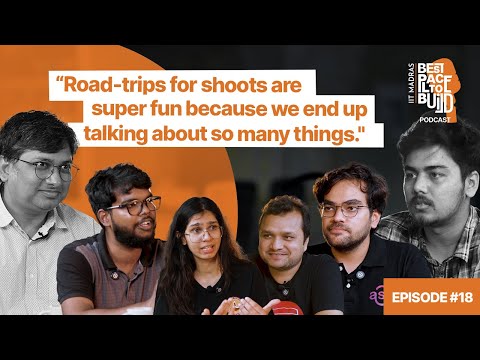
BTS: Behind the Scenes of the Best Place to Build Podcast | Episode 18
In this episode of Best Place To Build, BTS: Behind the Scenes of the Best Place to Build Podcast | Episode 18 explores inside IIT Madras’ “Best Place to Build” podcast-making machine Amrit and Piyush unpack why the podcast exists: to extend IITM’s earlier counseling tradition into a digital format and to spotlight builders across the IIT Madras ecosystem.
Inside IIT Madras’ “Best Place to Build” podcast-making machine
Amrit and Piyush unpack why the podcast exists: to extend IITM’s earlier counseling tradition into a digital format and to spotlight builders across the IIT Madras ecosystem.
They describe how their content strategy evolved from short-form assumptions to long-form deep dives, prompted by audience data and the need to overcome skepticism about IITM’s cutting-edge work (e.g., Hyperloop).
The episode details practical production realities—guest prioritization, scheduling constraints, research-heavy prep for technical guests, and early-morning shoots at CFI to avoid noise.
They also explain the release workflow across platforms (teasers, full episodes, tailored captions), plus the team rhythms, travel logistics, and how the process has become increasingly streamlined over time.
Key Takeaways
Consistency creates the data that clarifies what audiences truly want.
The team initially assumed viewers wouldn’t watch beyond a minute, but consistent publishing and analytics revealed a real appetite for longer, deeper conversations—especially for complex “build” stories.
Get the full analysis with uListen AI
The podcast’s job is partly to resolve audience disbelief about IITM’s current capabilities.
They recount a parent accusing them of “lying” about the Hyperloop project—highlighting the gap between IITM’s present-day work and public perception, and why showing credible builders on-camera matters.
Get the full analysis with uListen AI
Guest selection is less about access and more about sequencing and logistics.
They emphasize there’s no shortage of IITM builders; the real constraint is deciding who comes first and aligning schedules—especially for guests outside Chennai/India given the shoot timings and travel.
Get the full analysis with uListen AI
Early-morning shooting is a strategic tradeoff to capture a real environment.
They shoot around 7–9 a. ...
Get the full analysis with uListen AI
Technical depth requires serious pre-interview research and external validation.
For complicated domains, the team studies publications and consults experts so the host can ask coherent questions—balancing curiosity with competence in highly technical episodes.
Get the full analysis with uListen AI
Great episodes combine ‘core tech’ with the founder’s human story.
Their interview framework intentionally pairs product/technology deep dives with personal journeys, believing what people build is shaped by who they are and the circumstances they’ve faced.
Get the full analysis with uListen AI
Trust is built by resisting clickbait and matching packaging to substance.
They tailor captions per platform and avoid misleading teasers, aiming to keep promotional hooks faithful to the real episode—something they believe drives loyal repeat viewership.
Get the full analysis with uListen AI
Notable Quotes
“Counseling stopped in 2009. 2025 is the fourth year of Ask IITM.”
— Amrit (with Piyush in conversation)
“When we started… we were like: ‘Nobody watches more than one minute.’ … you start realizing that there are a set of people who are looking at longer stuff, who want to deep dive.”
— Amrit
“This parent… came up to me and said, ‘Why were you guys lying about this?’”
— Amrit
“Once you have been a part of this ecosystem, you never actually leave.”
— Piyush/Amrit (discussion on IITM ecosystem)
“It looks simple on the camera… but… it takes a lot of effort to clean everything up, and then… start setting everything up.”
— Mridul
Questions Answered in This Episode
AskIITM started as a “digital successor” to counseling—what pieces of the old counseling experience are still missing, and how might you rebuild them digitally?
Amrit and Piyush unpack why the podcast exists: to extend IITM’s earlier counseling tradition into a digital format and to spotlight builders across the IIT Madras ecosystem.
Get the full analysis with uListen AI
What specific analytics or audience signals convinced you to move from short-form assumptions to prioritizing longer-form deep dives?
They describe how their content strategy evolved from short-form assumptions to long-form deep dives, prompted by audience data and the need to overcome skepticism about IITM’s cutting-edge work (e. ...
Get the full analysis with uListen AI
In episodes where the subject is highly technical, what does your research workflow look like step-by-step (papers → expert consults → question outline)?
The episode details practical production realities—guest prioritization, scheduling constraints, research-heavy prep for technical guests, and early-morning shoots at CFI to avoid noise.
Get the full analysis with uListen AI
How do you decide the balance between ‘core tech’ questions and personal-journey storytelling so the episode doesn’t become either too shallow or too niche?
They also explain the release workflow across platforms (teasers, full episodes, tailored captions), plus the team rhythms, travel logistics, and how the process has become increasingly streamlined over time.
Get the full analysis with uListen AI
You mentioned audience skepticism (e.g., Hyperloop). What’s your strategy for building credibility with viewers who assume you’re exaggerating?
Get the full analysis with uListen AI
Transcript Preview
[mellow music] Hi, my name is Amrit. We've heard that IIT Madras is the best place to build. [upbeat music] So we've come down to the Sudha and Shankar Innovation Hub. We want to meet some people. These are builders. We want to talk to them about their work, and also ask them: What makes IIT Madras the best place to build? [upbeat music]
Hi, for today's episode, we are going behind the scenes. So why did this podcast come about? Uh, nobody asked us, but we are saying it anyway, and, uh, some of the details of what we do here. So my name is Amrit, uh, with me is Piyush.
Okay. Hi, Amrit. So, um, what are we talking about today?
I think we can start by talking about what is Ask IITM, and why did we get here.
I remember our initial phrasing being, it's a digital successor to the counseling that used to have happen ten years ago, right?
Yeah, counseling stopped in 2009. 2025 is the fourth year of Ask IITM, and I think we made... I think most of the videos, you were involved in, right? Like, uh, 300 videos?
350 videos.
Okay. When we started in the beginning, we were like: "Oh, people are very impatient. Nobody watches more than one minute." And then actually, as a content team, if you could put content consistently, you get a lot of data, and you start realizing that there are a set of people who are looking at longer stuff, who want to deep dive. There are things that you can't really explore, uh, in one minute, two minutes.
And we were also sort of thinking that in terms of the student aspects, we have mostly covered everything. I-
I remember this moment in, uh, very vividly in, uh, the demo day at Bangalore in 2024, where, uh, we were-- we had a three-hour-long presentation and about 200 people. We presented everything, and then at the end... And we were talking of Hyperloop, which is in my background, right? So it's a real thing, that there is a Hyperloop project at IITM, and, uh, there is a track at the other campus. Uh, and, uh, this parent, uh, sort of after the event, uh, uh, came up to me and said, "Why were you guys lying about this?" And we weren't, obviously we were not lying, but so much of cognitive dissonance, like, we are talking about these amazing things that are happening, but somehow the audience is like, "Yeah, I..." Uh, they're stuck in the past, like
Exactly, and
Uh, US...
... But we showed it. We invited Suyash to the podcast-
Yes
... who was-
Yeah
... who started the Hyperloop team in IIT Madras.
Yeah, and Professor Satya also. It took us a while to figure out how to set up the frame and what is the background and what is the art direction on it, and...
I remember you being so particular about this feeling that has to be there, about people leaning in and-
Install uListen to search the full transcript and get AI-powered insights
Get Full TranscriptGet more from every podcast
AI summaries, searchable transcripts, and fact-checking. Free forever.
Add to Chrome