Can India lead the Hyperloop race? | BP2B: Student Edition! Ep.04
Vidhi (host)
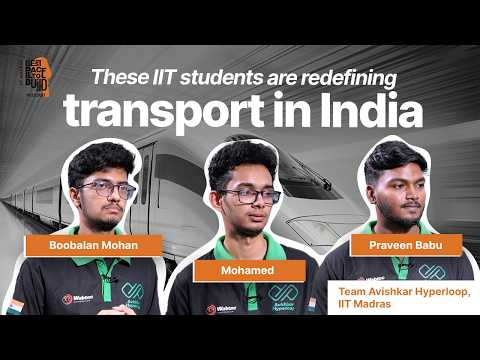
In this episode of Best Place To Build, featuring Vidhi, Can India lead the Hyperloop race? | BP2B: Student Edition! Ep.04 explores iIT Madras students push Hyperloop prototypes toward scalable Indian reality Avishkar Hyperloop (IIT Madras) presents itself as both a research and competition team, evolving from SpaceX-era Hyperloop contests to strong showings at European Hyperloop Week and an India-based Global Hyperloop Competition they helped initiate.
IIT Madras students push Hyperloop prototypes toward scalable Indian reality
Avishkar Hyperloop (IIT Madras) presents itself as both a research and competition team, evolving from SpaceX-era Hyperloop contests to strong showings at European Hyperloop Week and an India-based Global Hyperloop Competition they helped initiate.
The team explains Hyperloop as a hybrid of airplane-like speeds and train-like efficiency by minimizing friction via levitation and minimizing drag via a semi-vacuum tube, targeting conceptual speeds near 1200 km/h (e.g., Chennai–Bangalore in ~20 minutes).
A core differentiator from maglev is infrastructure economics: Avishkar emphasizes a passive track with electromagnetics largely on the pod, aiming to reduce track cost and improve scalability compared with coil-powered maglev tracks.
Beyond propulsion and levitation, major R&D focus areas include vacuum-compatible thermal management (e.g., phase-change materials), passenger-cabin life support constraints in vacuum, and infrastructure cost reductions such as thinner tubes and exploring concrete tubes for low permeability.
The discussion acknowledges skepticism about capital costs and logistics, arguing that low operating energy could enable long-term break-even if systems run for decades, while competitions assess scalability, safety, and evolving technical metrics rather than speed alone.
Key Takeaways
Hyperloop’s value proposition is drag-and-friction elimination, not just raw speed.
The speakers repeatedly frame Hyperloop as achieving airplane-like speeds by levitating (no rolling friction) and traveling in a semi-vacuum (minimal air drag), reducing energy needed during cruise.
Get the full analysis with uListen AI
Infrastructure economics are the real battleground for Hyperloop viability.
They argue the pod is small relative to thousands of kilometers of tube/track, so even small percentage cost reductions in the track or tube can dramatically change overall project feasibility.
Get the full analysis with uListen AI
Avishkar’s “passive track” strategy targets a key maglev failure mode: expensive powered guideways.
Unlike many maglev systems that embed powered coils along the track, Avishkar puts most electromagnetics in the pod and keeps the track primarily ferromagnetic material plus an aluminum T-section, aiming to reduce capex and complexity.
Get the full analysis with uListen AI
Hybrid levitation is used to cut energy consumption after lift is achieved.
Their vertical levitation uses electromagnets to establish the air gap and permanent magnets to sustain lift, while lateral electromagnets guide and prevent contact with the track.
Get the full analysis with uListen AI
Propulsion is contactless via a linear induction motor, with grid-powered boosting to solve battery limits.
The LIM induces forces in the aluminum T-section using changing magnetic fields (Lenz’s law), but since onboard energy is limited, they describe a track-based “booster motor” to accelerate initially, after which maintaining speed in vacuum needs far less power.
Get the full analysis with uListen AI
Thermal control is a non-obvious technical risk in vacuum—and a major research theme.
With limited convective cooling, they describe dedicated thermal subsystems (e. ...
Get the full analysis with uListen AI
Their R&D extends beyond engineering into societal impact and commercialization constraints.
In addition to mechanical/electrical subsystems, they describe business and socio-economic research (e. ...
Get the full analysis with uListen AI
Notable Quotes
“We are trying to combine both of them—the speed of airplanes with the cost and running efficiency of a train.”
— Praveen
“Rather, we have a passive track. All our electromagnetics is in the pod.”
— Praveen
“Before the Wright brothers, no one said we can fly… It’s still in its baby phase, so we should nurture it rather than discouraging it.”
— Praveen
“Most of the cost goes in the infrastructure and maintaining the vacuum part of it. When it starts moving, the amount of energy it consumes is really, really less.”
— Praveen
“We don’t buy modules off the shelf and connect them… We work on the technology aspect of it.”
— Praveen
Questions Answered in This Episode
What specific assumptions (tube pressure, route constraints, acceleration limits) underpin the “Chennai to Bangalore in 20 minutes” estimate?
Avishkar Hyperloop (IIT Madras) presents itself as both a research and competition team, evolving from SpaceX-era Hyperloop contests to strong showings at European Hyperloop Week and an India-based Global Hyperloop Competition they helped initiate.
Get the full analysis with uListen AI
How do you quantify the capex savings of a passive track versus maglev-style powered guideways over hundreds of kilometers?
The team explains Hyperloop as a hybrid of airplane-like speeds and train-like efficiency by minimizing friction via levitation and minimizing drag via a semi-vacuum tube, targeting conceptual speeds near 1200 km/h (e. ...
Get the full analysis with uListen AI
The pod uses a track-based booster motor—how long is the booster section, and how does that affect infrastructure cost and station design?
A core differentiator from maglev is infrastructure economics: Avishkar emphasizes a passive track with electromagnetics largely on the pod, aiming to reduce track cost and improve scalability compared with coil-powered maglev tracks.
Get the full analysis with uListen AI
You mention a tube thickness as low as 6 mm and a 422 m tube built at IITM—what safety factors, buckling constraints, and vacuum-load calculations support this thickness?
Beyond propulsion and levitation, major R&D focus areas include vacuum-compatible thermal management (e. ...
Get the full analysis with uListen AI
Concrete tubes are proposed for low permeability—what mix design, liners/coatings, and joint/seal strategies are required to maintain vacuum over time?
The discussion acknowledges skepticism about capital costs and logistics, arguing that low operating energy could enable long-term break-even if systems run for decades, while competitions assess scalability, safety, and evolving technical metrics rather than speed alone.
Get the full analysis with uListen AI
Transcript Preview
We have a passive track. All our electromagnetics is in the pod. You have railways, you have a flight, so basically we are trying to combine both of them. So our estimated, uh, speed is around 1200 kilometers per hour, uh, Chennai to Bangalore in 20 minutes. Now, in your track, in the middle, there's this thing we call T-section. We, uh, evolved the Hyperloop technology, so in India, we are the pioneering team. [upbeat music]
Hi, welcome to Best Place To Build: Student Edition. I'm Vidhi, a fifth-year engineering design student at IIT Madras. We are here with Avishkar Hyperloop today, the team pioneering the future of India's Hyperloop research. So I'm here today 'cause I have numerous questions. What is the Hyperloop? How does it work? How is the student team pulling this off? And is this something that belongs to science fiction, or will it one day be commercially scalable? I'm here with Praveen today to answer all of these questions.
Hi.
Hi, Praveen. Nice to meet you.
Yeah. Hello, Vidhi.
So you'd be a great person to tell us, what is Avishkar?
So, Avishkar Hyperloop is, uh, ha- a competition team in CFIA, where we not only concentrate on the competition, rather we are a research team plus a competition team. Basically, we participate in competitions in Europe, but the start of our, uh, Avishkar tenure was, like, in 2017. Elon Musk coined this term of Hyperloop and started a competition in, uh, USA. It is called SpaceX Hyperloop Competition. So we went there for the first time, but we came 42nd and we didn't get selected. But the second year, we finished in top 10. So that's how this team was started, by a bunch of PhD students in ISTI, and then slowly it shifted to BTech, and now we are in our ninth generation of Hyperloop.
That's a very inspiring story.
Yeah.
So to start off with, what is the Hyperloop technology, exactly? I've heard that, yes, this is the brainchild of Elon Musk, possibly the fifth mode of transport.
Exactly.
But in simple terms, what is a Hyperloop, exactly?
You have railways, you have a flight, so basically we are trying to combine both of them. The speed of airplanes with the cost and running, uh, efficiency of a train. So what, what basically this does is, if you take a train, what are the en- engineering inefficiency that you have? The friction and the air drag. It, it keeps fighting a- against that, so major power is being lost over there. What Hyperloop does it alternatively is that it levitates over the track. It does not touch the track. As well as it runs on a semi-vacuum tube, so the air drag is also as minimal as possible. So in that way, we have very low power consumption while running the pod.
Uh, how fast do you think this can run?
So our estimated, uh, speed is around 1200 kilometers per hour, but that doesn't give any picture to you. Rather, I would say it as, it can go from here, uh, Chennai to Bangalore in 20 minutes.
Install uListen to search the full transcript and get AI-powered insights
Get Full TranscriptGet more from every podcast
AI summaries, searchable transcripts, and fact-checking. Free forever.
Add to Chrome