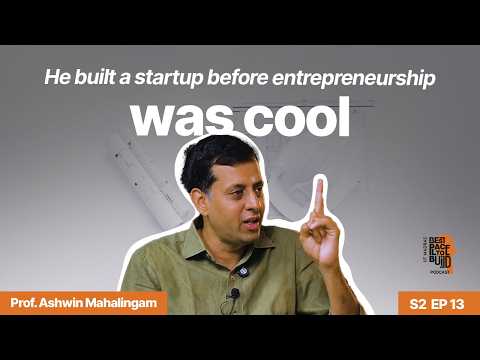
This Dean left the US to build IITM's entrepreneurial future | Prof Ashwin Mahalingam | BP2B S2E13
Ashwin Mahalingam (guest)
In this episode of Best Place To Build, featuring Ashwin Mahalingam, This Dean left the US to build IITM's entrepreneurial future | Prof Ashwin Mahalingam | BP2B S2E13 explores how IIT Madras built a barrier-free, alumni-powered entrepreneurship ecosystem Civil engineering has shifted from “steel and concrete” to an interdisciplinary profession integrating technology, finance, policy, and social dynamics to deliver complex infrastructure responsibly.
How IIT Madras built a barrier-free, alumni-powered entrepreneurship ecosystem
Civil engineering has shifted from “steel and concrete” to an interdisciplinary profession integrating technology, finance, policy, and social dynamics to deliver complex infrastructure responsibly.
Sustainability is now central to civil engineering because the built environment contributes significantly to climate risk, making engineers both accountable and essential to solutions.
New tools like drones and AI are expanding civil engineering’s scope by enabling better monitoring, automation, and productivity in construction, especially where labor shortages exist.
IIT Madras’ entrepreneurship culture grew from a tiny, uncertain early ecosystem into ~100 student startup teams annually, driven by CFI, alumni mentorship, and shifting social perceptions.
As Dean of Alumni & Corporate Relations, Mahalingam describes “friend-raising” and fundraising as institutional mechanisms that convert alumni goodwill into mentorship, networks, and scalable campus capability-building.
Key Takeaways
Civil engineering is now a systems-and-people discipline, not just structures.
Mahalingam argues modern projects blend mechanical, electrical, software, and human/community constraints, so engineers must understand incentives, contracts, and stakeholder communication alongside technical design.
Get the full analysis with uListen AI
Sustainability has become a defining mandate for civil engineers.
Because construction and materials contribute to greenhouse gas emissions, civil engineers must lead solutions through greener design choices, better policy alignment, and public buy-in.
Get the full analysis with uListen AI
AI expands civil engineering’s scope by making execution measurable and controllable.
Using drones for site imaging and AI for progress interpretation turns schedule tracking and logistics into near-real-time decision-making, especially valuable for remote projects.
Get the full analysis with uListen AI
Automation is becoming necessary due to construction labor scarcity.
He frames robotics and 3D printing as responses to the growing inability to staff sites, requiring “new civil engineers” who can integrate materials, robotics, and embedded systems.
Get the full analysis with uListen AI
IITM’s entrepreneurship inflection came from ecosystem, not motivation alone.
Early students were “smart and motivated but clueless” about commercialization; CFI’s build-first culture, alumni capital/mentorship, and visible Indian startup successes made entrepreneurship viable.
Get the full analysis with uListen AI
A strong “building” culture benefits far more than founders.
Mahalingam describes a funnel: many should build, a smaller fraction found startups, others become key early employees, and another set pushes research/patents—together compounding institutional output.
Get the full analysis with uListen AI
Alumni engagement is a strategic asset that must be actively activated.
He notes alumni are a “sleeping bear”: institute outreach and matchmaking can translate shared identity into mentoring, hiring, funding, and crisis response (e. ...
Get the full analysis with uListen AI
Notable Quotes
“Today, I think a civil engineer is someone who goes beyond just working with steel and concrete.”
— Prof. Ashwin Mahalingam
“A big thrust in civil engineering today is really saving the planet.”
— Prof. Ashwin Mahalingam
“I learned very quickly that it had nothing to do with the engineering.”
— Prof. Ashwin Mahalingam
“You are purposefully ruining my child.”
— Irate parent (recounted by Prof. Mahalingam)
“We do it through two key mechanisms… friend-raising and fundraising.”
— Prof. Ashwin Mahalingam
Questions Answered in This Episode
When you say infrastructure projects fail on time and budget due to “not engineering,” what are the top 2–3 contract/incentive failures you see most often?
Civil engineering has shifted from “steel and concrete” to an interdisciplinary profession integrating technology, finance, policy, and social dynamics to deliver complex infrastructure responsibly.
Get the full analysis with uListen AI
What specific sustainability levers (materials, design standards, procurement, policy) do you believe would reduce emissions fastest in Indian construction?
Sustainability is now central to civil engineering because the built environment contributes significantly to climate risk, making engineers both accountable and essential to solutions.
Get the full analysis with uListen AI
In the drone+AI monitoring example, what construction decisions improve the most—scheduling, quality control, safety, or cash-flow—and why?
New tools like drones and AI are expanding civil engineering’s scope by enabling better monitoring, automation, and productivity in construction, especially where labor shortages exist.
Get the full analysis with uListen AI
You mentioned 3D printing as a labor-scarcity response: what are the biggest technical blockers (materials, QA, codes, economics) to mainstream adoption?
IIT Madras’ entrepreneurship culture grew from a tiny, uncertain early ecosystem into ~100 student startup teams annually, driven by CFI, alumni mentorship, and shifting social perceptions.
Get the full analysis with uListen AI
What changed culturally at IITM between the era of “selling is frowned upon” and the current startup aspiration—was it role models, risk capital, CFI, or something else?
As Dean of Alumni & Corporate Relations, Mahalingam describes “friend-raising” and fundraising as institutional mechanisms that convert alumni goodwill into mentorship, networks, and scalable campus capability-building.
Get the full analysis with uListen AI
Transcript Preview
I was trying to get students to call me by my first name, so they would say, uh, "Okay, sir." I said, "It's not sir, it's Ashwin." And they'd say, "Yes, Ashwin, sir." [laughing] Today, I think a civil engineer is someone who goes beyond just working with steel and concrete. So a big thrust in civil engineering today is really saving the planet. A lot of people say, "What is the scope for civil engineering?" It's a typical concern that- Yeah ... particularly parents have. Why do large infrastructure projects not get built on time and on budget? And I learned very quickly that it had nothing to do with the engineering. Hey, there are these guys called Sergey Brin and Larry Page, who just stayed in the same dorm, and they've started this company called Google. And our head of the department came and said, "Look at that guy. He's just selling soap." I even had a call from an irate parent once, saying, "You are, uh, you know, purpose- Ruining my child. [chuckles] Uh, exactly. It's exactly what that person said. Hi, this is Amrit. We are at IIT Madras, my alma mater, and India's top university for people who like to build. We are here to meet some builders, ask them: What are you building? What does it take to build? And what makes IIT Madras the best place to build? [upbeat music] Hello, and welcome to The Best Place to Build podcast. Today, we are sitting with Professor Ashwin Mahalingam, who's an alumnus from the batch of '98. Uh, he was a lit sec in Godav, uh, but currently a professor in the Civil Engineering Department, and the Dean of Alumni and Corporate Relations, ACR. Uh, we'll learn a little bit about what that is. Professor, welcome to the podcast. Hi, Amrit. Pleasure to be here. Um, Professor, I want to start by just tracing your career a little bit. I know that you were studying here from '94 to '98. Uh, were you a civil engineering student? I was, uh, did a BTech in Civil Engineering from '94 to '98. Uh, when I was here, uh, uh, my, my life at IIT was a mix of academics, but also literary and, uh, you know, athletic pursuits. I played a little bit of tennis. I used to quiz quite a bit. Uh, it was a very enjoyable time. After I graduated, I went to Stanford. Um, I had the opportunity to do a master's in a field of civil engineering called construction management. Okay. A lot of civil engineering is about designing things, buildings and bridges, and airports, and things like that. Construction management is all about getting them built, so it's an interesting field that's at the intersection of technical engineering, but also requires you to understand finance, contracting, how to deal with people. So it's a little bit of a engineering-meets-management- MBA ... kind of program. Uh, right. And after that, I actually... So I- at Stanford in, uh... if you were in the, in the Bay Area in the late '90s, uh, you could not be- you could not avoid the, uh, being, being bitten by the dot-com bug, right? So everybody was starting up companies. The people were coming up with these valuations that were astronomical. And at Stanford, I stayed in this dorm, and people said, "Hey, there are these guys called Sergey Brin and Larry Page, who just stayed in the same dorm, and they've started this company called Google." And the next thing we knew, it- Blew up ... this was a, uh- '98? They'd already finished by then, so they'd already started up. But there were still these stories about, "These guys are in the same student accommodation that you're in." So the thinking was, "These guys can start a company. I mean, they use the same toilets, they eat at the same cafeterias, then why not us?" Mm. So, uh, as soon as I graduated, I helped start up a company in Silicon Valley. Oh, okay. Um, and it was, uh, uh, I guess it was... People call it the sharing economy now, and it was probably the sharing economy twenty years before it was time. Uh, so this was a company that essentially said, "If you're a construction firm and you have equipment that you're not using, can we find a marketplace where you can rent it to other construction companies?" and things like that. Uh, so it was going well, uh, but unfortunately, two things happened. We had the, the dot-com bust, uh, and then also we had 9/11, where the airplanes sort of crashed into the World Trade Center. And so the bottom of the market fell out. Investors lost confidence because the world was a very uncertain place. Mm. And we needed to raise a round of funding, which we were unable to do, so we did a fire sale to another company. Uh, so we got acquired, uh, but then I ended up leaving the company and was wondering what to do when my advisor at Stanford called me and said: "You wrote a piece of code when you were here. It doesn't seem to work, and no one else [chuckles] seems to know how to fix it, so can you come back?" So I went back to Stanford, and, uh, in his words, I ended up staying too long, and they made a, a professor out of me, so I ended up doing a PhD. And towards the end of my PhD, the then director of IIT Madras, Professor Ananth, and a team had come to the US and were meeting a bunch of people. And they painted a wonderful picture of how IIT Madras could be a place where you could really do meaningful and cutting-edge research. So I essentially, in early 2006, just bought myself a one-way ticket and ended up flying back from San Francisco to Chennai, and I've been here, uh, ever since as a professor in, uh, civil engineering. I remember that time. I think, uh, I was here on campus, and you were teaching some of my friends, so you were a young faculty back then, uh, who had just come back and had a startup in the US, and- That's right, yeah ... It was, uh- It was very exuberant. I was trying to get students to call me by my first name, so they would say, uh, "Okay, sir." I said, "It's not sir, it's Ashwin." And they'd say, "Yes, Ashwin, sir." [laughing] So, yeah, so those, those were fun times. Yeah. Professor, this is very interesting. Um, can I ask you, just for my understanding in, uh, civil engineering, you mentioned it briefly, but civil engineering as a discipline, what are all the things that contain civil engineering? Yeah. So that's actually, uh, you know, becoming a difficult question to answer. Earlier, we had these silos where we would say, civil engineering contains this, and mechanical engineering contains this, but now the boundaries are blurring.... I think a long time ago, there were two kinds of engineering. There was military engineering, and, uh, which was essentially what the army did. Uh, and then there was everything else that was non-military, and that was called civil engineering. And in those days, because electrical and electronic technology had not really evolved and computers were not even there, and we're talking about decades ago, civil engineering was really more about building physical assets. So these could be houses, these could be, uh, you know, factories, these could be dams, these could be bridges, airports, railways, things like this. Um, and a lot of civil engineering at the time was brick and mortar. So essentially, you use materials, you put them together, and you built a structure. And because technology had not really evolved, building was actually quite easy. Designing was the difficult part, so people spent a lot of time figuring out the mathematics behind, "How do I design a slab that will not break?" and things like this. But over a period of time, the field has evolved. Today, if you look at a, at a building, for instance, there's quite a lot of mechanical and electrical equipment in a building. So you have, uh, you know, building management systems that monitor temperature, uh, you know, you automate your air conditioning systems. There's all kinds of smart lighting that's available. So anything that you build now is a composition of materials, but also electrical, mechanical, communication kinds of equipment. So civil engineering today is a lot more complex. Uh, it involves creating assets that impact people's lives, um, but it involves creating assets that bring together a multitude of disciplines. Um, and also one of the things that people don't really realize, because it impacts people's lives, the people side of, uh, of the equation is something that's part and parcel of civil engineering. So if you want to build a water treatment plant, for instance, it's a very nice thing to do, because you can treat wastewater and bring out fresh water, but the local community is probably going to be unhappy that you're doing it close to where they stay, because they're going to be worried about-
Install uListen to search the full transcript and get AI-powered insights
Get Full TranscriptGet more from every podcast
AI summaries, searchable transcripts, and fact-checking. Free forever.
Add to Chrome