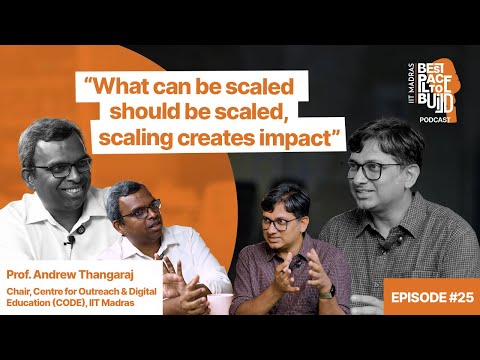
How did this team from IITM quietly build the world's largest edtech platform? | BP2B S1 Ep. 25
Andrew Thangaraj (guest)
In this episode of Best Place To Build, featuring Andrew Thangaraj, How did this team from IITM quietly build the world's largest edtech platform? | BP2B S1 Ep. 25 explores how IIT Madras scaled NPTEL into degrees and national impact NPTEL began in 2000 by recording IIT classroom lectures and distributing them free—well before YouTube and the MOOC wave—to broaden access to IIT-level teaching nationwide.
How IIT Madras scaled NPTEL into degrees and national impact
NPTEL began in 2000 by recording IIT classroom lectures and distributing them free—well before YouTube and the MOOC wave—to broaden access to IIT-level teaching nationwide.
NPTEL’s major inflection point was adding certification via proctored, in-person exams (from 2014), creating employer- and college-trusted credentials that later fit naturally into the government’s SWAYAM portal.
SWAYAM enabled scalable credit transfer across institutions, reducing the friction of bilateral MOUs and helping mainstream online learning in India at a national level.
IIT Madras leveraged NPTEL’s operational know-how to launch low-cost, large-scale BS programs (Data Science and Electronic Systems) using a “wide entry, tough progression” model: qualifier → foundation → diploma → degree.
The BS programs aim to convert high-potential learners—often excluded by JEE coaching economics—into employable graduates, with strong financial support and early skills-first learning validated by projects and vivas.
Key Takeaways
NPTEL succeeded early because it solved a faculty-quality distribution problem.
Recording IIT lectures gave colleges and self-learners nationwide “a peep into IIT classes,” addressing uneven teaching capacity without requiring physical mobility.
Get the full analysis with uListen AI
Proctored exams were the trust-engine that made online credentials mainstream in India.
IITM rejected purely online exams for certification and instead used center-based invigilated tests, aligning with how Indian institutions validate performance and enabling reputation-building at scale.
Get the full analysis with uListen AI
Scale comes from repeatable operations, not just great content.
Running LMS workflows, payments, question paper setting, exam logistics, and evaluation processes (plus in-house execution) created the backbone that later made BS degrees feasible.
Get the full analysis with uListen AI
SWAYAM’s real breakthrough is administrative interoperability (credit transfer).
By standardizing course + certification under a ministry-backed portal, SWAYAM reduces the need for one-off inter-university MOUs, making credit recognition practical at national scale.
Get the full analysis with uListen AI
IITM’s BS model flips the traditional IIT approach: admit wider, filter through learning.
Instead of extreme upfront selection (like JEE), the program uses staged progression—qualifier, foundation, diploma—so motivated learners can prove capability over time and exit with meaningful credentials.
Get the full analysis with uListen AI
Skills-first sequencing improves employability for non-traditional learners.
After foundational math/stats/programming, the diploma emphasizes hands-on projects, application-building, and ML workflows, evaluated with vivas to verify real competence.
Get the full analysis with uListen AI
Democratization doesn’t have to mean diluted quality—if quality is defined by transformation and outcomes.
Thangaraj argues that elite entrance filtering isn’t the same as educational value-add; the BS program’s quality shows in upward mobility, job readiness, and successes like top GATE ranks from BS learners.
Get the full analysis with uListen AI
Notable Quotes
“So whatever we can scale, we should scale.”
— Andrew Thangaraj
“This is before YouTube and all that.”
— Andrew Thangaraj
“We have taken them from zero, literally, and given them every single thing that they know.”
— Andrew Thangaraj
“We wanted to create something which would have a chance of building up a reputation… it has to be followed by a proctored exam.”
— Andrew Thangaraj
“This year, GATE DA paper, Rank 1, Rank 7, and Rank 10 are BS students… First rank… is an AIIMS doctor.”
— Andrew Thangaraj
Questions Answered in This Episode
On certification credibility: What evidence convinced IITM that proctored exams (not online tests) were essential for employer and college acceptance in India?
NPTEL began in 2000 by recording IIT classroom lectures and distributing them free—well before YouTube and the MOOC wave—to broaden access to IIT-level teaching nationwide.
Get the full analysis with uListen AI
On operations: What were the hardest “non-obvious” operational bottlenecks (exam centers, question paper security, grading pipelines, support) when NPTEL scaled to lakhs of test-takers per semester?
NPTEL’s major inflection point was adding certification via proctored, in-person exams (from 2014), creating employer- and college-trusted credentials that later fit naturally into the government’s SWAYAM portal.
Get the full analysis with uListen AI
On learning design: How exactly are the diploma projects and one-hour vivas structured to detect plagiarism and ensure each learner can perform hands-on work independently?
SWAYAM enabled scalable credit transfer across institutions, reducing the friction of bilateral MOUs and helping mainstream online learning in India at a national level.
Get the full analysis with uListen AI
On outcomes: What proportion of BS diploma exiters secure jobs or role changes, and what roles/companies are most common for Data Science versus Electronic Systems?
IIT Madras leveraged NPTEL’s operational know-how to launch low-cost, large-scale BS programs (Data Science and Electronic Systems) using a “wide entry, tough progression” model: qualifier → foundation → diploma → degree.
Get the full analysis with uListen AI
On selection fairness: If the qualifier filters ~25% in and foundation filters ~50% of those, what learner signals best predict who will survive the diploma “huge filter”?
The BS programs aim to convert high-potential learners—often excluded by JEE coaching economics—into employable graduates, with strong financial support and early skills-first learning validated by projects and vivas.
Get the full analysis with uListen AI
Transcript Preview
So it started out by recording classes at IIT, putting it up on the portal, making it free for anybody to access. This is before YouTube and all that. We have taken them from zero, literally, and given them every single thing that they know. At least get a peep into the classes at IIT.
Right.
Because otherwise, IITs are these really tough places to get in. This year, GATE DA paper, Rank 1, Rank 7, and Rank 10 are BS students. First rank, you won't believe it, is an AIIMS doctor. So whatever we can scale, we should scale. [upbeat music]
Hi, my name is Amrit. We've heard that IIT Madras is the best place to build. [upbeat music] So we've come down to the Sudha and Shankar Innovation Hub. We want to meet some people. These are builders. We want to talk to them about their work and also ask them, what makes IIT Madras the best place to build? [upbeat music] Hello, and welcome to The Best Place to Build podcast. Today, our guest with us is Professor Andrew Thangaraj. He's a professor of electrical engineering at IIT Madras, but also is involved in NPTEL, CODE, and the BS degree. So we'll learn a little bit about electrical engineering and a lot about how the other stuff works, uh, the outreach of IIT Madras. Professor, welcome to the podcast.
Thank you. Happy to be here.
Professor, let's start with, uh, uh, what are your research areas? What do you teach? What are the courses where students interact with you?
Yeah, so my research area is in the broad field of information theory, so, uh, sort of theoretical, mathematical-oriented, probability, statistics. So what I teach these days is primarily that. I teach, uh, probability class, which is quite popular with the students. Uh, I teach an information theory class, which is popular with the students as well, and, uh, I'm gonna teach a statistics class as well, so those kind of topics I teach.
Professor, um, I don't know much about it, but I've read that information theory or Shannon's information theory is-
Yeah
... like, a very magical moment in this field.
Yeah.
Can you tell us a little bit about that? [laughing]
So when it started, it was, uh, really magic, because I think people didn't really think of information as a quantity, right? I think, uh, you always think of it as, um, some abstract entity. Uh, so Shannon's work, I think, first quantified information, how much information is there when somebody talks, when somebody sings, when somebody is shooting a movie, et cetera, et cetera. And then not only that, he came up with, uh, algorithms or not, not... Yeah, actually, I shouldn't say he came up with algorithms. He came up with analysis of these algorithms to say, how best you can store information, how best you can process information, how best you can communicate information. These kind of, uh, fundamental limits on how best you can do these things is what Shannon did very, very early on. And today, after so many years of decades of work, uh, today, you can say a lot of algorithms that are currently in existence, in your phone, in your cameras, in your recording devices, are pretty close to the best, uh, that Shannon had predicted. So that way, it is theory, it's mathematics, and it's engineering, all of it coming together wonderfully.
Install uListen to search the full transcript and get AI-powered insights
Get Full TranscriptGet more from every podcast
AI summaries, searchable transcripts, and fact-checking. Free forever.
Add to Chrome