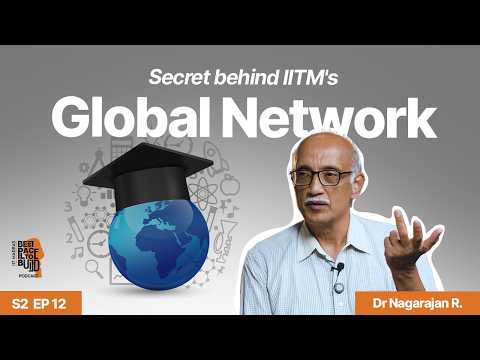
Prof Nagarajan did it all: boosted alum ties, reimagined Heritage Centre & got a Mills & Boon award!
Nagarajan R. (guest)
In this episode of Best Place To Build, featuring Nagarajan R., Prof Nagarajan did it all: boosted alum ties, reimagined Heritage Centre & got a Mills & Boon award! explores how IIT Madras built innovation, alumni power, and campus heritage IIT Madras’s distinctive edge is a vertically integrated innovation pipeline that moves ideas from student tinkering at CFI to pre-incubation (Nirman), entrepreneurship readiness (GDC), incubation, and scaling inside Research Park.
How IIT Madras built innovation, alumni power, and campus heritage
IIT Madras’s distinctive edge is a vertically integrated innovation pipeline that moves ideas from student tinkering at CFI to pre-incubation (Nirman), entrepreneurship readiness (GDC), incubation, and scaling inside Research Park.
The innovation ecosystem has changed campus culture by increasing alumni presence, boosting deep-tech startup formation, and helping students connect classroom fundamentals to real engineering problems.
A major shift over decades is that fewer students pursue higher studies abroad, not due to reduced global competitiveness but because India’s on-campus and domestic opportunities now feel comparably compelling.
IIT Madras professionalized alumni engagement by separating community-building (Alumni Association) from institutional advancement (Alumni & Corporate Relations), contributing to dramatic growth in fundraising and global programs.
Nagarajan’s personal journey—from a Tamil-medium rural background to Yale, IBM, and back to IIT Madras—highlights the value of adaptability, multiple interests, and creative outlets beyond technical work.
Key Takeaways
Build an innovation pipeline, not isolated maker spaces.
IIT Madras’s advantage comes from a staged pathway—prototype, pre-incubate, validate markets, incubate, then scale near industry—so teams don’t stall after early demos.
Get the full analysis with uListen AI
Faculty-triggered creativity is essential for students who “have no idea.”
Nagarajan argues classroom design should kindle creativity early, because creativity in class translates into innovation outside, and faculty can actively nudge ideation.
Get the full analysis with uListen AI
Hands-on projects can improve academic seriousness, not just distract from classes.
Examples like the satellite team show students often start valuing fundamentals once they see direct payoff to building and troubleshooting real systems.
Get the full analysis with uListen AI
A strong alumni network needs clear division of responsibilities.
Separating alumni community-building (association) from fundraising/institutional benefit (advancement) creates both emotional connection and measurable outcomes.
Get the full analysis with uListen AI
Measure engagement before you measure donations.
Verified contactability, reunion attendance, and chapter participation are leading indicators; once alumni are engaged, mentoring, hiring, and giving follow.
Get the full analysis with uListen AI
Industry–academia proximity works when incentives are enforceable.
Research Park’s credit system ties space to meaningful collaboration (internships, sponsored research, lectures), with penalties for non-participation, keeping the ecosystem active.
Get the full analysis with uListen AI
Heritage storytelling strengthens trust, pride, and visitor conversion.
The redesigned Heritage Centre adds “wow factor” via interactive exhibits, AR/video narratives, and a timeline structure—helping outsiders overcome skepticism and helping students/parents feel connected.
Get the full analysis with uListen AI
Notable Quotes
““Walk in with an idea, walk out with a prototype.””
— Nagarajan R.
““Creativity in the classroom translates to innovation outside the classroom.””
— Nagarajan R.
““Alma mater… literally translates to mother of nourishment.””
— Nagarajan R.
““We felt that by going abroad, we could make more money.””
— Nagarajan R.
““You really should not lock yourself into thinking that you will only be happy in one geographical location or even in one profession.””
— Nagarajan R.
Questions Answered in This Episode
In practical terms, what specific course structures or assessments best ‘instill creativity’ in first-year classrooms without diluting fundamentals?
IIT Madras’s distinctive edge is a vertically integrated innovation pipeline that moves ideas from student tinkering at CFI to pre-incubation (Nirman), entrepreneurship readiness (GDC), incubation, and scaling inside Research Park.
Get the full analysis with uListen AI
How does IIT Madras decide which CFI projects graduate into Nirman (10–15 selections)—what are the selection criteria and who evaluates them?
The innovation ecosystem has changed campus culture by increasing alumni presence, boosting deep-tech startup formation, and helping students connect classroom fundamentals to real engineering problems.
Get the full analysis with uListen AI
The ecosystem is described as “mostly deep tech”—what examples best illustrate how IITM startups differ from typical app/service startups, and why?
A major shift over decades is that fewer students pursue higher studies abroad, not due to reduced global competitiveness but because India’s on-campus and domestic opportunities now feel comparably compelling.
Get the full analysis with uListen AI
Research Park’s credit system sounds strict; what were the hardest enforcement cases, and did any major companies actually get removed for failing credits?
IIT Madras professionalized alumni engagement by separating community-building (Alumni Association) from institutional advancement (Alumni & Corporate Relations), contributing to dramatic growth in fundraising and global programs.
Get the full analysis with uListen AI
Fundraising grew from ~50 lakhs/year to ~80 crores and later ~400 crores—what were the 2–3 decisive strategy changes that enabled this curve?
Nagarajan’s personal journey—from a Tamil-medium rural background to Yale, IBM, and back to IIT Madras—highlights the value of adaptability, multiple interests, and creative outlets beyond technical work.
Get the full analysis with uListen AI
Transcript Preview
To me, there are certain things that are quite unique to IIT Madras that I don't find in the other IITs that I have visited. Someone today writing the joint entrance exam, and I'm trying to decide which IIT to go to, I think it's important to have multiple interests in your life, both to prepare for entry into IIT and also to deal with life in case you didn't get into IIT.
But it starts with the students having an idea.
Yes.
What if there is a student who has no idea?
For example, in the US, if you look at the annual salary survey, chemical engineers are always number one, number two, or number three. We felt that by going abroad, we could make more money. I think y- you really should not, uh, lock yourself into thinking that you will only be happy in one geographical location or even in one profession.
Some of the things that students and faculty here are doing are sort of, like, unbelievable to people outside. [upbeat music] Hi, this is Amrit. We are at IIT Madras, my alma mater, and India's top university for people who like to build. We are here to meet some builders, ask them: What are you building? What does it take to build? And what makes IIT Madras the best place to build? [upbeat music] Hello, and welcome to the Best Place to Build Podcast. Today, we are sitting with Professor Nagarajan, recently retired faculty from the chemical engineering department at IIT Madras. He used to be the first dean of international alumni relations at IIT Madras, during a very interesting period in IIT's history. We'll go over it a little bit. Uh, also, if you have come to the campus and seen the new Heritage Center, uh, professor was leading the team that relaunched it, and that- that's why it looks like that today. Um, professor was also in the team that set up CFI, first from the alumni side, and then from the faculty side. So lots to learn, lots to unpack today. Um, uh, welcome, Professor.
Thank you. A- and I'm from chemical engineering, [chuckles]
Yes. [chuckles] Sorry. Uh, you've written two books on chemical engineering, right?
Yes, yes, yes, I have.
We will do that, too.
Sure.
Uh, Professor, I, I have spoken to you over many years on this one topic that is-- uh, that we have discussed and debated a lot, uh, which is that all old IITs are good, but there are some differences. And, um, what is unique about IIT Madras that sets it apart? Would love to hear it again from you for our audience [chuckles] -
Sure
... and discuss it a bit.
Yeah, I mean, if, if I'm, uh, someone today writing the, uh, joint entrance exam, and I'm trying to decide which IIT to go to, I think I, I get input from a lot of people, my parents, my seniors, the coaching school, and so on. But I think, um, y- I, I would expect that I will also try to make that decision somewhat independently by, um, looking at what, what makes each IIT different from the others. And to me, there are certain things that are quite unique to IIT Madras that I don't find in the other IITs that I have visited. Uh, the first one, I would say, i- is the whole innovation ecosystem. In fact, the place we are sitting in, the Center for Innovation, um, is, is on the ground floor of the, um, Sudha and Shankar Innovation Hub. This place didn't exist twenty years ago. In 2006, when we had our silver reunion, I'm class of '81 from IIT Madras, um, Professor Unni Chandy, who was the dean of students at the time, and one of my batchmates, um, Shankar Vaidyanathan, actually did a joint proposal to our batch to fund this center. Their thesis was that you needed a place like this, where, um, students could kind of get together as a team and do something interesting, something innovative, something path-breaking. And they felt that if, if they had a place like this, they would come, and so we agreed. I mean, the batch, um, we were the first batch to walk into a reunion with a 1.4 crore fund raised. And, uh, so we, we did it. We had a voting process, and there were several projects that were presented to us, and we voted. And, um, so back then, I didn't have any association with the alumni activity, so I was, like I said, sitting on the other side of the table. But, uh, the Center for Innovation was a clear winner by almost 70% of it.
Install uListen to search the full transcript and get AI-powered insights
Get Full TranscriptGet more from every podcast
AI summaries, searchable transcripts, and fact-checking. Free forever.
Add to Chrome