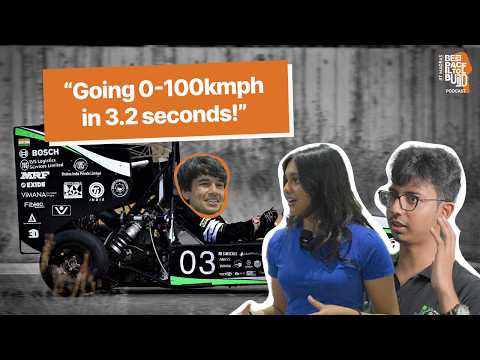
These students make & drive Formula race cars all by themselves? 🤯 | BP2B: Student Edition! Ep.01
Vidhi (host)
In this episode of Best Place To Build, featuring Vidhi, These students make & drive Formula race cars all by themselves? 🤯 | BP2B: Student Edition! Ep.01 explores iIT Madras students build electric Formula car, test, and go autonomous Team Raftar at IIT Madras runs an intensive late-night build-and-test cycle to move from merely “running the car” to systematically optimizing performance for competition.
IIT Madras students build electric Formula car, test, and go autonomous
Team Raftar at IIT Madras runs an intensive late-night build-and-test cycle to move from merely “running the car” to systematically optimizing performance for competition.
The team transitioned from combustion to electric after 2020, achieving strong results (e.g., Formula Bharat podium and design awards) and aiming to win with their newest car, RFR 26.
They describe the technical trade-offs and guiding principles behind the car—minimizing weight, ensuring strength, and maximizing reliability—supported by aggressive redesigns like a battery pack weight cut from ~75 kg to ~40 kg.
Raftar is actively pursuing driverless racing via a one-third scale autonomous test platform to validate perception, SLAM, mapping, and planning before scaling to a full car.
The episode highlights student-built engineering depth across subsystems—patented decoupled suspension, aero with in-house carbon fiber, high-voltage safety redundancies, and competition-driven learning through open collaboration with top global teams.
Key Takeaways
Testing time turns a student build into a real motorsports program.
Raftar emphasizes that getting the car ready early enables repeated tune-test-iterate loops (e. ...
Get the full analysis with uListen AI
Clear principles simplify hard engineering trade-offs.
They use weight, strength, and reliability as decision filters, keeping designs aligned across subteams and preventing performance gains that compromise safety or endurance.
Get the full analysis with uListen AI
Battery design is a major performance lever—especially via weight reduction.
Seeing global benchmarks pushed them from a 75 kg first-gen pack to ~40 kg, illustrating how competition exposure can directly translate into step-change redesign targets.
Get the full analysis with uListen AI
Modern Formula Student is converging on electric and driverless.
They note Europe has removed combustion categories, so their long-term competitiveness depends on building autonomy capabilities—not just improving the electric powertrain.
Get the full analysis with uListen AI
A scaled autonomous platform reduces risk and accelerates learning.
By validating perception, SLAM, mapping, and path planning on a one-third scale “garage-built” car, they can iterate cheaply and then scale the stack to the full-size vehicle.
Get the full analysis with uListen AI
Vehicle dynamics wins are often about controlling motion, not just adding power.
Their decoupled suspension targets better pitch/roll control to protect aero stability under braking and cornering, preserving grip and driver confidence.
Get the full analysis with uListen AI
Safety constraints shape design details as much as performance goals.
Rules like 5-second egress drive features such as a quick-release steering wheel, while HV disconnects and redundant electrical checks mitigate post-crash hazards.
Get the full analysis with uListen AI
Notable Quotes
“Our zero to 100 acceleration time is under four seconds… comparable to a Porsche 911.”
— Aditya (Team Captain)
“In 2020… we decided that now is the time, let’s shift to electric.”
— Aditya (Team Captain)
“In the competition… the driver should get out of the car within five seconds from a fully harnessed position.”
— Aditya (Team Captain)
“You have checks, you have checks to check those checks.”
— Aditya (Team Captain)
“I kind of trust the team… I was more scared about crashing it.”
— DJ (Driver)
Questions Answered in This Episode
What specifically changed in your design process this year that allowed an earlier-ready car and a longer tuning window?
Team Raftar at IIT Madras runs an intensive late-night build-and-test cycle to move from merely “running the car” to systematically optimizing performance for competition.
Get the full analysis with uListen AI
You say the car is designed for 154 km/h but you’ve hit 90–100 on track—what are the limiting factors (track layout, gearing, thermal limits, traction)?
The team transitioned from combustion to electric after 2020, achieving strong results (e. ...
Get the full analysis with uListen AI
Can you break down how your launch control approach (fuzzy logic vs sliding mode) will be validated during testing, and what success metrics you’ll use?
They describe the technical trade-offs and guiding principles behind the car—minimizing weight, ensuring strength, and maximizing reliability—supported by aggressive redesigns like a battery pack weight cut from ~75 kg to ~40 kg.
Get the full analysis with uListen AI
Your battery pack dropped from ~75 kg to ~40 kg—what trade-offs did you make (cell choice, enclosure, cooling, safety margins), and what was hardest to redesign?
Raftar is actively pursuing driverless racing via a one-third scale autonomous test platform to validate perception, SLAM, mapping, and planning before scaling to a full car.
Get the full analysis with uListen AI
You mention a patented decoupled suspension—what are the real-world lap-time or consistency gains you’ve observed versus a conventional setup?
The episode highlights student-built engineering depth across subsystems—patented decoupled suspension, aero with in-house carbon fiber, high-voltage safety redundancies, and competition-driven learning through open collaboration with top global teams.
Get the full analysis with uListen AI
Transcript Preview
We're actually comparable to a Porsche 911 in terms of our acceleration time. Uh, but if you look at the modern electric cars, like Teslas and, uh, Cybertrucks and stuff, they can do much faster than this. The driver should get out of the car within five seconds from a fully harnessed position.
Hi, guys. Welcome to The Best Place To Build: Student Edition. I'm Vidhi, a fifth-year student in IIT Madras. Today, we're at the Center for Innovation, CFI, with the Raftar Student Formula racing team. Today, they're about to test their car, so let's go find out more. [upbeat music] I'm here with Aditya, the team captain. He's a fourth-year student from electrical engineering. So Aditya, what's happening here in the background right now as we stand?
Uh, so we tested the car yesterday. All the tasks that have been found out yesterday, all the issues with the car, the team members tried to fix it by 9:00 PM, so that post, uh, all the daily meetings, we can complete all the tasks and check if the car is running, and then aim for a rollout at 12:00 AM. That's what we're doing right now.
And typically, how long do you guys spend working on the car every day? And is it different during testing periods?
Uh-
Does it get more hectic?
So yeah, obviously. Uh, I mean, during testing periods, it's just that, uh, you have to spend an extra three hours after 12:00 AM because you're running the car. Otherwise, on a week night, it's usually... uh, we have daily meetings at 9:00 PM, and then the team, uh, team members just work on whatever task they're allotted, and they typically go back around 1:00 AM, 12:00 AM, around that time.
Sounds a little rough, but [chuckles] yeah, everyone seems to be driven-
I mean, it's their passion, so.
When I think of, like, a race car team, the first question that pops in my head, and I think in a lot of people's heads, is, like, what's the top speed?
Okay.
What's the fastest that the car can go?
It's designed to reach a top speed of 154 kilometers per hour.
Wow.
But on track, we've only hit around 90 to 100. Uh, the track has a maximum straight line of only 75 meters, so it's more about the acceleration. So our zero to 100 acceleration time is under four seconds on this car. We're actually comparable to a Porsche 911 in terms of our acceleration time. Uh, but if you look at the modern electric cars, like Teslas and, uh, Cybertrucks and stuff, they can do much faster than this.
And you mentioned going electric, so was this a recent change for you guys, or since when have you been switching?
Um, so this team started off in 2012 as a combustion team. In 2020, after the lockdown, uh, we noticed that, okay, the world's shifting now, and we decided that now is the time, let's shift to electric.
Install uListen to search the full transcript and get AI-powered insights
Get Full TranscriptGet more from every podcast
AI summaries, searchable transcripts, and fact-checking. Free forever.
Add to Chrome