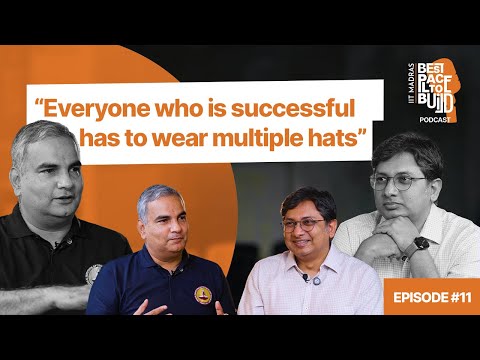
Prof. Raghunathan, Dean, Global Engagement | “Everyone successful wears multiple hats”| Ep. 11
Unknown Host (host)
In this episode of Best Place To Build, featuring Unknown Host, Prof. Raghunathan, Dean, Global Engagement | “Everyone successful wears multiple hats”| Ep. 11 explores professor Raghu on global campuses, AI, and academic multitasking today Professor Raghu contrasts IIT Madras student life in the late 1980s—fun, security, and low pressure—with today’s higher-stakes, higher-pressure environment.
Professor Raghu on global campuses, AI, and academic multitasking today
Professor Raghu contrasts IIT Madras student life in the late 1980s—fun, security, and low pressure—with today’s higher-stakes, higher-pressure environment.
He explains chemical engineering as the discipline of scaling chemistry to safe, efficient bulk manufacturing, and describes his early pivot into AI via expert systems built from rule-based “knowledge shells.”
He outlines his academic career across IIT Bombay and multiple US universities, emphasizing mentorship, departmental culture, and the practical tradeoffs that led him back to IIT Madras.
As Dean of Global Engagement, he describes four operating verticals—academic programs, research collaborations, international conferences, and Institute of Eminence administration—shifting from “bringing the world to IITM” to “taking IITM to the world.”
He details IIT Madras Zanzibar as a full-stack microcosm of IITM (teaching, research, skilling, consultancy, innovation) plus a newer IITM Global initiative aimed at exporting IITM’s research, IP, and startup ecosystem via international outposts.
Key Takeaways
Chemical engineers turn lab reactions into scalable, safe production.
Raghu frames chemical engineering as “making things in bulk,” where mixing, heat transfer, safety, and scale effects change dramatically from test tubes to industrial reactors.
Get the full analysis with uListen AI
Early AI in engineering often started as rule-based expert systems.
His entry into AI came from building an expert system with ~150–200 rules for selecting vapor–liquid equilibrium models, illustrating how “old AI” enabled structured decision-making before modern ML.
Get the full analysis with uListen AI
Great teaching can be built around a unifying ‘central principle.’
He wrote his process control book after repeatedly refining the course to revolve around one core mathematical idea (partial fractions of transfer functions) and only adding concepts when necessary.
Get the full analysis with uListen AI
Writing technical books demands accuracy pressure beyond classroom teaching.
He notes that mistakes can be corrected live in class, but persist “forever” in print, requiring years of iteration and painstaking example-checking—often during rare time windows like COVID or jet lag.
Get the full analysis with uListen AI
Global academic strategy should prioritize intent and excellence pockets over rankings.
He argues against rigid rank-based partnering, because niche strengths and the right collaborators can exist anywhere, especially in emerging or interdisciplinary areas.
Get the full analysis with uListen AI
IIT Madras Zanzibar is designed as a full-fledged IITM microcosm, not a ‘degree shop.’
Beyond degrees, the plan includes research, skilling, consultancy, and incubation, with international admissions and a rotating global faculty model to build a truly international campus from day one.
Get the full analysis with uListen AI
Modern successful faculty roles are inherently multi-hatted and cumulative.
Teaching, research, grants, people management, administration, and innovation stack rather than replace each other; he recommends strong time management and emotional equanimity toward success/failure.
Get the full analysis with uListen AI
Notable Quotes
“Chemical engineers make things in bulk.”
— Prof. Raghunathan
“He was like a catalyst.”
— Prof. Raghunathan
“In a book, it’s there forever.”
— Prof. Raghunathan
“Most successful faculty have to wear multiple hats.”
— Prof. Raghunathan
“We’ve not gone… with the idea that I’m coming to uplift people… we are learning from each other.”
— Prof. Raghunathan
Questions Answered in This Episode
For IITM Zanzibar, what concrete milestones define success in year 3 and year 5 (research output, placements, faculty hiring, partnerships)?
Professor Raghu contrasts IIT Madras student life in the late 1980s—fun, security, and low pressure—with today’s higher-stakes, higher-pressure environment.
Get the full analysis with uListen AI
How does the Zanzibar admissions test and interview process benchmark against JEE in terms of rigor and diversity goals?
He explains chemical engineering as the discipline of scaling chemistry to safe, efficient bulk manufacturing, and describes his early pivot into AI via expert systems built from rule-based “knowledge shells.”
Get the full analysis with uListen AI
What are the hardest ‘culture + academic governance’ missteps you actively try to avoid when operating an IIT-style campus abroad?
He outlines his academic career across IIT Bombay and multiple US universities, emphasizing mentorship, departmental culture, and the practical tradeoffs that led him back to IIT Madras.
Get the full analysis with uListen AI
You said rankings aren’t the main criterion—what evaluation framework do you use to choose global partner universities in practice?
As Dean of Global Engagement, he describes four operating verticals—academic programs, research collaborations, international conferences, and Institute of Eminence administration—shifting from “bringing the world to IITM” to “taking IITM to the world.”
Get the full analysis with uListen AI
What does ‘academic matchmaking’ look like operationally for visiting students—who decides course seat allocation and credit transfer rules?
He details IIT Madras Zanzibar as a full-stack microcosm of IITM (teaching, research, skilling, consultancy, innovation) plus a newer IITM Global initiative aimed at exporting IITM’s research, IP, and startup ecosystem via international outposts.
Get the full analysis with uListen AI
Transcript Preview
so that's a big pressure, actually. People might not realize, because we don't want to be saying wrong things, uh-
So Professor Anand was like the forcing function?
He was like the catalyst.
Catalyst. Oh, I missed that. Yeah, the catalyst. Uh-
You're a mechanical engineer, right?
Yes, yes. Yeah, uh, that. [upbeat music]
Hi, my name is Amrit. We've heard that IIT Madras is the best place to build. [upbeat music] So we've come down to the Sudha and Shankar Innovation Hub. We want to meet some people. These are builders. We want to talk to them about their work, and also ask them, what makes IIT Madras the best place to build? [upbeat music]
Hello, and welcome to the Best Place to Build podcast. Today, we are sitting with Professor Raghu. He's a professor at IIT Madras in the Department of Chemical Engineering and the Department of Data Science and AI, so that's two departments. And, uh, he's also a well-published researcher. He's written two books. Uh, we'll explore that. He's also the Dean for Global Engagement, and we'll explore what that means. In addition, one final piece of introduction, he's also an alumnus of IIT Madras from, I think, the batch of 1990. Is that correct, Professor? Welcome to the podcast.
Thank you, Amrit.
Uh, Professor, let's start with your student days. So you were a profe- you were a student here from '80, '85 to 1990?
'86 to '90.
Okay. Can you tell us about how your days were at IIT Madras? And also, since you're now a professor, how has times changed?
Uh, so I don't go to hostels much now, so I don't know what's the scene in the hostel. But, uh, our days, it was, uh, a lot of fun. I still remember my four years as the best times of my life here at IIT Madras. Um, we used to study, uh, we used to do well in academics, but at the same time, there was really not much pressure, uh, compared to now. I think that's something that has changed. We were very secure about what we'll get after finishing. There were never any doubts about, uh, what life holds for us. Uh, the brash, young, uh, IITian those days. We used to have fantastic times. We used to play TT till, uh, 2:30 AM, 3:00 in the night in the common room. We used to have these cricket competitions in the quadrangle, and so on. I, I simply remember those days as about some of the best times of my life.
Uh, I have to ask you, which hostel were you in?
Narmada.
Narmada, okay.
The best hostel. [laughs]
Oh, okay. [laughs]
Uh, [chuckles] we had several, uh, six-a-side competitions that we won, I think nine or something.
Was it, was it called Schroeder back then?
Schroeder was the overall cup, but, uh, the competition that was very popular was six-a-side.
Okay.
It's not there anymore, I think. Uh, it used to be played opposite Quark, uh, and, uh, Narmada was the best. In fact, we had such a strong set of players, we had Narmada A and B.
Install uListen to search the full transcript and get AI-powered insights
Get Full TranscriptGet more from every podcast
AI summaries, searchable transcripts, and fact-checking. Free forever.
Add to Chrome