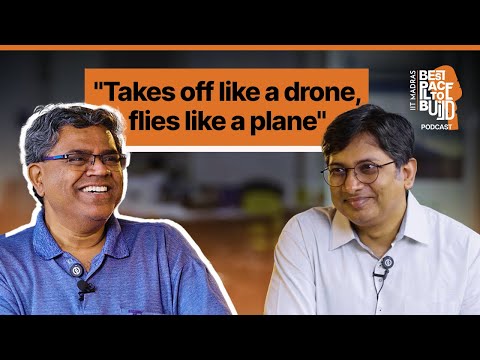
Prof. Satya Chakravarthy| "Takes off like a drone, flies like a plane"| Ep. 7 | IIT Madras
Satya Chakravarthy (guest)
In this episode of Best Place To Build, featuring Satya Chakravarthy, Prof. Satya Chakravarthy| "Takes off like a drone, flies like a plane"| Ep. 7 | IIT Madras explores iIT Madras professor on deep tech startups in aerospace, mobility Chakravarthy argues students should “follow your heart” because today’s opportunities exist across fields, not just computer science, and the internet has leveled global awareness and ambition.
IIT Madras professor on deep tech startups in aerospace, mobility
Chakravarthy argues students should “follow your heart” because today’s opportunities exist across fields, not just computer science, and the internet has leveled global awareness and ambition.
The ePlane Company is developing an electric VTOL that takes off like a drone and flies like a plane, optimized for short intra-/peri-city routes, targeting early commercial operations around late 2026.
He explains core eVTOL constraints—battery energy density and power delivery during vertical takeoff/landing—and the engineering levers that still meaningfully improve range and economics.
He frames India’s aerospace evolution as four waves—government R&D, MNC R&D, manufacturing, and now startups—enabled by talent depth, affordability-driven innovation, and a maturing VC ecosystem.
He highlights IIT Madras’ “culture of building” and large test infrastructure at the Thaiyur (Discovery) campus, including rocket test facilities and a 400m+ Hyperloop vacuum tube that can attract global teams.
Key Takeaways
Pick the field you care about; the market is broader than you think.
Chakravarthy’s core heuristic is “follow your heart,” arguing that unlike earlier decades, viable high-impact opportunities now exist in many domains (including aerospace) due to globalized knowledge and growing Indian ecosystems.
Get the full analysis with uListen AI
eVTOLs win first on short-range, high-friction commutes—not intercity routes.
He positions eVTOLs as best for ~30–60 km trips (e. ...
Get the full analysis with uListen AI
Battery limits are real, but aerodynamic/structural engineering still buys range.
Instead of waiting for a battery breakthrough, ePlane focuses on aerodynamics, lightweighting, and motor improvements; he cites current ~250 Wh/kg packs and notes fuel is ~15,000 Wh/kg equivalent, underscoring why optimization matters.
Get the full analysis with uListen AI
Vertical takeoff is a power problem as much as an energy problem.
He distinguishes power (rate of energy use) from energy (total), explaining VTOL phases demand high instantaneous power and add aerodynamic “draggy contraptions,” raising the engineering bar versus conventional takeoff aircraft.
Get the full analysis with uListen AI
In aviation, certification is a core product feature, not a paperwork afterthought.
He emphasizes that civilian aviation is regulated down to minor components for safety reasons, and that a meaningful share of effort is navigating compliance to achieve airline-grade reliability.
Get the full analysis with uListen AI
Indian deep-tech fundraising often depends on global precedent and comparables.
He claims many Indian investors are reluctant to fund ideas not validated elsewhere; eVTOL fundraising becomes easier because multiple global players exist (even if many are only “PowerPoint level”).
Get the full analysis with uListen AI
India’s aerospace sector is entering a startup wave after R&D and manufacturing waves.
He outlines four phases: pre-2000 government (ISRO/DRDO/HAL), 2000s MNC R&D (Boeing/GE etc. ...
Get the full analysis with uListen AI
Affordability-first innovation can be India’s strategic edge in frontier mobility.
He contrasts US innovation that can ignore affordability (e. ...
Get the full analysis with uListen AI
World-class test infrastructure can pull global ecosystems toward India.
He repeatedly notes that facilities like the 400m+ vacuum tube for Hyperloop and combustion/microgravity infrastructure can make IITM/Thaiyur a destination for international teams and collaborations.
Get the full analysis with uListen AI
Notable Quotes
“In my view, the universal principle is follow your heart.”
— Satya Chakravarthy
“It takes off and lands like a drone… but flies forward like a plane.”
— Satya Chakravarthy
“There are hundreds of eVTOL companies at the PowerPoint level.”
— Satya Chakravarthy
“With GalaxEye, we have run out of excuses for not imaging the world 24 by 7.”
— Satya Chakravarthy
“You need to be impatient to break the barrier… but once you set yourself up… you’ve got to be patient to do it.”
— Satya Chakravarthy
Questions Answered in This Episode
ePlane says it builds the “shortest-winged eVTOLs in the world”—what are the explicit aerodynamic and stability trade-offs, and how do you mitigate them?
Chakravarthy argues students should “follow your heart” because today’s opportunities exist across fields, not just computer science, and the internet has leveled global awareness and ambition.
Get the full analysis with uListen AI
You mention ~250 Wh/kg today and a chemistry you’re working on that could reach ~2,000 Wh/kg—what’s the underlying chemistry direction, and what are the safety/cycle-life hurdles?
The ePlane Company is developing an electric VTOL that takes off like a drone and flies like a plane, optimized for short intra-/peri-city routes, targeting early commercial operations around late 2026.
Get the full analysis with uListen AI
For eVTOL certification in India, which specific DGCA certification basis and standards are you aligning to, and what are the biggest unknowns for eVTOLs versus conventional aircraft?
He explains core eVTOL constraints—battery energy density and power delivery during vertical takeoff/landing—and the engineering levers that still meaningfully improve range and economics.
Get the full analysis with uListen AI
You argued hybrid powertrains may be economically unattractive due to complexity—under what mission profiles (range, payload, utilization) would hybrid or fuel cells actually win?
He frames India’s aerospace evolution as four waves—government R&D, MNC R&D, manufacturing, and now startups—enabled by talent depth, affordability-driven innovation, and a maturing VC ecosystem.
Get the full analysis with uListen AI
Hyperloop Chennai–Bangalore in 15–25 minutes at ~₹1,500–₹2,500: what assumptions drive this (capex amortization, ridership, energy costs, tube maintenance), and which are most fragile?
He highlights IIT Madras’ “culture of building” and large test infrastructure at the Thaiyur (Discovery) campus, including rocket test facilities and a 400m+ Hyperloop vacuum tube that can attract global teams.
Get the full analysis with uListen AI
Transcript Preview
The Agnikul 3D printed rocket packs more, more technology than the largest of the rockets. In my view, the universal principle is follow your heart. In, in good time, we will actually get Hyperloop to actually do Chennai, Bangalore in 15 to 20 minutes. We build the shortest winged eVTOLs in the world, so that we will be able to land in highly tight spaces, and pick you up from where you are, take you to where you want to go. So we are, we are looking at first commercial flights happening sometime in 2026. [upbeat music]
Hi, my name is Amrit. We've heard that IIT Madras is the best place to build. [upbeat music] So we've come down to the Sudha and Shankar Innovation Hub. We want to meet some people. These are builders. We want to talk to them about their work, and also ask them, what makes IIT Madras the best place to build? [upbeat music] Hello, and welcome. This is the Best Place to Build podcast. Today, we are with Dr. Satya Chakravarthy. He's a professor at IIT Madras in Aeronautical Department. Uh, he's also a co-founder in multiple companies, including The ePlane Company, and we'll talk about it a lot today. He's the head of the National Centre for Combustion Research and Development at IIT Madras. Welcome, Professor Satya. Uh, good morning, and, uh, before anything, I want to know... I mean, I think we should start from the very beginning, and you were a student at IIT Madras, right? Which years were you here? How was insti like back then? And, uh, most, uh, interesting to me would be to know if insti lingo was still a thing then, and how did it sound like?
Well, yeah, I was, uh, here as a BTech student, uh, in aerospace, uh, from 1987 to 1991. I was in, uh, Alak, is the hostel in which I was. Um, insti lingo was huge, uh, back then when compared to what I can see now, uh, to the extent I can interact with students, but students won't talk the lingo to me. [chuckles] So I think the insti was, like, far more laid back when compared to what it is today.
Did you have, uh, the culture of giving nicknames? Did you have a nickname?
I did. I do- I still do. I still do carry the nickname.
Can I... May I ask?
Yeah, it is, it's, it's a, it's a very nice nickname to have. It's, it's... I, I was called Mama.
You were called Mama. And is there a funda behind it?
Um, maybe I was actually a bit bigger than other people.
Ah, okay. [chuckles] Nice. Damn cool. Um, when you say insti was more laid back, uh, what, what do you mean? Like, was there lesser academic pressure? Was there less... I, I don't know what that means.
We did not feel academic pressure as such. Um, but, uh, uh, academics was difficult. Uh, we had to, we- particularly in aero. Aero is actually an extremely difficult branch to be in, uh, it- while you are a student, but you really enjoy what you're doing once you get out of there, um, and so on. Because you have to get down to things like, uh, some fourth-order partial differential equations and all of those sets. It's, it's highly mathematical now. So we enjoyed doing that, but, uh, they, they will, they will give you assignments. You have to keep beyond the toes and stuff, but it was not exactly like pressure, it was just work. And, uh, uh, professors were actually a lot more laid back, uh, as I could see. Um, they were a lot more approachable back then, or at least we- you don't see students approaching us as much [chuckles] today. I don't know why, and so on. Yeah. So there is, there is, uh, de- definitely, uh, something a bit more personal back then when compared to a bit more impersonal these days.
Install uListen to search the full transcript and get AI-powered insights
Get Full TranscriptGet more from every podcast
AI summaries, searchable transcripts, and fact-checking. Free forever.
Add to Chrome