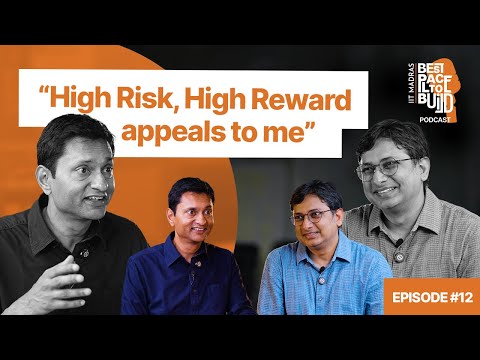
Anand Rajaraman| The IIT Madras founder who sold to Amazon & Walmart; Now owns a cricket team| Ep.12
In this episode of Best Place To Build, Anand Rajaraman| The IIT Madras founder who sold to Amazon & Walmart; Now owns a cricket team| Ep.12 explores anand Rajaraman on building Junglee, VC, and US cricket bets Rajaraman explains how Junglee emerged from Stanford data-integration research to pioneer comparison shopping and was acquired by Amazon in 1998, where the team helped build the Marketplace model.
Anand Rajaraman on building Junglee, VC, and US cricket bets
Rajaraman explains how Junglee emerged from Stanford data-integration research to pioneer comparison shopping and was acquired by Amazon in 1998, where the team helped build the Marketplace model.
He shares the quirky origin of the name “Junglee,” how early VCs often dismissed student founders, and how The Washington Post became a key investor despite disliking the brand.
He describes his motivation for “zero to one” work through first-principles thinking—challenging hidden assumptions to find non-obvious solutions.
He outlines why cricket can work in the US now—critical mass of fans (especially South Asian diaspora), T20’s TV-friendly format, and the rise of Major League Cricket with prominent owners and global talent.
He demystifies venture capital mechanics and contrasts network-driven investing with Rocketship’s data/ML-driven approach to proactively identify startups beyond personal networks.
Key Takeaways
Research-to-product translation can create category-defining startups.
Junglee began as an academic data-integration idea applied to the web, leading to early comparison shopping—showing how a clear use case can turn “systems research” into a mass-market product.
Get the full analysis with uListen AI
Early-stage success often depends on unconventional capital sources.
Traditional VCs were hesitant to back student founders in the mid-90s; Junglee’s meaningful backing came from The Washington Post as a strategic customer-investor who saw disruption coming.
Get the full analysis with uListen AI
Naming and narrative matter, but momentum matters more.
“Junglee” was chosen opportunistically (domain + memorability) and justified afterward with a story; even a skeptical lead investor ultimately didn’t force a rebrand once execution progressed.
Get the full analysis with uListen AI
First-principles thinking is about surfacing and challenging hidden axioms.
Rajaraman frames it as questioning unstated assumptions baked into how a community solves a problem, which can unlock entirely different solution paths and “zero-to-one” opportunities.
Get the full analysis with uListen AI
Cricket’s US growth thesis rests on format-market fit and an initial beachhead audience.
T20 aligns with a ~3-hour entertainment window, while a sizable diaspora fan base provides the initial demand needed to build a league and expand outward to broader US audiences.
Get the full analysis with uListen AI
VC is a portfolio game; entrepreneurship is a concentrated bet.
He contrasts investor risk management (20–25-company portfolios where most fail but a few return 10–100x) with the founder reality of putting “all eggs in one basket” but retaining control.
Get the full analysis with uListen AI
Data can replace (or augment) networks in venture sourcing.
Rocketship’s approach builds a global startup-activity database and uses ML to identify promising companies, flipping the standard model by reaching out to founders rather than waiting for intros.
Get the full analysis with uListen AI
Universities can be engines for deep-tech startups when mentorship and seed funding exist.
His teaching and research proximity led to investments like Aster Data, while IIT Madras initiatives (e. ...
Get the full analysis with uListen AI
India’s opportunity improved dramatically since the early 90s across talent and market size.
He argues the shift is visible in outcomes: earlier cohorts overwhelmingly left for the US, whereas today many more stay because India now offers both a large adoption-ready market and strong technical talent.
Get the full analysis with uListen AI
For students/parents, branch choice is less important than the network and problem-solving training.
Rajaraman calls branches “artificial,” emphasizing IIT’s peer cohort, faculty, alumni network, and the ability to become a general problem solver as the enduring advantages.
Get the full analysis with uListen AI
Notable Quotes
““So that's how we ended up investing in Facebook.””
— Anand Rajaraman
““To boldly go where no one has gone before.””
— Anand Rajaraman
““The Internet is a jungle, and you need a creature of the jungle to help you… navigate.””
— Anand Rajaraman
““You gotta be in an opportunity-rich environment.””
— Anand Rajaraman
““These branches at IIT, they're very artificial, and they're completely meaningless.””
— Anand Rajaraman
Questions Answered in This Episode
Junglee helped build Amazon Marketplace—what were the hardest product/engineering decisions in making third-party selling work at early Amazon scale?
Rajaraman explains how Junglee emerged from Stanford data-integration research to pioneer comparison shopping and was acquired by Amazon in 1998, where the team helped build the Marketplace model.
Get the full analysis with uListen AI
You said most VCs rejected student founders in 1996–97—what specific objections did you hear, and what evidence finally changed minds?
He shares the quirky origin of the name “Junglee,” how early VCs often dismissed student founders, and how The Washington Post became a key investor despite disliking the brand.
Get the full analysis with uListen AI
In your definition of first-principles thinking, what are the “hidden assumptions” in today’s AI/startup hype that founders should explicitly challenge?
He describes his motivation for “zero to one” work through first-principles thinking—challenging hidden assumptions to find non-obvious solutions.
Get the full analysis with uListen AI
Major League Cricket: what are the key constraints to mainstream US adoption (stadiums, broadcast, youth participation, rules complexity), and which is the bottleneck?
He outlines why cricket can work in the US now—critical mass of fans (especially South Asian diaspora), T20’s TV-friendly format, and the rise of Major League Cricket with prominent owners and global talent.
Get the full analysis with uListen AI
How do MLC teams decide whether to target diaspora fans vs. converting new American sports fans, and what marketing experiments have worked so far?
He demystifies venture capital mechanics and contrasts network-driven investing with Rocketship’s data/ML-driven approach to proactively identify startups beyond personal networks.
Get the full analysis with uListen AI
Transcript Preview
to boldly go where no one has gone before.
Yeah.
So that's how we ended up investing in Facebook.
That's why we decided to name the company Junglee.
Washington Post ended up investing in us, but then they told us, "Look, we don't like the name of your company. It doesn't sound corporate enough."
So Yahoo! was the one company that was ahead of us. [upbeat music]
Hi, my name is Amrit.
We've heard that IIT Madras is the best place to build. [upbeat music] So we've come down to the Sudha and Shankar Innovation Hub. We want to meet some people. These are builders. We want to talk to them about their work, and also ask them, what makes IIT Madras the best place to build? [upbeat music] Hi, welcome to The Best Place to Build podcast. Today, we are sitting with Anand Rajaraman, alumnus of IIT Madras from '93 batch. He's a deep tech investor and entrepreneur, a tech entrepreneur, and recently a founder- or no, founder, a, a sports entrepreneur. Would that be right?
Yeah, I think that's a fair way of describing it. Actually, uh, the traditional way is maybe a sports team owner.
Sports team owner. So welcome to the podcast, Anand, and we would love for you to just introduce yourself a little bit, and then we'll get started.
I'm, uh, an alumnus of IIT Madras, uh, class of '93. It's amazing to be back on campus today, by the way. I was just... Uh, I came in early, uh, and I just realized that today there's Saarang going on. It's the last day. Uh, you know, the- we- it used to be called Mardi Gras when, uh, I was, uh, on campus. Uh, and I still haven't gotten used to this new name, by the way, Saarang. Uh, but it was just, you know, so nice to just wander around the campus and see the energy and all the stalls and-
Yeah
... uh, and all those-
It's the most colorful day on campus.
The most colorful day, for sure, and also with great weather for, you know, frankly, because I think it rained yesterday, so the weather's nice. It's sort of very magical to be on, uh, on campus today. So that's, that's kind of a detour, but so class of '93, uh, IITM, and then, uh, and after that, uh, I went to the, uh, US to Stanford to do my grad school. Uh, but then I got sidetracked along the way and started a company, um, and then got into investing in startups. Um, and, uh-
Uh, wait, can I stop you there?
Right.
When I, when I joined Insti in 2003, 2008, I stayed from 2003 to '8, your first startup journey was like a big success story for us, and we used to hear about it a lot.
Right.
Uh, and this is, of course, the story of Junglee, uh, which you sold to Amazon, and then you were with Amazon for a while.
Install uListen to search the full transcript and get AI-powered insights
Get Full TranscriptGet more from every podcast
AI summaries, searchable transcripts, and fact-checking. Free forever.
Add to Chrome