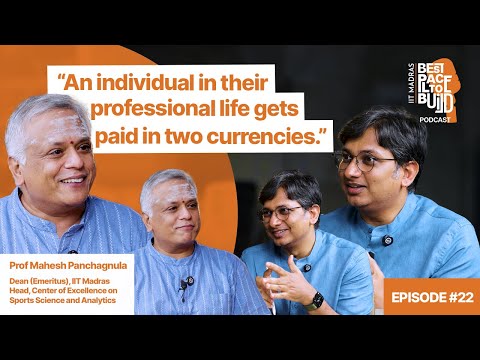
Dr. Mahesh Panchagnula |"An individual in their professional life gets paid in 2 currencies"| Ep. 22
Dr. Mahesh V. Panchagnula (guest), Amrut (host)
In this episode of Best Place To Build, featuring Dr. Mahesh V. Panchagnula and Amrut, Dr. Mahesh Panchagnula |"An individual in their professional life gets paid in 2 currencies"| Ep. 22 explores iIT Madras’ builder-professor on sports, research, and institutional ecosystems IIT Madras’ Sports Excellence Admissions program admits JEE-Advanced-qualified athletes and uses sports excellence to decide branch allocation, aiming to diversify the student body and improve campus health culture.
IIT Madras’ builder-professor on sports, research, and institutional ecosystems
IIT Madras’ Sports Excellence Admissions program admits JEE-Advanced-qualified athletes and uses sports excellence to decide branch allocation, aiming to diversify the student body and improve campus health culture.
The initiative moved quickly through IITM’s internal academic governance (departments, BAC, Faculty Senate, Board of Governors), countering the idea that IITs are inherently bureaucratic.
Panchagnula’s Center of Excellence in Sports Science and Analytics (CESSA) grew from data/AI work like ESPN Cricinfo’s “Smart Stats” into Olympic-aligned R&D across sports such as boxing, archery, and shooting.
He describes India—especially IIT Madras—as unusually enabling for faculty to reinvent themselves across domains (sports analytics, crowd dynamics, aerosols/lung function), due to funding, opportunity, and institutional openness.
Beyond salary, he argues academics are “paid in two currencies”—money and societal goodwill—while highlighting IITM’s strong incentives for patents, industry consultancy, startups, scholarships, and student information initiatives like ASK IITM.
Key Takeaways
IITM’s sports admissions is diversification, not dilution.
Athletes must still qualify JEE Advanced; sports excellence mainly determines branch choice, while the program’s broader goal is to change campus culture via a small but visible cohort (eventually ~32 of ~1200 intake).
Get the full analysis with uListen AI
IIT governance can be fast when the idea is well-shepherded.
Panchagnula outlines a clear internal path—BAC scrutiny, Faculty Senate debate (with student members), then Board of Governors approval—showing that major changes can be institutionalized without external bureaucracy.
Get the full analysis with uListen AI
Sports tech is bigger than “Moneyball”—it spans full-stack performance support.
CESSA’s mandate goes beyond dashboards to include sensors, biomechanics, analytics, and even psychological edge, working with SAI, federations, and pro teams to raise elite performance.
Get the full analysis with uListen AI
A real “center” often starts with a credible, shippable project.
The Smart Stats work for ESPN Cricinfo served as a proof point that IITM could build deployable sports analytics products, creating momentum and legitimacy for forming CESSA.
Get the full analysis with uListen AI
India can be unusually good for academic reinvention right now.
He contrasts the US ecosystem’s depth and specialization with India’s current opportunity: significant funding for new ideas and fewer people positioned to pursue them, enabling cross-domain work.
Get the full analysis with uListen AI
Faculty compensation includes an invisible, powerful social currency.
He argues professional life pays in money plus societal goodwill; in India, IIT faculty receive exceptional respect and access, which he views as non-fungible and career-enabling.
Get the full analysis with uListen AI
IITM operationalizes “build” via incentives and infrastructure.
Examples include a highly inventor-friendly IP policy (he cites ~72% of upside returning to inventors), strong consultancy frameworks, and a mature incubation model that supports insiders and credible outsiders.
Get the full analysis with uListen AI
Notable Quotes
“An individual in their professional life gets paid in two currencies.”
— Dr. Mahesh V. Panchagnula
“No US faculty member gets the kind of respect in their ecosystem that an Indian faculty member gets within India.”
— Dr. Mahesh V. Panchagnula
“Sports excellence is just the jhaanki. Picture abhi baaki hai.”
— Dr. Mahesh V. Panchagnula
“We wanted to bring the math that we had learned in fluid dynamics to crowd flow, primarily to understand how stampedes start.”
— Dr. Mahesh V. Panchagnula
“You can choose your axis of excellence, and every one of them has their own reward structure at IIT Madras.”
— Dr. Mahesh V. Panchagnula
Questions Answered in This Episode
How exactly does “sports excellence decides the branch” work in practice—what’s the selection rubric and who sits on the evaluation panel?
IIT Madras’ Sports Excellence Admissions program admits JEE-Advanced-qualified athletes and uses sports excellence to decide branch allocation, aiming to diversify the student body and improve campus health culture.
Get the full analysis with uListen AI
What academic accommodations or scheduling supports are in place so Sports Excellence admits can train rigorously without falling behind in coursework?
The initiative moved quickly through IITM’s internal academic governance (departments, BAC, Faculty Senate, Board of Governors), countering the idea that IITs are inherently bureaucratic.
Get the full analysis with uListen AI
CESSA aligns to TOPS sports like boxing, archery, and shooting—what are 2–3 concrete projects and measurable performance improvements you’re targeting?
Panchagnula’s Center of Excellence in Sports Science and Analytics (CESSA) grew from data/AI work like ESPN Cricinfo’s “Smart Stats” into Olympic-aligned R&D across sports such as boxing, archery, and shooting.
Get the full analysis with uListen AI
Smart Stats changed fan engagement on Cricinfo—what were the core modeling ideas behind valuing “contextual runs” and “contextual wickets,” and what data constraints mattered most?
He describes India—especially IIT Madras—as unusually enabling for faculty to reinvent themselves across domains (sports analytics, crowd dynamics, aerosols/lung function), due to funding, opportunity, and institutional openness.
Get the full analysis with uListen AI
On crowd dynamics: what actionable design recommendations (entry/exit geometry, barricading, flow control) has your stampede-prevention work produced for temples or the Kumbh?
Beyond salary, he argues academics are “paid in two currencies”—money and societal goodwill—while highlighting IITM’s strong incentives for patents, industry consultancy, startups, scholarships, and student information initiatives like ASK IITM.
Get the full analysis with uListen AI
Transcript Preview
So we wanted to bring the math that we had learned in fluid dynamics to crowd flow, primarily to understand how stampedes start. An individual in their professional life gets paid in two currencies. On ESPN Cricinfo, we created a set of products called Smart Stats. No US faculty member gets the kind of respect in their ecosystem that an Indian faculty member gets within India. [upbeat music]
Hi, my name is Amrut. We've heard that IIT Madras is the best place to build. [upbeat music] So we've come down to the Sudha and Shankar Innovation Hub. We want to meet some people. These are builders. We want to talk to them about their work, and also ask them: What makes IIT Madras the best place to build? [upbeat music] Hi, welcome to the Best Place to Build podcast. This is your host, Amrut. I'm sitting here with Professor Mahesh Panchagnula. He's one of the most popular professors on campus, and we'll learn today why. Uh, welcome, Professor.
Thank you, Amrut, for having me.
Uh, Professor, welcome to the podcast. I know there's a lot of ground we have to cover. Uh, we have to cover your research interests. Uh, you were a student here at IIT Madras. Uh, you've been a faculty for a while. Uh, there's some work we have to cover about the ACR office, the Incubation Cell, and, uh, there's just a lot, but let's start with what I think is definitely the most unexpected piece of news I've heard from IIT Madras in a long time, which was the admission of the Sports Excellence quota. Uh, what is, uh... I mean, I guess it's popularly called sports quota, but it's the Sports Excellence Program.
Sports Excellence Admissions program.
Admissions program. So can you explain what it is?
Sure. Um, first, thank you for having me, Amrut. I've been a big fan of the last several episodes that you've made with several of our alumni faculty, and it does a wonderful job of bringing out an angle, a view of IIT Madras that I think has been missing for some time. So thank you for stepping in to fill the gap.
Uh, but I'm just a storyteller.
Wonderful. That's exactly, I think, who we, who we need more of around this place. Uh, the Sports Excellence Admissions, um, has been a game changer in many ways. When an institution like IIT Madras lays emphasis on a pursuit that was not hitherto rewarded, you know, in the classical JEE, you know, math, chemistry, physics, sort of a framework, it raises multiple eyebrows. It raises multiple aspirations. So it's one of those things that raise both eyebrows and aspirations, and it's, it's a phenomenal initiative, I think. Uh, formally, we've chosen to admit two students into each of our undergraduate programs, and these two students have to qualify JEE Advanced.
Okay.
So they are, in some sense, not too distant from the rest of their peer students in the class, uh, in the old math, physics, chemistry rubric of evaluation. But their choice of which branch they actually end up in is formally decided by their sports excellence.
Install uListen to search the full transcript and get AI-powered insights
Get Full TranscriptGet more from every podcast
AI summaries, searchable transcripts, and fact-checking. Free forever.
Add to Chrome