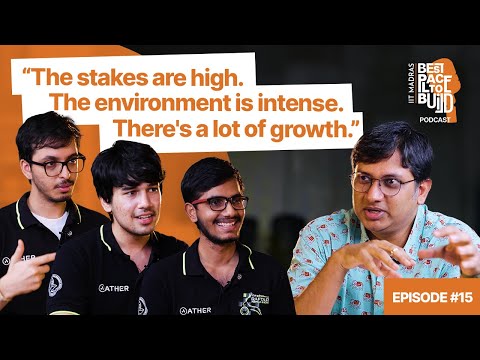
Raftar Formula Racing Team, IIT Madras | "The stakes are high. The environment is intense." | Ep. 15
Divyaratna (guest), Aryan Varma (guest), Ankith Suresh (guest)
In this episode of Best Place To Build, featuring Divyaratna and Aryan Varma, Raftar Formula Racing Team, IIT Madras | "The stakes are high. The environment is intense." | Ep. 15 explores iIT Madras Raftaar team builds EV racecars, eyes autonomy supremacy Raftaar Formula Racing is one of IIT Madras’ oldest CFI competition teams, building a full prototype race car each year for Formula Student / FSAE-style competitions in India (Formula Bharat) and abroad (notably Formula Student Germany).
IIT Madras Raftaar team builds EV racecars, eyes autonomy supremacy
Raftaar Formula Racing is one of IIT Madras’ oldest CFI competition teams, building a full prototype race car each year for Formula Student / FSAE-style competitions in India (Formula Bharat) and abroad (notably Formula Student Germany).
The episode explains how the team operates like a startup: raising funds, managing sponsors, coordinating manufacturing and logistics, and justifying engineering decisions through design, cost, and business-plan events—alongside on-track dynamic events.
After years of success in combustion (including national championships around 2020–2022), Raftaar used the COVID period to pivot to electric, podium-finishing early in their EV era and seeking to close the gap to heavily resourced European teams.
Team members emphasize hands-on learning, intense stakes, interdisciplinary participation, resilience through failures, and a long-term ambition: world-leading performance in electric autonomy by 2027.
Key Takeaways
Formula Student rewards engineering justification—not just speed.
Beyond lap times, teams are scored on cost efficiency, design rationale/validation, and a business plan pitch—forcing disciplined trade-offs and discouraging pure overengineering.
Get the full analysis with uListen AI
Raftaar runs like a startup as much as an engineering team.
Students pitch for sponsorships, manage budgets, plan launches, and handle international shipping/logistics—building real-world execution skills alongside technical depth.
Get the full analysis with uListen AI
The COVID downtime became a strategic inflection point to go electric.
With limited campus access, the team invested design time into an EV powertrain and returned with a new electric car, quickly translating that pivot into competitive results.
Get the full analysis with uListen AI
Interdisciplinary participation is normal and valuable in CFI teams.
Chemical or civil students can contribute meaningfully to electronics or aerodynamics; motivation and self-learning matter more than department labels, and projects often teach concepts before classrooms do.
Get the full analysis with uListen AI
Iteration compounds: small yearly gains produce major multi-year performance jumps.
Weight savings (e. ...
Get the full analysis with uListen AI
Sponsors engage most when the relationship is mutually technical, not purely CSR.
Examples include MRF using Raftaar’s sensor-driven tire testing data to refine compounds and Daimler collaborating on EV test-bench efforts—turning the team into an R&D partner.
Get the full analysis with uListen AI
Resilience under failure is a core competitive advantage.
A major pre-launch crash that destroyed suspension components forced an emergency rebuild under time constraints, reinforcing the team’s culture of ownership, coordination, and ‘no one gives up’ execution.
Get the full analysis with uListen AI
Notable Quotes
“By 2027, we want to be the fastest electric autonomous vehicle in the world, period.”
— Divyaratna Joshi
“The way our team works is essentially kind of like a startup.”
— Aryan Varma
“Because this is a competition team, the stakes are high, and the environment is intense.”
— Aryan Varma
“It all culminates down to those final few days of the competition, which defines pretty much all the work you’ve done across the entire year.”
— Ankith Suresh
“No one ever gives up.”
— Ankith Suresh
Questions Answered in This Episode
Raftaar’s 2027 goal is ‘fastest electric autonomous vehicle’—what specific benchmark (acceleration, lap time, autonomy score) will you use to define ‘fastest’ and compare globally?
Raftaar Formula Racing is one of IIT Madras’ oldest CFI competition teams, building a full prototype race car each year for Formula Student / FSAE-style competitions in India (Formula Bharat) and abroad (notably Formula Student Germany).
Get the full analysis with uListen AI
What concrete design changes enabled a podium finish in your first electric Formula Bharat outing—battery, motor control, weight, aero, or reliability?
The episode explains how the team operates like a startup: raising funds, managing sponsors, coordinating manufacturing and logistics, and justifying engineering decisions through design, cost, and business-plan events—alongside on-track dynamic events.
Get the full analysis with uListen AI
How do you decide yearly goals (e.g., carbon fiber parts, lighter accumulator) and prevent ‘cool tech’ from hurting reliability or cost/design judging?
After years of success in combustion (including national championships around 2020–2022), Raftaar used the COVID period to pivot to electric, podium-finishing early in their EV era and seeking to close the gap to heavily resourced European teams.
Get the full analysis with uListen AI
In the design event, what’s an example of a part you chose NOT to add because the justification or validation wasn’t strong enough?
Team members emphasize hands-on learning, intense stakes, interdisciplinary participation, resilience through failures, and a long-term ambition: world-leading performance in electric autonomy by 2027.
Get the full analysis with uListen AI
What were the biggest technical inspection pain points in Formula Student Germany, and what did you change afterward to avoid repeat failures?
Get the full analysis with uListen AI
Transcript Preview
By 2027, we want to be the fastest electric autonomous vehicle in the world, period.
Even with lesser resources, there's definitely a lot that you can do if you have the determination. Uh, the way our team works is k- essentially kind of like a startup. You know, you have to pitch to people, you have to raise funds, you have this really good idea and a project in mind that you want to build, and you have to convince people that it's worth the amount of money required. [upbeat music]
Hi, my name is Amrit. We've heard that IIT Madras is the best place to build. [upbeat music] So we've come down to the Sudha and Shankar Innovation Hub. We want to meet some people. These are builders. We want to talk to them about their work, and also ask them, what makes IIT Madras the best place to build? [upbeat music] Hi, welcome to the Best Place to Build Podcast. Today, we are sitting with the Raftaar team. It's a little different from the normal podcast we have, where we called, uh, professors or alumnus who have made startups. Uh, this is an actual student team, uh, one of the oldest student teams. So let's get started. Hi, Aryan.
Hi.
Welcome to the podcast.
Yeah, nice to be here.
Can you start by introducing yourselves?
Yeah. So my name is Aryan Varma, and, um, I'm a BTech student in the Metallurgy Department. So this is my final year right now. I have one semester left, and currently I am team captain of Raftaar Formula Racing.
Okay.
Yeah.
So what is Raftaar Formula Racing? In fact, before you say that, can you tell us what is student formula racing?
Okay, so FSAE is basically a type of competition where, um, student teams from different engineering colleges around the world, um, are tasked with building a high-performance race car. Uh, this can be... Depending on which competition you're taking part in, this can be, uh, a different types of powertrains. So one is a combustion pub-based powertrain, which we've been for a lot of our history. Um, the other is the electric vehicle, so you know, with a battery pack and then an ECU and everything. And then there's a third level where teams, some teams, um, in the world have now shifted to driverless. So if you're a driverless team, you get bonus points. So basically, this team, uh, works throughout the year in designing and manufacturing, and, um, you know, testing a full race car prototype, and then we take it to competitions, both in India and around the world, and then we race with the other engineering colleges and see who comes out on top.
Okay, so are there competitions in India for this?
Yes. So there is one main one called Formula Bharat. So this used to happen at the racetrack in Delhi, now it happens in Coimbatore. Um, this has been hap- uh, going on for quite a long time. Uh, recently, they also incorporated the electric side of things. So, um, when we started, we started off in 2012 as a combustion vehicle, and from there to 2020, um, the, the competition was fully combustion. Um, and then electric had just started out, and then COVID hit, right? So we had a two-year break where no one was on campus. We couldn't do much physical stuff, so we thought, "Why don't we take this time and, uh, work on designing our electric powertrain? Because, you know, the world is moving, and we should also evolve with it. So why not just do this big step?" So we took two years, we designed our electric powertrain, and now we've been competing in the electric category, Formula Bharat.
Install uListen to search the full transcript and get AI-powered insights
Get Full TranscriptGet more from every podcast
AI summaries, searchable transcripts, and fact-checking. Free forever.
Add to Chrome