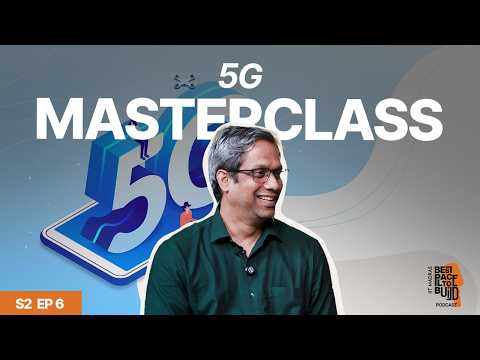
How IIT Professors created India's own 5G Tech | Prof. Radha Krishna Ganti, EE, IITM on BP2B S2 Ep.6
Dr. Radha Krishna Ganti (guest), Unknown Host (host)
In this episode of Best Place To Build, featuring Dr. Radha Krishna Ganti and Unknown Host, How IIT Professors created India's own 5G Tech | Prof. Radha Krishna Ganti, EE, IITM on BP2B S2 Ep.6 explores inside IIT Madras’s indigenous 5G testbed and standards journey Wireless communication is about reliably moving information through noisy, interference-filled, fast-changing channels, especially at high mobility and high user density.
Inside IIT Madras’s indigenous 5G testbed and standards journey
Wireless communication is about reliably moving information through noisy, interference-filled, fast-changing channels, especially at high mobility and high user density.
A 5G system comprises base stations (radio + signal processing) and a core network, and only a handful of global firms build end-to-end infrastructure at scale.
IIT Madras and seven other institutions created an indigenous 5G “testbed” that evolved into a near field-deployable pilot (around TRL 7–7.5), enabling India’s first 5G call and providing a platform for startups to test products.
5G standards are shaped internationally via the ITU through KPIs and spectrum harmonization, and India fought to include rural-coverage needs (LMLC: low mobility, large cell) into global requirements.
The conversation links deep EE math (probability, linear algebra, signal processing) to real deployments, arguing that systems-building and theory reinforce each other and that AI/ML is a tool best used with strong domain knowledge and known theoretical limits (Shannon capacity).
Key Takeaways
5G is a full-stack infrastructure problem, not just faster phones.
Ganti emphasizes that a usable 5G system requires sophisticated base stations plus a high-throughput core network handling massive aggregated traffic, which is why only a few global vendors can deliver it end-to-end.
Get the full analysis with uListen AI
India’s indigenous 5G effort succeeded by decomposing the system across institutions.
Eight institutions split responsibilities (IIT Madras led radio development and integration), requiring coordinated hardware, RF, embedded, antenna, and software teams over multi-year timelines.
Get the full analysis with uListen AI
A “testbed” can be strategically built to approach product readiness.
Although funded as a lab-scale test platform, the team adopted industry interfaces and customer discovery, pushing the system toward TRL ~7–7. ...
Get the full analysis with uListen AI
Standards-setting is where national needs become global technology requirements.
Through the ITU, countries negotiate KPIs; India argued that coverage radius and rural economics matter, pushing LMLC (low mobility, large cell) into the 5G framework despite resistance from regions prioritizing speed/latency.
Get the full analysis with uListen AI
5G’s value is multi-vertical: broadband, massive IoT, and ultra-reliable low-latency.
Beyond higher throughput, 5G targets dense sensor connectivity (smart meters/IoT), low-latency gaming/control, and highly reliable links for factories and telemedicine.
Get the full analysis with uListen AI
Geopolitics and security shaped BSNL’s 4G rollout into a domestic capability milestone.
Post-Galwan, procurement constraints and security concerns drove a fully homegrown approach; consortiums formed to meet scale and proof-of-concept needs, culminating in a Tata/Tejas/C-DOT-led Indian deployment.
Get the full analysis with uListen AI
EE’s “difficulty” is largely the upfront rigor that later unlocks flexibility.
The field’s heavy math foundation (probability, linear algebra, calculus) can feel abstract early, but it enables switching into ML, systems, or even quant-style work once students connect theory to implementations.
Get the full analysis with uListen AI
AI/ML in wireless must respect known theoretical limits and requires domain tuning.
Because Shannon capacity gives hard performance bounds, ML approaches are judged by how close they get to those limits; success depends on blending domain expertise with ML rather than applying generic models.
Get the full analysis with uListen AI
Notable Quotes
“If we don't attempt to build this, it's always going to be a distant dream.”
— Dr. Radha Krishna Ganti
“There are maybe like four to five companies across the world who can build this kind of infrastructure.”
— Dr. Radha Krishna Ganti
“It was a nerve-wracking moment... the first 5G phone call was being made... with the homegrown technology.”
— Dr. Radha Krishna Ganti
“From an Indian perspective, if you don't have coverage, what is the point of having all of other fancy things?”
— Dr. Radha Krishna Ganti
“Electrical engineering is the field to be. Not computer science, not AI.”
— Dr. Radha Krishna Ganti
Questions Answered in This Episode
What specific components did each of the eight institutions build, and what were the hardest integration interfaces to standardize?
Wireless communication is about reliably moving information through noisy, interference-filled, fast-changing channels, especially at high mobility and high user density.
Get the full analysis with uListen AI
When you say TRL 7–7.5 for the IITM 5G stack, what concrete gaps remain to reach carrier-grade deployment (testing, reliability, cost, supply chain, compliance)?
A 5G system comprises base stations (radio + signal processing) and a core network, and only a handful of global firms build end-to-end infrastructure at scale.
Get the full analysis with uListen AI
What did the ‘customer survey’ and trade-show learnings change in your design choices compared to a purely academic prototype?
IIT Madras and seven other institutions created an indigenous 5G “testbed” that evolved into a near field-deployable pilot (around TRL 7–7. ...
Get the full analysis with uListen AI
In the first 5G call incident, why did people ‘blocking the base station’ matter so much—was it mmWave/beamforming/attenuation, and what does that teach about real deployments?
5G standards are shaped internationally via the ITU through KPIs and spectrum harmonization, and India fought to include rural-coverage needs (LMLC: low mobility, large cell) into global requirements.
Get the full analysis with uListen AI
How does LMLC (large-cell rural coverage) trade off against peak throughput and latency, and what technical innovations are needed to make it economical?
The conversation links deep EE math (probability, linear algebra, signal processing) to real deployments, arguing that systems-building and theory reinforce each other and that AI/ML is a tool best used with strong domain knowledge and known theoretical limits (Shannon capacity).
Get the full analysis with uListen AI
Transcript Preview
See, the math that you learn in electrical engineering is the basis of most of the AI ML that you do.
Okay.
Okay? So that way, electrical engineering people learning AI ML is actually very easy. We have, I mean, have seen this whole cycle of, uh, 5G. It's a big team effort, but this requires dedication of, like, the timescales are ten years. We felt that if we don't attempt to build this, it, it's always going to be, like, a distant dream.
We do a lot of work with students who come in to campus through this program called Ask IITM. I have heard a lot of parents say that IIT Madras is supposed to be a theoretical campus, uh, and they're quite worried about it, or they're like... But when I talk to professors, when I talk to alumni, they seem to have been doing a lot of building. Hi, this is Amrit. We are at IIT Madras, my alma mater, and India's top university for people who like to build. We are here to meet some builders, ask them: What are you building? What does it take to build? And what makes IIT Madras the best place to build? [upbeat music] Hello, and welcome to The Best Place to Build Podcast. Today, we are sitting with Professor Radhakrishna Ganti. He's a professor of electrical engineering at IIT Madras in the field of wireless communication. He's also the twenty twenty-four winner of the Shanti Swarup Bhatnagar Prize. Young Scientist Prize, is that the right word?
Yes. [chuckles]
Congratulations, Professor, and welcome-
Thank you.
-to the podcast.
Thank you. Thank you for having me here.
Professor, we also had, uh, Professor Prabhu Raghu Gopal last year on the podcast, and I think the two of you got the prize together. Must have felt really good, right?
Yeah, it, it, it was a absolutely fabulous feeling, but an eerie feeling also. I never expected [chuckles] the prize to come to me, and there was a huge gap of, like, one year before the... Um, not one year, about eight months before they announced the prize, and it was a sudden surprise one day, I see an email saying that, "Yeah, you got the prize." Yeah.
You mean, eight months from the-
Actual-
-nomination?
-date of nom... No, no, uh, from the time the prize was supposed to get announced. It got delayed because of elections last year.
Okay.
So they couldn't announce the prize, and we- almost of us forgot that we have submitted this, [chuckles] and, uh, suddenly it was a boom, we got this, uh-
Nice. Congratulations, Professor.
Thank you.
There aren't too many prizes for professor... academic life, right?
Uh, I guess so, yeah.
Nice. Um, Professor, your work is in the field of wireless communication, a field that I understand really nothing of. [chuckles] Uh, I do remember, uh, in my first year, I was in mechanical, and, uh, my friends in electrical engineering had this project that they would carry one of these Nokia phones around campus with a notepad, and every twenty meter, they were supposed to stop and note down the signal strength.
Install uListen to search the full transcript and get AI-powered insights
Get Full TranscriptGet more from every podcast
AI summaries, searchable transcripts, and fact-checking. Free forever.
Add to Chrome