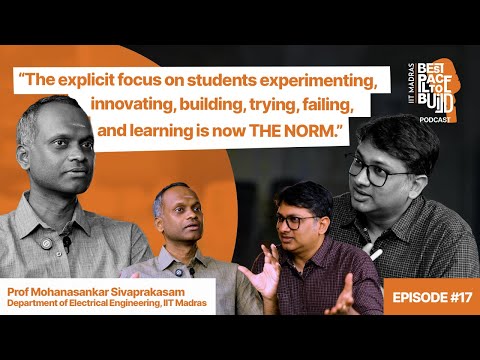
Dr. Mohanasankar S | “Students experimenting, building, failing, & learning is now the norm”| Ep. 17
Dr. Mohanasankar Sivaprakasam (guest), Unknown Host (host), Dr. Mohanasankar Sivaprakasam (guest), Unknown Host (host)
In this episode of Best Place To Build, featuring Dr. Mohanasankar Sivaprakasam and Unknown Host, Dr. Mohanasankar S | “Students experimenting, building, failing, & learning is now the norm”| Ep. 17 explores iIT Madras builder explains brain mapping and medtech innovation ecosystem The episode profiles Dr. Mohanasankar Sivaprakasam—electrical engineering professor, head of IIT Madras’ Brain Center and HTIC—framing him as a “builder” who connects deep theory with real-world systems and products.
IIT Madras builder explains brain mapping and medtech innovation ecosystem
The episode profiles Dr. Mohanasankar Sivaprakasam—electrical engineering professor, head of IIT Madras’ Brain Center and HTIC—framing him as a “builder” who connects deep theory with real-world systems and products.
He explains how the Brain Center, seeded by alumnus Kris Gopalakrishnan, tackles the engineering bottlenecks behind whole human-brain, cellular-resolution mapping—spanning delicate tissue handling, precision slicing, high-throughput imaging, petabyte-scale data pipelines, visualization, and AI-based cell analysis.
In contrast, HTIC focuses on near-term, India-context medtech: import substitution, maintainability, affordability, and commercialization via industry partnerships, with ~12 market products and reported impact of ~1.4 crore patients.
The conversation broadens to IIT Madras’ culture of experimentation, interdisciplinary work, curriculum flexibility, student-led research output (papers/patents), the logic of IP/patents vs publications, and why “freedom to build” is a differentiator versus many global labs.
Key Takeaways
Whole-brain cellular mapping is primarily an engineering gap, not a biology gap.
The central barrier is tooling: light penetration limits force ultra-thin slicing, delicate handling, high-speed imaging, and scalable pipelines. ...
Get the full analysis with uListen AI
The brain-mapping pipeline is a full-stack problem: thermodynamics to AI.
They must freeze soft, water-rich tissue without cracking, slice at ~5–20 microns, transfer intact sections, image fast enough to scale to 100+ brains, reconstruct ~10,000 sections, and analyze petabyte-scale data—including cell counting/classification at high accuracy.
Get the full analysis with uListen AI
Data accessibility is treated as a product requirement, not an afterthought.
The Brain Center aims for public, easy access—from high schoolers to senior researchers—via a custom viewer that can stream cellular-resolution regions even on a phone, despite the underlying dataset being petabytes.
Get the full analysis with uListen AI
HTIC measures success by real-world adoption and patient impact, not just papers.
HTIC is structured as translational R&D built for commercialization with hospitals and industry. ...
Get the full analysis with uListen AI
India’s medtech import dependence is not only costly—it’s a serviceability and sovereignty risk.
Imported devices may be hard to maintain, service, upgrade, or adapt locally. ...
Get the full analysis with uListen AI
The mobile cataract unit solves an access problem after cost was largely solved.
Cataract surgery can be low-cost/free in many Indian settings, but rural patients face multiple trips and lack local surgical facilities. ...
Get the full analysis with uListen AI
Patents are framed as an enabling mechanism for risky R&D investment.
Unlike publications, patents grant legal control that allows licensing and commercialization, making it possible to justify investment where failure rates can be very high. ...
Get the full analysis with uListen AI
Notable Quotes
“At the intersection of neuroscience and engineering.”
— Dr. Mohanasankar Sivaprakasam (quoting Kris Gopalakrishnan)
“We are on our way to perhaps produce the world’s most comprehensive set of human brain maps, starting from fetus all the way to hundred-plus-year-old.”
— Dr. Mohanasankar Sivaprakasam
“This is actually a significant AI challenge… ‘How do you count billions of cells in a human brain?’”
— Dr. Mohanasankar Sivaprakasam
“HTIC is essentially a medical devices R&D center… explicitly focused on developing technologies and products… that will be commercialized.”
— Dr. Mohanasankar Sivaprakasam
“The focus on students experimenting, innovating, building, trying, failing, learning is now a norm.”
— Dr. Mohanasankar Sivaprakasam
Questions Answered in This Episode
Brain Center: What specific slicing/section-transfer innovations made whole-brain processing reliable at 5–20 microns, and what failure modes were hardest to eliminate?
The episode profiles Dr. ...
Get the full analysis with uListen AI
Data + AI: How do you validate AI-based cell counting/classification at scale (ground truth strategy, error tolerance by region/age, and bias control)?
He explains how the Brain Center, seeded by alumnus Kris Gopalakrishnan, tackles the engineering bottlenecks behind whole human-brain, cellular-resolution mapping—spanning delicate tissue handling, precision slicing, high-throughput imaging, petabyte-scale data pipelines, visualization, and AI-based cell analysis.
Get the full analysis with uListen AI
Public resource: What licensing/terms govern reuse of the public brain-map data, and how do you handle privacy/ethics for postmortem and fetal datasets?
In contrast, HTIC focuses on near-term, India-context medtech: import substitution, maintainability, affordability, and commercialization via industry partnerships, with ~12 market products and reported impact of ~1. ...
Get the full analysis with uListen AI
Clinical translation: Which near-term clinical use cases do you expect first from cellular-resolution maps—early diagnosis, drug targeting, or surgical planning—and what’s the timeline?
The conversation broadens to IIT Madras’ culture of experimentation, interdisciplinary work, curriculum flexibility, student-led research output (papers/patents), the logic of IP/patents vs publications, and why “freedom to build” is a differentiator versus many global labs.
Get the full analysis with uListen AI
HTIC strategy: How do you decide which medtech problems to pursue—import bill size, clinical need severity, manufacturability, or ability to service/maintain locally?
Get the full analysis with uListen AI
Transcript Preview
Building solutions require different layers. In fact, you need to have very, very strong theory and foundations. This Brain Center has one of the most advanced technology platforms. What you realize is, this is one of those very unique fields where it is inherently multi and interdisciplinary. We released the most comprehensive digital brain maps of this phase, which today is a public source. [upbeat music]
Hi, my name is Amrit. We've heard that IIT Madras is the best place to build. [upbeat music] So we've come down to the Sudha and Shankar Innovation Hub. We want to meet some people. These are builders. We want to talk to them about their work, and also ask them, "What makes IIT Madras the best place to build?" [upbeat music] Hello, and welcome to The Best Place to Build podcast. Today, we have Professor Mohan with us. He's a professor of electrical engineering at IIT Madras, but also heads the Brain Center and HTIC, and is widely regarded as one of India's top medical technology entrepreneurs, investigators. I don't know, what is the right word I should use, Professor?
You can say builder.
Builder, right. Top medical tech builder in India. Professor, let's start backwards. Let's talk about the Brain Center, because it's stunning, the work that you're doing, and, uh, yeah, we'd like to hear about it more.
So before we get to the Brain Center, you'd probably be interested in knowing how the Brain Center got started. It actually started with an alumnus, Mr. Kris Gopalakrishnan, who needs no introduction. So in about 2015, '16, uh, when he stepped off of Infosys, he wanted to seed something at IIT Madras that can do really cutting-edge research work related to brain. But he said something very interesting, and I quote that word, "At the intersection of neuroscience and engineering."
Right.
So this was the seed that he sowed, uh, in 2015, '16, and then there were several discussions on what we could do, something that's really puts India at the frontier, absolutely cutting edge, leading edge of this field. And then, so several ideas, we said, "Can we image the human brain at cellular resolution?"
Okay.
To give you a context, today we can see the human brain only at millimeter. Uh, the brain cells are about ten micron, 20 micron, and there are about a few hundred billions of them in the brain, and we have not seen them, right? It's one of the few organs which is... We've not even seen. So even the what part of the question is not answered, then the how part of the question, why part of the question comes.
Right.
And that's how this project got started. And today, this Brain Center, uh, has one of the most advanced technology platforms that can take in a human brain, a postmortem, uh, which is extracted in a, in a very, very delicate and a very, uh, high-quality manner, so that the cellular architecture and the connectivity inside the brain is preserved. And through a series of processes, which we'll perhaps talk about, uh, in a while, gets the entire map of the human brain.
Install uListen to search the full transcript and get AI-powered insights
Get Full TranscriptGet more from every podcast
AI summaries, searchable transcripts, and fact-checking. Free forever.
Add to Chrome