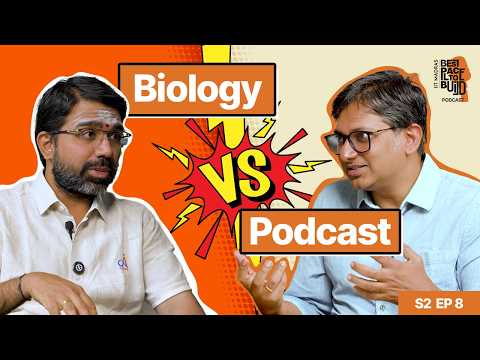
How Computational Microbiology drives disease research & treatment | Prof Karthik Raman | BP2B S2 E8
Karthik Raman (guest)
In this episode of Best Place To Build, featuring Karthik Raman, How Computational Microbiology drives disease research & treatment | Prof Karthik Raman | BP2B S2 E8 explores computational systems microbiology: modeling microbes to understand disease and health Systems biology uses simplified mathematical models to understand and manipulate complex biological systems, much like engineering models, while acknowledging that all models are imperfect but still useful.
Computational systems microbiology: modeling microbes to understand disease and health
Systems biology uses simplified mathematical models to understand and manipulate complex biological systems, much like engineering models, while acknowledging that all models are imperfect but still useful.
Computational systems biology combines large-scale experimental “omics” measurements (genomics, transcriptomics, proteomics, metabolomics) with algorithms to connect molecular parts into predictive system-level behavior.
Systems microbiology applies these ideas to microbes and microbiomes—ranging from single pathogens like tuberculosis to communities in the gut, cities, oceans, and the International Space Station—to study interactions and functions.
Network representations (graphs) unify many problems in the lab, from metabolic pathways and microbe–microbe interactions to finding “best routes” for producing commercially valuable molecules.
The discussion critiques hype in gut-supplement marketing and argues for more systematic, model-driven design of probiotics and microbiome interventions, including future goals like personalized or environment-specific “concoctions.”
Key Takeaways
Modeling is selective simplification, not perfect replication.
Raman emphasizes that models mimic only key characteristics needed to answer a question (e. ...
Get the full analysis with uListen AI
Start with “spherical cows,” then iterate toward reality.
He defends crude assumptions as a necessary entry point, then recommends incremental refinement through the DBTL cycle when data reveal missing mechanisms (e. ...
Get the full analysis with uListen AI
Omics produces parts lists; systems biology builds the ‘engine.’
Genomics/transcriptomics/proteomics/metabolomics catalog what’s present, but computation is needed to infer interactions, control, and emergent behavior from those components.
Get the full analysis with uListen AI
Networks are the common language across scales in biology.
From microbe–microbe ecology to metabolite conversions and even atom-bond graphs of chemicals, graph abstractions enable reuse of algorithms (pathfinding, interaction inference, community design).
Get the full analysis with uListen AI
Drug and pathogen targeting requires a systems perspective.
Using TB as an example, choosing targets among ~4,000 genes demands understanding essentiality and off-target effects, including impacts on host proteins and beneficial microbes.
Get the full analysis with uListen AI
Microbiomes may differ by species but converge by function.
He notes a key idea for interventions: individuals can have different organisms performing similar metabolic roles, suggesting therapies might aim to restore functions (e. ...
Get the full analysis with uListen AI
Probiotic design should move from marketing-led to model-led.
While many supplements focus on ‘helpful’ microbes, he argues the field needs systematic design based on interaction models, dynamics, and context (antibiotics, allergies, infection state).
Get the full analysis with uListen AI
Genomic surveillance will likely become routine infrastructure.
From MetaSub city signatures to drinking water/sewage monitoring and airline waste studies, he frames metagenomics as a future early-warning system for outbreaks and antimicrobial resistance.
Get the full analysis with uListen AI
Extreme and ‘exotic’ microbiomes can power green manufacturing.
Studying extremophiles and ISS microbes is not just curiosity—novel pathways can be harnessed for biomanufacturing, like transplanting pathways to produce high-value compounds (e. ...
Get the full analysis with uListen AI
Education needs to break the false math-vs-biology tradeoff.
He highlights a systemic barrier: students self-sort into ‘math people’ or ‘biology people,’ yet modern biology increasingly requires quantitative, computational fluency.
Get the full analysis with uListen AI
Notable Quotes
“All models are wrong, but some are useful.”
— Prof. Karthik Raman (citing statistician George Box)
“You wanna start with a spherical cow in a vacuum.”
— Prof. Karthik Raman
“Can we tame biology as an engineering discipline?”
— Prof. Karthik Raman (citing Tom Knight)
“Biology is too important to be left to the biologists.”
— Prof. Karthik Raman (attributed to a major science-agency leader; described as controversial)
“It’s like a forest fire… your gut nicely recovers after an antibiotic administration.”
— Prof. Karthik Raman
Questions Answered in This Episode
When you decide the ‘right’ abstraction level (SIR vs adding asymptomatic compartments vs digital-twin-like detail), what criteria do you use to stop adding complexity?
Systems biology uses simplified mathematical models to understand and manipulate complex biological systems, much like engineering models, while acknowledging that all models are imperfect but still useful.
Get the full analysis with uListen AI
In TB target discovery, what does your modeling pipeline look like end-to-end—from genome annotation to predicting essential reactions and filtering host/off-target risks?
Computational systems biology combines large-scale experimental “omics” measurements (genomics, transcriptomics, proteomics, metabolomics) with algorithms to connect molecular parts into predictive system-level behavior.
Get the full analysis with uListen AI
You mention functional similarity despite organismal differences in guts; how do you quantify ‘function’ computationally (pathways, metabolite fluxes, gene families), and what data are most limiting?
Systems microbiology applies these ideas to microbes and microbiomes—ranging from single pathogens like tuberculosis to communities in the gut, cities, oceans, and the International Space Station—to study interactions and functions.
Get the full analysis with uListen AI
What are the strongest scientific reasons to be skeptical of many consumer probiotic claims, and what evidence would convince you a product is genuinely effective?
Network representations (graphs) unify many problems in the lab, from metabolic pathways and microbe–microbe interactions to finding “best routes” for producing commercially valuable molecules.
Get the full analysis with uListen AI
Your lab designs ‘minimal microbial communities’ for a function—what constraints matter most (stability, invasion resistance, growth-rate matching, metabolite exchange)?
The discussion critiques hype in gut-supplement marketing and argues for more systematic, model-driven design of probiotics and microbiome interventions, including future goals like personalized or environment-specific “concoctions.”
Get the full analysis with uListen AI
Transcript Preview
old physicist, uh, joke, right? So they say, "Hey, let's, uh, assume a spherical cow." I used to hate biology like everybody else in school. [chuckles]
It's an either-or.
I hate biology, so I go for math.
Yeah.
I, I can't do math, so I'll go into medicine or biology. Usually start sharing the first class in my course on systems biology, right? This is called, "Can a biologist fix a radio?" Compound called, uh, surfactant in the International Space Station microbes. Heavily used in cosmetics, deep sea, gut, International Space Station. How do these microbes interact with each other? You literally have to- everything has to be done by reverse engineering.
Hi, this is Amrit. We are at IIT Madras, my alma mater, and India's top university for people who like to build. We are here to meet some builders, ask them: what are you building? What does it take to build? And what makes IIT Madras the best place to build? [upbeat music] Today on the Best Place to Build podcast, we have with us Professor Karthik Raman, a professor in the Department of Data Science and AI in the Wadhwani School of Data Science and AI at IIT Madras. Previously, he was a professor in the Biotech Department. Uh, Professor, welcome to the podcast.
Hi.
I also personally know you from our Ask IITM demo days. You've been answering questions. When students come in, they have a lot of questions about how IIT works, and, uh, I want to just tell you that his answering speed is insane. He'll answer at one question per second. Professor, I- we had, we had a conversation earlier this week about the work you do, and I've come to realize that [chuckles] there is a lot that I don't understand at all. So if I may ask, can you give me a basic primer, and I've noted down some words-
Sure.
-so maybe you can help me understand this. Um, and without this, everything is going to be OHT for me. [chuckles] So-
Sure, sure.
What is systems biology?
Yeah. So, so I think, you know, it's, it's, uh, it's because, um, uh, in, in a sense, biology has become quite, uh, you know, um, diverse from engineering in, in a lot of our education, right? So I think that's, that's one of the reasons, and I hope, you know, we'll, uh, we'll talk about that and emphasize that at some point of time. Um, uh, but I think it's very important today to be able to straddle both the biology and math, and so on. And if you look at systems biology, it's essentially like, um, it's, um... There are various flavors of computational biology I like to think of, right? So that is, uh, you'll see this term quantitative or computational biology in a lot of, uh, scenarios. Or you must have, uh, heard of the term bioinformatics, right? That's, uh, you know, there are even degrees on bioinformatics, and so on. So I like to think of bioinformatics as IT intersection biology, computational biology as computer science intersection biology, and systems biology actually as engineering or chemical or computational engineering intersection biology.
Install uListen to search the full transcript and get AI-powered insights
Get Full TranscriptGet more from every podcast
AI summaries, searchable transcripts, and fact-checking. Free forever.
Add to Chrome