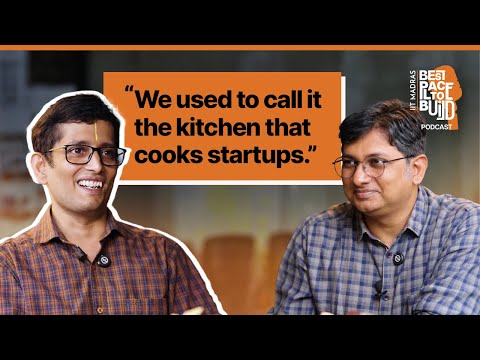
Prof. Satyanarayanan Seshadri | "We used to call it the kitchen that cooks startups" | Ep. 4
Satyanarayanan Seshadri (guest)
In this episode of Best Place To Build, featuring Satyanarayanan Seshadri, Prof. Satyanarayanan Seshadri | "We used to call it the kitchen that cooks startups" | Ep. 4 explores iIT Madras’ startup kitchen: deep-tech, energy innovation, risk culture thrives IIT Madras’ innovation stack evolved from CFI’s student maker culture into Nirmaan’s pre-incubation and a broader pipeline that supports ventures from tinkering to global scaling.
IIT Madras’ startup kitchen: deep-tech, energy innovation, risk culture thrives
IIT Madras’ innovation stack evolved from CFI’s student maker culture into Nirmaan’s pre-incubation and a broader pipeline that supports ventures from tinkering to global scaling.
Technology Readiness Levels (TRLs) explain why universities excel at early science (TRL 0–4) but need partners, systems, and startups to push technologies to field validation and commercialization (TRL 7–9).
Decarbonization is framed as reducing greenhouse-gas emissions (not removing carbon), with industrial efficiency, appropriate energy use, renewable integration, and carbon removal forming a practical “pyramid” of actions.
AI-driven compute could grow from ~2% to ~14% of global GHG emissions in 15 years, pushing debate toward firm low-carbon power options like small modular nuclear reactors for data centers.
Seshadri’s own pathway (pollution research → GE energy → Research Park industry R&D → IIT faculty) informs his focus on translating industrial energy tech into IP-backed, asset-heavy startups and venture-building models.
Key Takeaways
IITM built a deliberate progression from tinkering to venture creation.
CFI enables hands-on making, clubs mature into competition teams with rigorous engineering, and Nirmaan provides mentorship, seed funding, and even placement deferrals so students can attempt startups with reduced downside.
Get the full analysis with uListen AI
Nirmaan’s origin story reflects how ecosystems bootstrap themselves.
A repurposed abandoned Cauvery hostel kitchen became Nirmaan’s first co-working space—nicknamed “the kitchen that cooks startups”—before scaling into today’s integrated innovation hub.
Get the full analysis with uListen AI
TRLs clarify the commercialization gap—and why it persists in academia.
Universities typically stop around TRL 0–4 where papers, patents, and PhDs are produced; TRL 4–7 needs engineering, manufacturing thinking, and customer validation that academic incentives don’t strongly reward.
Get the full analysis with uListen AI
Commercial success needs more than TRL: manufacturing and market readiness matter.
Seshadri highlights adding MRL (Manufacturing Readiness Level) and CRL (Commercialization Readiness Level) because a lab prototype can still fail if it can’t be built, serviced, or sold reliably.
Get the full analysis with uListen AI
Decarbonization should start with “right energy, right use,” not just renewables.
His “pyramid” prioritizes appropriate energy choice and efficiency first, then renewable integration with storage and demand-side management, and only later “undoing past mistakes” via removal approaches.
Get the full analysis with uListen AI
Industrial steam and heat are immediate, high-impact decarbonization levers.
He claims pressure-to-power recovery from steam throttling could unlock ~20 GW of ‘free’ potential in India—comparable to ~60–70 GW of solar when adjusted for load factor—reducing emissions at national scale.
Get the full analysis with uListen AI
Heavy-tech startups scale differently and require patient capital and service capability.
Unlike asset-light software, industrial hardware must meet multi-year reliability expectations and fast service response; deploying a single unit can cost ~₹1 crore, limiting hockey-stick growth without robust teams and financing models.
Get the full analysis with uListen AI
AI may become a major climate sector unless energy supply changes.
Compute today contributes ~2% of global GHG, but could reach ~14%; because demand is democratized and power-hungry, it may drive new baseload generation and renewed interest in nuclear (e. ...
Get the full analysis with uListen AI
Venture-building talent is the missing bridge from ‘1 to 100’ for deep-tech.
Seshadri argues MS Entrepreneurship and lab IP can get ideas to ‘0→1,’ but scaling needs seasoned builders; this motivates his venture-studio approach (Indus DC) to repeatedly commercialize lab technologies.
Get the full analysis with uListen AI
IITM’s differentiator is a campus-wide ‘celebration of risk.’
He attributes IITM’s build momentum to leadership and cultural tolerance for experimentation—citing ambitious institutional bets (like a rapid international campus setup) and alumni willingness to seed uncertain initiatives.
Get the full analysis with uListen AI
Notable Quotes
“We used to call it as the kitchen that cooks startups.”
— Satyanarayanan Seshadri
“Decarbonization is a very often used and probably misunderstood term… we’re not really trying to get rid of carbon.”
— Satyanarayanan Seshadri
“It’s expected that in the next fifteen years… [compute] will get to about fourteen percent… one of the top two sectors of GHG contribution.”
— Satyanarayanan Seshadri
“This is a learning institute… I can go plug myself into any of the centers of excellence and say, ‘I’m here to learn.’”
— Satyanarayanan Seshadri
“The tolerance and the celebration of risk here is far higher than anywhere else.”
— Satyanarayanan Seshadri
Questions Answered in This Episode
What specific metrics does IITM use to decide when a CFI/Nirmaan project is ready to move from ‘club prototype’ to a real company formation path?
IIT Madras’ innovation stack evolved from CFI’s student maker culture into Nirmaan’s pre-incubation and a broader pipeline that supports ventures from tinkering to global scaling.
Get the full analysis with uListen AI
In the redeveloped MS Entrepreneurship model, how are students matched to faculty IP, and what prevents ‘technology-first’ teams from missing product-market fit?
Technology Readiness Levels (TRLs) explain why universities excel at early science (TRL 0–4) but need partners, systems, and startups to push technologies to field validation and commercialization (TRL 7–9).
Get the full analysis with uListen AI
You mentioned TRL plus MRL and CRL—what does a practical evaluation rubric look like for an IITM deep-tech startup at TRL 4–6?
Decarbonization is framed as reducing greenhouse-gas emissions (not removing carbon), with industrial efficiency, appropriate energy use, renewable integration, and carbon removal forming a practical “pyramid” of actions.
Get the full analysis with uListen AI
On the AI emissions claim (2% to 14% in 15 years), what assumptions drive the projection—model sizes, inference volume, data-center energy mix, or something else?
AI-driven compute could grow from ~2% to ~14% of global GHG emissions in 15 years, pushing debate toward firm low-carbon power options like small modular nuclear reactors for data centers.
Get the full analysis with uListen AI
If nuclear SMRs power data centers, what are the realistic deployment constraints in India—regulation, safety, cost, timelines, or public acceptance?
Seshadri’s own pathway (pollution research → GE energy → Research Park industry R&D → IIT faculty) informs his focus on translating industrial energy tech into IP-backed, asset-heavy startups and venture-building models.
Get the full analysis with uListen AI
Transcript Preview
Hi, my name is Amrit. We've heard that IIT Madras is the best place to build. [upbeat music] So we've come down to the Sudha and Shankar Innovation Hub. We want to meet some people. These are builders. We want to talk to them about their work, and also ask them, "What makes IIT Madras the best place to build?" [upbeat music] They're not really trying to get rid of carbon.
It's expected that in the next fifteen years, given the acceleration of AI in common usage, this number will get to about fourteen percent. If it gets to fourteen percent, this will immediately start becoming one of the top two sectors of GHG contribution.
Scary to even think about it. [upbeat music] Hi, I am with Dr. Satya Seshadri. We are sitting in CFI, and we are discussing, um... We have a lot to discuss on our plate today. Maybe, Professor, um, of course, firstly, welcome.
Thank you.
Uh, and maybe what we can do is, since we are sitting in Nirmaan and CFI, we can talk about this first. Um, from when I was in campus, we didn't have CFI or Nirmaan. Um, and then there was CFI, and now there's Nirmaan, and now it feels like there's an entire innovation stack. So can you lead us through and explain to us what this is?
Sure. Um, as you rightly said, CFI was created in 2007, thereabout, uh, to become a student tinkering lab, just more of a, a maker space and after-class program for students to come and explore building, uh, the whole thing about what they can achieve with their hands. And I think that gradually led to there, in about 2013, '14 timeframe, a couple of these students wanting to create, uh, enterprises out of it, which is a natural progression. So Nirmaan was created as a club within CFI, just like there are how many other clubs. There's a product design club, there is a, um, genomics club, or a AI club. So many clubs are created based on special interest groups of students. Nirmaan was created as a pre-incubator. So what it really meant was to provide some kind of a platform for students to learn how to create startups, and in the process, how to approach market, how to talk to customers, and so on, and created this with certain set of mentorship. Like, for the product design and others, there is mentorship available within campus, the technical mentors, the faculty advisors, and so on. For this case, we had to go outside to bring in alumni who have created companies or led large corporate positions to come back and support these students, and that's how Nirmaan was created. And what we recognized-
Hold on, hold on one second. So CFI is a student maker space, and there are clubs in CFI?
Yeah.
And these clubs-- How are these clubs organized?
Clubs, typically, uh, you put it together or students come together and create a club with, um, I would say, a special interest group. So, for example, if a series of students are interested in product design, there is a product design club that comes in, and they create a charter, they create a, a set of projects they want to do, with the goal of, uh, realizing something. And then they come and seek some funding from the CFI student administrative body and the faculty advisor to say, "Can I realize some of these projects?" Um, it can come and go depending on, uh, the interest of students. Right now, for example, sustainability, campus sustainability is being created as a club. There's a lot of special interest groups that are being formed, primarily because now sustainability is a, a buzzword or a keyword-
Install uListen to search the full transcript and get AI-powered insights
Get Full TranscriptGet more from every podcast
AI summaries, searchable transcripts, and fact-checking. Free forever.
Add to Chrome