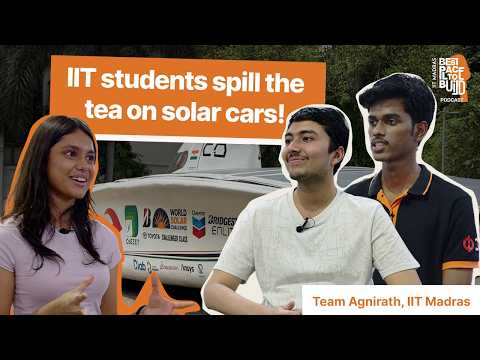
From kangaroos to sudden explosions, this team is ready to face it all! | BP2B: Student Edition! Ep3
Sairam (guest), Vidhi (host), Pratyush (guest)
In this episode of Best Place To Build, featuring Sairam and Vidhi, From kangaroos to sudden explosions, this team is ready to face it all! | BP2B: Student Edition! Ep3 explores iIT Madras Team Agnirath races solar car across Australia’s extremes Team Agnirath (IIT Madras) builds ultra-efficient solar race cars and represented India at the World Solar Challenge in 2023 and 2025.
IIT Madras Team Agnirath races solar car across Australia’s extremes
Team Agnirath (IIT Madras) builds ultra-efficient solar race cars and represented India at the World Solar Challenge in 2023 and 2025.
The World Solar Challenge is a 3,022 km, five-day cross-Australia endurance race where solar is the primary energy source and rules tightly restrict external charging and on-road modifications.
The car’s “boat/monocoque” shape and lightweight carbon-fibre construction prioritize aerodynamic drag reduction and low rolling resistance to maximize energy efficiency.
Key technical systems include high-efficiency ETFE-encapsulated solar panels, MPPT-based power management, and mostly passive battery cooling using airflow under the car.
The 2023 campaign featured real-world failures (overheating MPPTs, degraded battery cells, suspension rod-end issues) that forced a shift into Adventure Class and informed a more test-heavy roadmap toward Sasol Solar Challenge 2026 and eventually Cruiser Class.
Key Takeaways
In solar racing, efficiency beats speed—every watt and every drag source matters.
The team frames performance around energy auditing: improving input (solar efficiency, MPPT conversion) while reducing losses (aero drag, rolling resistance, unnecessary auxiliary loads).
Get the full analysis with uListen AI
Boat-shaped (monocoque/monohull) bodies are a deliberate aerodynamic tradeoff, not aesthetics.
Teams converge on a few proven shapes because minimizing drag is central to finishing long stages on limited solar and battery energy under harsh crosswinds.
Get the full analysis with uListen AI
Thermal control is a safety system, not just a performance feature.
With desert temperatures and limited use of power-hungry cooling, overheating can cascade into catastrophic battery events; Agnirath emphasizes passive cooling via underbody airflow with fans as backup.
Get the full analysis with uListen AI
MPPT reliability can decide a race even if the solar cells are excellent.
They experienced MPPT overheating that reduced harvested power, illustrating that power electronics packaging, heat sinking, and derating strategies are as critical as panel efficiency.
Get the full analysis with uListen AI
Battery health and matching are make-or-break for endurance stages.
A few aged cells reduced effective capacity and forced an early competitive withdrawal; the lesson is rigorous cell screening, pack balancing strategy, and conservative operating windows.
Get the full analysis with uListen AI
Operational logistics are as complex as the car itself.
The convoy setup (lead car, solar car, support vehicles, mandatory container truck) plus an official observer and daily campsite planning shape strategy, rest, and compliance just as much as engineering does.
Get the full analysis with uListen AI
Adventure Class functions as a valuable “failure-tolerant” learning pathway.
When the team couldn’t meet the day-one distance requirement, Adventure Class still let them finish stages, encounter real conditions (rain/hail), and capture design fixes for the next iteration.
Get the full analysis with uListen AI
Notable Quotes
“Which means you have to travel from north part of Australia to southern part of Australia, which is around 3,022 kilometers, in just a span of five days.”
— Sairam
“The temperature sometimes goes around 50, 60 degree Celsius… and… 70 kilometers of crosswinds.”
— Sairam
“We have multiple incidents… where the entire battery got exploded, and their car… burned to ashes.”
— Sairam
“It’s a public highway… we have road trains… with speed of 100 and 120 kilometers.”
— Pratyush
“Around 250-kilometer mark… suddenly there was a drop in energy… a few cells had died.”
— Pratyush
Questions Answered in This Episode
On the 2023 run, what specifically caused the MPPT overheating (thermal design, placement, airflow limits, component rating), and what exact redesign are you implementing for 2026?
Team Agnirath (IIT Madras) builds ultra-efficient solar race cars and represented India at the World Solar Challenge in 2023 and 2025.
Get the full analysis with uListen AI
Your solar figure is described as “about 1.3 kWh” from ~6 m² at 25%—can you clarify whether you mean 1.3 kW peak power and share your typical in-race power budget at cruising speed?
The World Solar Challenge is a 3,022 km, five-day cross-Australia endurance race where solar is the primary energy source and rules tightly restrict external charging and on-road modifications.
Get the full analysis with uListen AI
What battery chemistry and pack architecture are you using, and how do you screen or match cells to avoid “a few old cells” compromising an entire module again?
The car’s “boat/monocoque” shape and lightweight carbon-fibre construction prioritize aerodynamic drag reduction and low rolling resistance to maximize energy efficiency.
Get the full analysis with uListen AI
How do you decide daily driving strategy (target speed vs state-of-charge) given mandatory stops and changing weather, and what data feeds into that decision in the convoy?
Key technical systems include high-efficiency ETFE-encapsulated solar panels, MPPT-based power management, and mostly passive battery cooling using airflow under the car.
Get the full analysis with uListen AI
What were the exact mechanical failure modes in the suspension rod ends (material choice, loading assumptions, fatigue), and how will the next design be validated?
The 2023 campaign featured real-world failures (overheating MPPTs, degraded battery cells, suspension rod-end issues) that forced a shift into Adventure Class and informed a more test-heavy roadmap toward Sasol Solar Challenge 2026 and eventually Cruiser Class.
Get the full analysis with uListen AI
Transcript Preview
In 2023 and '25 edition, we were the only Indian team to participate in the World Solar Challenge. Which means you have to travel from north part of Australia to southern part of Australia, which is around 3,022 kilometers, in just a span of five days. There are two primary shapes that teams use. One is, uh, the boat shape. Around 250-kilometer mark is when we observed that suddenly there was a drop in energy that we are gaining. There is air flowing beneath the car, so we take that flow of air and pass it through the battery. [upbeat music]
Hello, and welcome to Best Place To Build, Student Edition. I'm Vidhi, a fifth-year engineering student here at IIT Madras. Currently, we're at CEPHI with Team Agnirath. We're here today with the team that is building this solar car, and they are innovating towards the future of sustainable mobility. Today, I have Sairam, the business head, to tell us more about their journey since 2021 and how they've managed to build this car. Hi, Sairam.
Hi, Vidhi.
So could you let me know what exactly is Agnirath, and what are you guys doing here?
Sure. Uh, so we are a solar car racing team, uh, based on IIT Madras, and we aim to design and build, uh, the most efficient solar race car possible, and we represent India in global World Solar Challenges. And we participated in World Solar Challenge 2023 and World Solar Challenge 2025.
What is this World Solar Challenge, and how does it help you guys in any way to be building these cars?
The World Solar Challenge has a 37 years, uh, long history, and it's a very rich, uh, legacy competition. And this has been graced by the participation of top, uh, people like, uh, Google co-founder, uh, Larry Page, and Tesla co-founder, JB Straubel. And this competition is very unique in multiple ways. Like, this is a cross-continental competition, which means you have to travel from north part of Australia to southern part of Australia, which is around 3,022 kilometers, in just a span of five days, only using solar energy, and you can use a battery as a backup. The temperature sometimes goes around, uh, 50, 60 degree Celsius, and as you go down toward the south, uh, there's a possibility of rains, so that you should ensure that the car is completely encapsulated and waterproof, so that the car can be sustained in those temperatures. And apa- apa- apart from that, we have, like, 70 kilometers of crosswinds. And since, uh, the car is made up of, you know, carbon fiber to ensure it has very less weight, that strong gust of wind is good enough for your car to topple. And we have multiple incidents throughout the history of teams where the entire battery got exploded, and their car, along with their dreams, burned to ashes. So this is a very, uh, challenging competition.
So this sounds like a very daunting challenge. More than a typical speed-based race, this is more of an endurance challenge, like you mentioned. So are there different levels to these competitions or different modes, or does everyone participate in the same category?
Install uListen to search the full transcript and get AI-powered insights
Get Full TranscriptGet more from every podcast
AI summaries, searchable transcripts, and fact-checking. Free forever.
Add to Chrome