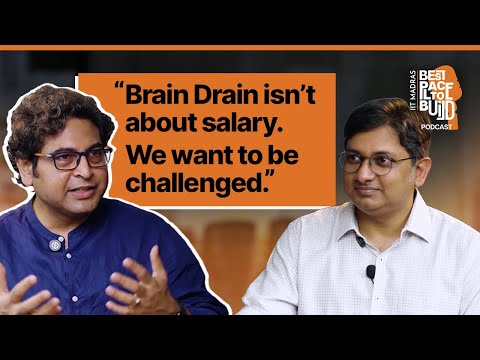
Prof. Prabhu Rajagopal l"Brain drain isn't about salary. We want to be challenged"| Ep. 3
Prabhu Rajagopal (guest)
In this episode of Best Place To Build, featuring Prabhu Rajagopal, Prof. Prabhu Rajagopal l"Brain drain isn't about salary. We want to be challenged"| Ep. 3 explores iIT Madras’ innovation stack fuels deep-tech startups beyond salaries alone Rajagopal argues “brain drain” is less about salary and more about access to challenging, high-impact problems, which India increasingly offers through stronger ecosystems.
IIT Madras’ innovation stack fuels deep-tech startups beyond salaries alone
Rajagopal argues “brain drain” is less about salary and more about access to challenging, high-impact problems, which India increasingly offers through stronger ecosystems.
He maps IIT Madras’ “innovation stack” from student making (CFI) through pre-incubation (NIRMAN), commercialization pathways (GDC/IC&SR), and full incubation, enabling both student- and research-led ventures.
He describes multiple CNDE-linked deep-tech startups (robotics, sensors, AI for inspection, blockchain-healthcare), showing how lab-to-field translation bridges the TRL “valley of death.”
He frames non-destructive evaluation (NDE) and guided ultrasonics as inherently cross-disciplinary, naturally evolving toward AI, cybersecurity, and data integrity challenges.
He connects personal foundations—alumni networks, philosophy, and poetry—to a broader worldview of truth, auspicious impact, and beauty shaping his approach to research and innovation.
Key Takeaways
Ecosystems retain talent by offering hard, meaningful problems.
Rajagopal says students left India earlier not only for better pay but to find intellectually demanding, high-impact work; as those opportunities emerge locally through startups and industry-linked research, more graduates stay.
Get the full analysis with uListen AI
IIT Madras’ advantage is a connected pipeline, not a single program.
He highlights a repeatable flow: student building at CFI, entrepreneurial grooming at NIRMAN (pre-incubation), and industry/commercial support via IC&SR, GDC, and the Incubation Cell—allowing multiple entry points for students and researchers.
Get the full analysis with uListen AI
Startups are a practical solution to the TRL “valley of death.”
Academic labs usually stop at TRL 1–3 (proof-of-concept), while field deployment requires TRL 7–9; Rajagopal positions startups as the commercialization arm that carries lab IP through tailoring, pilots, and deployment.
Get the full analysis with uListen AI
NDE is a safety-critical discipline with huge infrastructure relevance.
By “seeing inside” structures without damage (ultrasound, X-ray analogies), NDE prevents catastrophic failures in aging assets like bridges, dams, tanks, and pipelines—making it a strong base for impact-driven ventures.
Get the full analysis with uListen AI
Robotics becomes valuable when paired with sensing and analytics.
Planys and Solinas show that robots aren’t just mobility platforms; their advantage is carrying inspection sensors into inaccessible environments and turning large inspection datasets into actionable maintenance decisions.
Get the full analysis with uListen AI
Industrial-grade deep tech needs long-horizon lab capacity.
For high-temperature process monitoring (e. ...
Get the full analysis with uListen AI
AI’s usefulness depends on trustworthy, privacy-preserving data pipelines.
Rajagopal argues blockchain can help ensure data integrity (“not tampered”) and enable anonymization, which becomes essential when AI models use sensitive data from plants, banks, or hospitals—motivating Plenome and related work.
Get the full analysis with uListen AI
Notable Quotes
“People used to discuss, ‘Oh, IITians do not get enough package, so they're not staying behind.’ But it is not about, just about the salary. I think a lot of us here want to be challenged.”
— Prabhu Rajagopal
“CFI is, is at the heart of it… look around here… people building racing cars… Hyperloop… sounding rockets… on their own.”
— Prabhu Rajagopal
“TRL 3 is actually proof of concept… Traditionally… IIT would be involved in one, two, three… and we stop there… So that's—this is the valley of death, typically.”
— Prabhu Rajagopal
“I firmly believe… the promise of AI cannot be unlocked without blockchain on the back end… blockchain… protect[s] the fidelity of the data.”
— Prabhu Rajagopal
“Engineering and Technology have always been cross-disciplinary… none of us today are… practitioners of our core disciplines anymore.”
— Prabhu Rajagopal
Questions Answered in This Episode
In your “innovation stack,” what are the 2–3 most fragile handoffs (CFI→NIRMAN, lab→startup, pilot→deployment), and how do you actively de-risk them?
Rajagopal argues “brain drain” is less about salary and more about access to challenging, high-impact problems, which India increasingly offers through stronger ecosystems.
Get the full analysis with uListen AI
NIRMAN is described as unusually rare even globally—what specific services (funding, customers, prototyping, compliance, hiring) make it a true pre-incubator rather than just mentorship?
He maps IIT Madras’ “innovation stack” from student making (CFI) through pre-incubation (NIRMAN), commercialization pathways (GDC/IC&SR), and full incubation, enabling both student- and research-led ventures.
Get the full analysis with uListen AI
Planys’ “Internet of Underwater Things” uses acoustics and satellite relay—what were the biggest engineering constraints (bandwidth, localization, power, reliability) that forced this architecture?
He describes multiple CNDE-linked deep-tech startups (robotics, sensors, AI for inspection, blockchain-healthcare), showing how lab-to-field translation bridges the TRL “valley of death.”
Get the full analysis with uListen AI
For cities adopting Solinas, what’s the primary bottleneck: procurement cycles, proof-of-value, operational integration with utilities, or unit economics of inspections?
He frames non-destructive evaluation (NDE) and guided ultrasonics as inherently cross-disciplinary, naturally evolving toward AI, cybersecurity, and data integrity challenges.
Get the full analysis with uListen AI
You claim AI’s promise “cannot be unlocked without blockchain”—what counterexamples would change your mind, and where is blockchain clearly unnecessary overhead?
He connects personal foundations—alumni networks, philosophy, and poetry—to a broader worldview of truth, auspicious impact, and beauty shaping his approach to research and innovation.
Get the full analysis with uListen AI
Transcript Preview
Hi, my name is Amrit. We've heard that IIT Madras is the best place to build. [upbeat music] So we've come down to the Sudha and Shankar Innovation Hub. We want to meet some people. These are builders. We want to talk to them about their work, and also ask them, "What makes IIT Madras the best place to build?" [upbeat music]
Increasingly, we are getting people with aspirations of creating startups, and they're choosing areas. There are some students who say, "I only want to work on this particular problem, because this has startup potential." So the kind of poetry I practice is also called, uh, what I look at it, is as artist- art poetry, where, you know, rhyme and rhythm are not as important as the philosophy behind it. [upbeat music]
So we are at the Sudha and Shankar Innovation Hub with Dr. Prabhu. Uh, Dr. Prabhu, welcome to our podcast. Uh, we are-
Hi, Amrit.
- Best Place to Build podcast.
Yes.
And I realized in our research that, um, I went to IIT Madras, 'two thousand and three to 'eight, mechanical engineering with dual degree in intelligent manufacturing, and you went to the same thing, but five years my senior, right?
We were the inaugural batch of, uh, intelligent manufacturing.
Is it?
Yeah.
Okay. I, I remember, uh, choosing, uh, my branch, and, um, and, and I was not sure what it really meant. Uh, but can you give us an idea of what is intelligent in manufacturing back then, to how it's moved? And I know that your research area is also sort of linked to that.
Yeah. So today, we have this huge movement of Industry 4.0, right? Which is connected systems, networked systems, intelligent systems. Actually, this intelligent manufacturing was sort of anticipating all of that. How can we put sensors into the, uh, whole manufacturing process, getting some live feedback on, uh, information on the actual, you know, feed parameters, cutting parameters, and so on, and how can we use that to improve and optimize the process? Also, how can we have machines that are intelligent by themselves, machines that can talk to each other? Today, a lot of this is now there on the shop floors through Industry 4.0, and I think that's what is sort of, uh, uh, flowered over and blossomed from those days. Yeah.
Yeah. Uh, and, and I know that this year... Or maybe earlier this year, you won the, uh, Shanti Swarup Bhatnagar Prize. Congratulations!
Thank you.
It's, um, the most prestigious prize for engineers or engineering researchers in India. Uh, could you tell us a little bit about how the experience was? What is the body of work for which you were recognized?
Thank you. Um, thanks for the question as well, and it's a very special recognition. To me, it is a very personal, uh, feeling as well, because my father worked as a scientist in a CSIR laboratory in Hyderabad, the Indian Institute for Chemical Technology. And, uh, you know, that Bhatnagar Award originally has roots in CSIR as an organization, and Shanti Swarup Bhatnagar is a founder of CSIR as well. So, um, we grew up with stories of, you know, legends, you know, legendary scientists-
Install uListen to search the full transcript and get AI-powered insights
Get Full TranscriptGet more from every podcast
AI summaries, searchable transcripts, and fact-checking. Free forever.
Add to Chrome