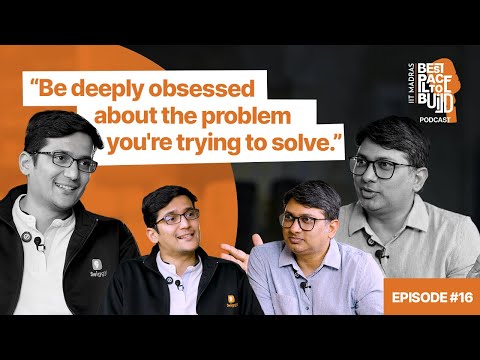
Phani Kishan, Co-Founder, Swiggy |"Be deeply obsessed with the problem you're trying to solve"| Ep16
Phani Kishan (guest), Unknown Host (host)
In this episode of Best Place To Build, featuring Phani Kishan and Unknown Host, Phani Kishan, Co-Founder, Swiggy |"Be deeply obsessed with the problem you're trying to solve"| Ep16 explores swiggy co-founder on problem obsession, scaling, culture, and moats Phani Kishan recounts his journey from IIT Madras (CS) to IIM Calcutta to BCG, and then joining Swiggy very early (around ~100 orders/day) as a co-founder, emphasizing impact and values over titles or day-one origin stories.
Swiggy co-founder on problem obsession, scaling, culture, and moats
Phani Kishan recounts his journey from IIT Madras (CS) to IIM Calcutta to BCG, and then joining Swiggy very early (around ~100 orders/day) as a co-founder, emphasizing impact and values over titles or day-one origin stories.
He argues that enduring startup success comes from deep obsession with the customer’s problem, high-agency teams, and the ability to sustain passion while competitors inevitably emerge once you prove a market.
He outlines Swiggy’s operating playbook: early big-picture ambition, customer-first values, a stage-gated approach to new bets (love → market size → profitability → scale), and selective diversification after core dominance.
The discussion also covers brand vs performance marketing, founder visibility and authenticity, first-principles thinking as structured problem decomposition, and the company’s societal impact alongside how it processes criticism.
Key Takeaways
Titles matter less than impact and stewardship.
Phani frames “co-founder” as reflecting non-trivial impact plus values-based stewardship—someone who can represent the company in any room and reduce internal territoriality, not merely someone present on day one.
Get the full analysis with uListen AI
Customer obsession is the simplifying constraint for complex multi-sided marketplaces.
Swiggy explicitly defined “customer” as the end consumer (not restaurants or delivery partners). ...
Get the full analysis with uListen AI
Structured experimentation beats random diversification.
Swiggy uses a stage-gate model: prove consumer love, confirm market size, establish profitability proof points, then scale. ...
Get the full analysis with uListen AI
Focus should precede breadth—especially for founders.
Phani argues founders should take the core business to a self-sustaining scale before diversifying because founder time and attention are scarce, and companies are shaped as much by what they choose not to do.
Get the full analysis with uListen AI
Supr Daily “worked” on love and retention but failed on unit economics.
He describes strong adoption (serving ~200k households/day) and product-market fit, but insufficient basket size and inability to make economics work; he also notes execution gaps and “ahead of time” risk.
Get the full analysis with uListen AI
Competition is guaranteed once value is proven—so you must match obsessive rivals.
He notes no meaningful problem stays uncontested; once a company demonstrates a viable model (the “four-minute mile” effect), equally driven founders will pursue it, requiring sustained passion and resilience.
Get the full analysis with uListen AI
Long-term moats consolidate around brand and process power.
Referencing Hamilton’s “7 Powers,” he argues that at scale, brand affinity and deeply embedded operating DNA (Toyota-like process power) can outperform purely tactical advantages in crowded markets.
Get the full analysis with uListen AI
Notable Quotes
““Being obsessed about a problem and making sure that you… take it to its logical conclusion is important before you start diversifying.””
— Phani Kishan
““In India or worldwide, you're never gonna be successful alone. If you're gonna be successful, people will necessarily take a crack at it.””
— Phani Kishan
““We were super clear that when we say customer, we meant the actual end consumer.””
— Phani Kishan
““Consumers are good at explaining their problem. They're not great at giving solutions.””
— Phani Kishan
““If you've not read Hamilton's Seven Powers… at the end, what matters… is going to be your brand… [and] process power.””
— Phani Kishan
Questions Answered in This Episode
Swiggy defined the “customer” as the end consumer—what were the hardest internal tradeoffs where this definition forced a painful decision (e.g., restaurant margins vs delivery speed)?
Phani Kishan recounts his journey from IIT Madras (CS) to IIM Calcutta to BCG, and then joining Swiggy very early (around ~100 orders/day) as a co-founder, emphasizing impact and values over titles or day-one origin stories.
Get the full analysis with uListen AI
In your stage-gate model (love → size → profitability → scale), what specific metrics or thresholds did Swiggy use to declare “consumer love” for a new product?
He argues that enduring startup success comes from deep obsession with the customer’s problem, high-agency teams, and the ability to sustain passion while competitors inevitably emerge once you prove a market.
Get the full analysis with uListen AI
Supr Daily reached ~200k households/day—what were the precise unit-economic levers that failed (basket size, delivery density, procurement, spoilage), and which ones would you change if restarting today?
He outlines Swiggy’s operating playbook: early big-picture ambition, customer-first values, a stage-gated approach to new bets (love → market size → profitability → scale), and selective diversification after core dominance.
Get the full analysis with uListen AI
You mentioned competitors proved 10-minute delivery could be profitable—what operational or network assumptions had to be true for Swiggy to adopt it without breaking unit economics?
The discussion also covers brand vs performance marketing, founder visibility and authenticity, first-principles thinking as structured problem decomposition, and the company’s societal impact alongside how it processes criticism.
Get the full analysis with uListen AI
Can you share an example of a first-principles “decision tree” Swiggy used that contradicted popular market narratives at the time (and what you did differently as a result)?
Get the full analysis with uListen AI
Transcript Preview
one thing which most founders will definitely give an arm and leg for is high-agency folks who just run once, given a mandate. Being obsessed about a problem and making sure that you, you know, take it to its logical conclusion is important before you start diversifying-
Right
... into others, right? In India or worldwide, you're never gonna be successful alone. If you're gonna be successful, people will necessarily take a crack at it. So there was this restaurant partner that we, you know, had in Dehradun, who survived the pandemic because Swiggy was still delivering. [upbeat music]
Hi, my name is Amrit. We've heard that IIT Madras is the best place to build. [upbeat music] So we've come down to the Sudha and Shankar Innovation Hub. We want to meet some people. These are builders. We want to talk to them about their work, and also ask them, what makes IIT Madras the best place to build? [upbeat music] Hi, welcome to The Best Place to Build Podcast. Today, we're sitting with Phani Kishan, co-founder at Swiggy. It's a very exciting day for me because it's going to be a great conversation. Welcome, Phani.
Hey, thanks a lot for having me here, M- Amrit.
Phani, let's start with, uh, some... Okay, so we all know that you're the co-founder of Swiggy, and it's been, I, I'm guessing, a very exciting last 10 years. [chuckles] But let's start from the beginning. You were a student at IIT Madras-
Yeah
... in the computer science department.
Yes, I did.
Um, why don't we start there? Tell us about how you got here. What is your JEE experience like?
Yeah, I keep, uh, joking about this, but, um, uh, there was a time in my life when I gave, like, an entrance exam to get into a coaching institute, which is preparing me for an entrance exam, to get into a coaching institute, which is preparing me for an entrance exam to get into IIT.
Okay.
Right? So I come from, like, a hardcore lineage of, you know, people who are trying to crack, uh, IIT from a very young age.
Okay.
That was kind of... Actually, i- this is surprising. I would say that you've not been to Hyderabad? [chuckles] Like, it's pretty common, uh, for, for people to do something like this, right? Um, but I would say my experience getting into IIT Madras was pretty straightforward, actually, to be honest. Uh, I was quite lucky to get the rank that I did. Um, actually, mine was the second batch where we switched from the, um, subjective, you know, oriented exams that you used to have, to the multiple-choice, or-
Right
... objective.
The mains and the advanced, or was it-
Oh, no, no, no, no
... paper one, paper two?
No, I, we only had, we only had one exam-
Okay
... still, but basically, we switched from these long-format questions where you would actually write down proofs-
Install uListen to search the full transcript and get AI-powered insights
Get Full TranscriptGet more from every podcast
AI summaries, searchable transcripts, and fact-checking. Free forever.
Add to Chrome