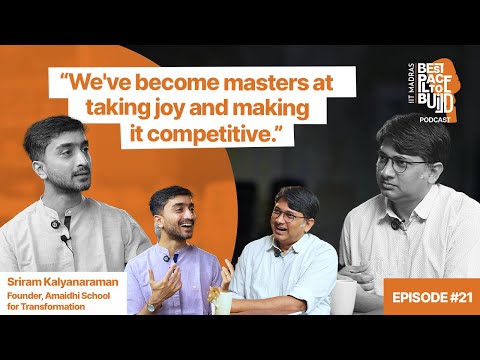
Sriram Kalyanaraman| "What job would you do if you were not paid any money to do it?"| Ep. 21
Sriram Kalyanaraman (guest), Amrutash Misra (host), Amrutash Misra (host)
In this episode of Best Place To Build, featuring Sriram Kalyanaraman and Amrutash Misra, Sriram Kalyanaraman| "What job would you do if you were not paid any money to do it?"| Ep. 21 explores building inner transformation: happiness habits, coaching, and campus community support Sriram Kalyanaraman (IIT Madras CSE ’07, ex‑McKinsey, Harvard Kennedy School) explains a career defined by “contrarian” choices that increasingly aligned with an inner calling: helping people grow through inner healing and transformation.
Building inner transformation: happiness habits, coaching, and campus community support
Sriram Kalyanaraman (IIT Madras CSE ’07, ex‑McKinsey, Harvard Kennedy School) explains a career defined by “contrarian” choices that increasingly aligned with an inner calling: helping people grow through inner healing and transformation.
A major focus is IIT Madras’s credited course “Happiness, Habits and Success” (HHS), created to address student pressure (rank → pay), loneliness, and rising mental health strain—now scaling from 25 students to ~600 per semester via an alumni-powered facilitator network.
They argue happiness and success are not trade-offs: habit formation, gratitude, exercise, and peer connection can raise wellbeing and performance, and structured interventions are more necessary today due to distraction-heavy digital life.
The conversation expands to leadership and workplace responsibility, the myth of being “self-made,” scarcity vs abundance mindsets, and lifelong learning—illustrated by Sriram’s father reinventing himself as a lawyer at 56.
Key Takeaways
Contrarian choices get easier when driven by inward attention and support.
Sriram frames repeated “path less taken” decisions as outcomes of asking what truly energizes him (intrinsic joy) and having an ecosystem—parents, sibling, mentors—who granted autonomy and backing.
Get the full analysis with uListen AI
Student stress is structurally produced: rank pressure becomes pay pressure.
The transcript highlights a continuous treadmill from JEE coaching to campus placements, often without a recovery phase, creating chronic stress that can persist into workplaces and adulthood.
Get the full analysis with uListen AI
Inner healing is treating ‘fracture lines’ in personality, not “fixing weakness.”
He normalizes emotional burdens as psychological “wounds” that can be healed to restore wholeness; transformation then becomes building toward potential, not just coping.
Get the full analysis with uListen AI
Happiness skills should be taught experientially, not as theory.
HHS emphasizes doing: students exercise during class to feel its effect, and run gratitude assignments that reconnect them with parents/grandparents’ life stories—making abstract ideas emotionally real.
Get the full analysis with uListen AI
Soft skills don’t reliably develop “organically” anymore—structured interventions matter.
They argue phones and screen time reduce the long in-person debates and community friction that previously trained patience, teamwork, and communication, so formal courses can fill the gap.
Get the full analysis with uListen AI
Consistency in habits is ‘showing up,’ not perfection.
A key habit-formation correction: expecting 100% adherence creates collapse after a miss; sustainable consistency looks like variable performance over time with continued re-engagement.
Get the full analysis with uListen AI
Measure wellbeing like any other outcome—and use validated instruments.
HHS uses baseline/endline surveys (PSS and MHWB) and reports a consistent 20–30% improvement in perceived stress/wellbeing, positioning the course as an evidence-seeking intervention rather than inspiration alone.
Get the full analysis with uListen AI
Kindness, empathy, and celebration can increase performance—not reduce it.
They challenge the cultural script that positivity makes people complacent or weak; leaders who only chase “what’s next” can under-recognize teams, harming motivation and culture.
Get the full analysis with uListen AI
No one is self-made; interdependence is a growth strategy.
From coaching to alumni-driven course delivery, the episode repeatedly returns to help-seeking and community as normal and necessary—mirroring how elite athletes rely on multiple coaches.
Get the full analysis with uListen AI
Abundance grows through giving, not hoarding.
They link India’s evolving philanthropic culture and IITM’s alumni-funded ecosystem to a mindset shift from scarcity to recognizing and expanding what’s already available through contribution.
Get the full analysis with uListen AI
Lifelong learning is identity, not a phase.
Sriram’s father’s post-retirement law degree and legal career becomes a model for ongoing reinvention—echoing the episode’s theme that there’s no final ‘arrival,’ only continued growth.
Get the full analysis with uListen AI
Notable Quotes
““What job would you do if you were not paid any money to do it?””
— Sriram Kalyanaraman
““Life is a journey of eternal humbling.””
— Sriram Kalyanaraman
““There is a logic to inner transformation.””
— Sriram Kalyanaraman
““Consistency is showing up. It’s not being perfect all the time.””
— Sriram Kalyanaraman
““Abundance comes by giving, not hoarding.””
— Sriram Kalyanaraman
Questions Answered in This Episode
HHS course design: What are the core weekly modules (exercise, gratitude, meditation, relationships, etc.), and which ones produce the biggest measured changes in MHWB/PSS?
Sriram Kalyanaraman (IIT Madras CSE ’07, ex‑McKinsey, Harvard Kennedy School) explains a career defined by “contrarian” choices that increasingly aligned with an inner calling: helping people grow through inner healing and transformation.
Get the full analysis with uListen AI
Measurement rigor: Do you track longer-term outcomes (e.g., 6–12 months later) to see if the 20–30% wellbeing gains persist beyond the semester?
A major focus is IIT Madras’s credited course “Happiness, Habits and Success” (HHS), created to address student pressure (rank → pay), loneliness, and rising mental health strain—now scaling from 25 students to ~600 per semester via an alumni-powered facilitator network.
Get the full analysis with uListen AI
Scaling challenge: With 600 students/semester and 20–25 facilitators, what’s the facilitator training and quality-control process to keep the experience consistent?
They argue happiness and success are not trade-offs: habit formation, gratitude, exercise, and peer connection can raise wellbeing and performance, and structured interventions are more necessary today due to distraction-heavy digital life.
Get the full analysis with uListen AI
Grading controversy: How do you grade a happiness/habits course without incentivizing “performative wellbeing” or turning self-care into another competition?
The conversation expands to leadership and workplace responsibility, the myth of being “self-made,” scarcity vs abundance mindsets, and lifelong learning—illustrated by Sriram’s father reinventing himself as a lawyer at 56.
Get the full analysis with uListen AI
Pressure dynamics: If “rank → pay” pressure is the root, what specific campus policies (placement culture, peer comparisons, parental expectations) could be redesigned to reduce stress upstream?
Get the full analysis with uListen AI
Transcript Preview
What job would you do if you were not paid any money? Abundance comes by giving, not hoarding, uh, because when we give, we also realize how much actually we do have.
Nobody is really self-made. Everybody has had help from other people.
Life is a journey of eternal humbling. [upbeat music]
Hi, my name is Amrut. We've heard that IIT Madras is the best place to build. [upbeat music] So we've come down to the Sudha and Shankar Innovation Hub. We want to meet some people. These are builders. We want to talk to them about their work and also ask them: What makes IIT Madras the best place to build? [upbeat music] Hi, welcome to the Best Place to Build podcast. I'm Amrut. I'm sitting with Sriram, a friend of mine from twenty more, more than twenty years, also known as KK. He was a student here at IIT Madras from two thousand and three to 'seven, Computer Science batch. Joined McKinsey, which was, at the time, the top job off campus, uh, and later, uh, studied again at the Kennedy School for Government at Harvard. Today, runs the Amaidhi School for Transformation. Welcome, Sriram.
Thank you. Thank you for having me here.
Lots to cover.
Yeah.
Um-
May I-- Actually, may I begin with a question?
Okay.
When you asked me to come to this podcast, honestly, the first question that came up was: Why is he asking me to be on this podcast? Because this is about best place to build, and I've usually thought of building and this podcast, uh, to be about entrepreneurship.
Mm.
So why did you ask me to be here?
Fair enough. I mean, when you hear the word build, uh, people think of bridges, cars, robots, and maybe today, AI foundational models. Uh, but we have been trying to, uh, promote this idea that the word build is a little more broad-based. Uh, we do talk about building ourselves, building our network, our resilience, our, um, uh, our mindsets, our attitudes, and I think your work in that area has been quite significant. Um, yeah, is that a satisfactory answer?
Yeah, yeah, it is, it is.
Um-
It is.
I feel like we should start with this. Um, you were at, uh, IIT Madras, uh, Computer Science, and later at McKinsey, and later at, uh, Kennedy School of Government. All these places, people who walk through them, there are some expectations that you will come out and do something, and you've almost always defied the expectations. Contrarian decisions. So I want to ask you, um, doesn't that take a lot of confidence, uh, and aren't you taking a lot of risks? Like, how did you get through the decisions where three times in your life you've taken a very different decision than what people would have expected you to?
Yeah, you're right. It, it takes some level of knowing oneself and being curious about, uh, what it is that, uh, I want at each stage. Uh, I remember when I got into IIT, the vision was very clear in my head: Uh, go to the US, do a master's, work somewhere for two years, do an MBA, and become a CEO by thirty-five. And-
Install uListen to search the full transcript and get AI-powered insights
Get Full TranscriptGet more from every podcast
AI summaries, searchable transcripts, and fact-checking. Free forever.
Add to Chrome