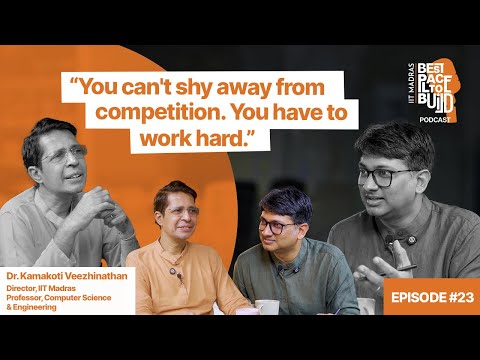
Prof. Kamakoti, Director, IIT Madras |"No substitute for hard work to become a great engineer"|Ep.23
Veezhinathan Kamakoti (guest), Unknown Host (host)
In this episode of Best Place To Build, featuring Veezhinathan Kamakoti and Unknown Host, Prof. Kamakoti, Director, IIT Madras |"No substitute for hard work to become a great engineer"|Ep.23 explores iIT Madras Director on engineering rigor, Shakti chips, startups Prof. Kamakoti frames great engineering as the outcome of rigorous conceptual thinking and sustained hard work, not merely exam ranks or early pay packages.
IIT Madras Director on engineering rigor, Shakti chips, startups
Prof. Kamakoti frames great engineering as the outcome of rigorous conceptual thinking and sustained hard work, not merely exam ranks or early pay packages.
He explains the RISE Lab’s long-term systems vision and how the Shakti indigenous RISC-V microprocessor program catalyzed a full-stack semiconductor startup ecosystem spanning core design, SoCs, verification, physical design, and hardware security.
He outlines IIT Madras’ CS curriculum as three pillars—Theory, Systems, and Applications—emphasizing “NAND-to-Tetris”-style stack-building that makes students understand computing end-to-end.
He argues JEE Advanced is difficult because it tests higher-order concept application across topics within the +2 syllabus, while cautioning that rank is not destiny and there is “no bad course” when aligned with student interest.
As director, he credits IIT Madras’ sustained performance to cohesion, alignment with national priorities, execution against a faculty-owned strategic plan, and targeted improvements for global rankings (especially sustainability, research networks, and citations).
Key Takeaways
Hard work and conceptual rigor are the real differentiators of great engineers.
Kamakoti emphasizes that IIT-level outcomes come from training students to apply concepts (often across multiple topics) and endure demanding practice over four years; there is “no substitute” for that effort.
Get the full analysis with uListen AI
Building an indigenous chip is not a single-project achievement—it requires an ecosystem.
Shakti’s impact is presented as full-stack: core IP, SoC integration, verification, physical design/PCB, and security, with different startups specializing in each layer so real products can be built end-to-end in-country.
Get the full analysis with uListen AI
A strong CS program should teach the entire computing stack, not just ‘coding’.
The curriculum described pushes students from logic gates to architecture, compilers, OS, and applications, so graduates understand how software maps to hardware and systems behavior rather than only writing high-level code.
Get the full analysis with uListen AI
Specialization works best after foundations are common and deep.
All students take core systems and theory courses early; only after 5th–6th semester do they choose deeper tracks (theory/systems/apps), which reduces premature narrowing and improves long-term fit.
Get the full analysis with uListen AI
AI education must be cross-disciplinary and infrastructure-backed to be credible.
He argues AI now belongs to every domain (bio, finance, management, humanities), so the AI/Data Analytics program is designed to bridge disciplines—while requiring significant investment in compute, storage, and accelerators.
Get the full analysis with uListen AI
Patents are a strategic precursor to scalable tech startups and national leverage.
IITM’s ‘patent-a-day’ push is framed as nation-building: standard-essential patents create royalty leverage and defensible IP that can seed deep-tech ventures rather than idea-only startups.
Get the full analysis with uListen AI
Rank-driven choices can harm students; interest-first counseling prevents long-term stress.
He recounts a counseling case where parents forced CS but the student wanted engineering physics, using it to urge parents to speak directly with the child and prioritize genuine interest over ‘safe’ herd choices.
Get the full analysis with uListen AI
Placements are only one outcome; institutes should enable multiple career pathways.
IITM’s shift from “placement cell” to “career pathway center” reflects rising student interest in entrepreneurship, higher studies, competitive exams (e. ...
Get the full analysis with uListen AI
Notable Quotes
“There’s no substitute for the hard work that you need to put… to become a great engineer.”
— Prof. V. Kamakoti
“If you come with an idea, we will give you the way to make it a unicorn—provided you work hard.”
— Prof. V. Kamakoti
“We have this entire innovation and entrepreneurship stack.”
— Prof. V. Kamakoti
“There is no bad course.”
— Prof. V. Kamakoti
“That forty-five marks of QS is out of syllabus for me.”
— Prof. V. Kamakoti
Questions Answered in This Episode
In the Shakti ecosystem, what are the biggest remaining bottlenecks for India: EDA tools, fabrication access, packaging, or volume customers—and which ones can IITM realistically influence?
Prof. ...
Get the full analysis with uListen AI
How do E-class, C-class, and I-class Shakti processors map to real product categories today (e.g., remotes, automotive, servers), and what benchmarks or deployments validate each class?
He explains the RISE Lab’s long-term systems vision and how the Shakti indigenous RISC-V microprocessor program catalyzed a full-stack semiconductor startup ecosystem spanning core design, SoCs, verification, physical design, and hardware security.
Get the full analysis with uListen AI
What specific course projects or lab components in IITM’s ‘NAND-to-Tetris’ style foundation most strongly predict success in systems/semiconductor roles later?
He outlines IIT Madras’ CS curriculum as three pillars—Theory, Systems, and Applications—emphasizing “NAND-to-Tetris”-style stack-building that makes students understand computing end-to-end.
Get the full analysis with uListen AI
You described InCore as the ‘Arm of Shakti’ and Mindgrove as the SoC builder—what IP licensing or business models will make these companies globally competitive?
He argues JEE Advanced is difficult because it tests higher-order concept application across topics within the +2 syllabus, while cautioning that rank is not destiny and there is “no bad course” when aligned with student interest.
Get the full analysis with uListen AI
IITM crossed ‘patent-a-day’: how do you decide which patents should be defended internationally versus filed domestically, and how is licensing revenue shared with inventors?
As director, he credits IIT Madras’ sustained performance to cohesion, alignment with national priorities, execution against a faculty-owned strategic plan, and targeted improvements for global rankings (especially sustainability, research networks, and citations).
Get the full analysis with uListen AI
Transcript Preview
if you get a great score in JEE rank, you can join IIT Madras with some great score. But if you fail in JEE, there's also a chance that you become a director. Our, uh, computer science, uh, department have been very quite conscious to make these courses quite focused so that the student can clearly get a career path within computer science. We have this entire innovation and entrepreneurship stack. If you come with an idea, we will give you the way to make it a unicorn, provided you work hard. [upbeat music]
Hi, my name is Amrit. We've heard that IIT Madras is the best place to build. [upbeat music] So we've come down to the Sudan Chunker Innovation Hub. We want to meet some people. These are builders. We want to talk to them about their work, and also ask them, what makes IIT Madras the best place to build? [upbeat music] Hi, welcome to The Best Place to Build podcast. Today is the big one. We are sitting with Professor Kamakoti. He's the director of IIT Madras. IIT Madras is NIRF number one for the last eight years, so there's a lot to cover. He's also one of India's top semiconductor research, um, scientists. So welcome to the podcast, Professor.
Namaste. Morning.
Professor, I would like to divide our time together into three parts. First, I want to talk to the Professor Kamakoti, the teacher, and the academic, and then we'll talk to, uh, you were the chairman of JEE earlier, so that'll be the second part, and last, we'll talk to the director. So I want to ask, uh, with the basics, Professor, what do you teach? What are your research interests?
So my, uh, research interests are three. One is I teach architecture. I work on computer architecture, that's my bread and butter, and I also worked on information security.
Okay, so if we go into it a bit, um, if I'm a student at IIT Madras, and I want to take your course, which course will that be?
Should be Computer Architecture VLSI, I think.
Nice. Are you still taking that course? I've heard from your students that sometimes they're called at 6:00 in the morning, and-
Uh, that was very early days, where we really wanted to experiment that how early can we... So always I believe that morning 4:00 to 8:00 is the most productive time. Your brain is fresh, provided you have slept well. [laughing] We just have this body called a suprabatham slot.
Suprabatham slot, okay.
And we start at 7:00 and go up to 8:00, or 6:30 to 8:00. Actually, student enjoyed. I did get good attendance in the morning.
Nice.
The, we, we did twice a, twice a week. This is sometime, somewhere in last part of the first decade, like 2010, 2011, and a little bit 20...
Okay, okay.
I was experimenting that. But I still teach, right? Uh, so this semester is my 50th semester at IIT Madras.
Install uListen to search the full transcript and get AI-powered insights
Get Full TranscriptGet more from every podcast
AI summaries, searchable transcripts, and fact-checking. Free forever.
Add to Chrome