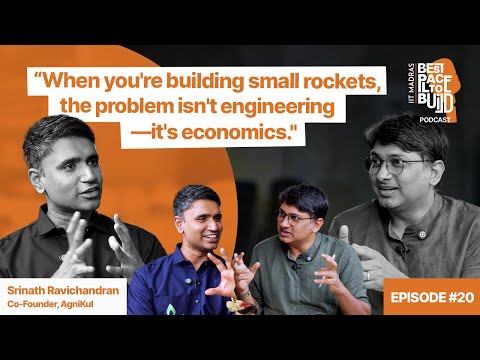
Srinath Ravichandran, Co-Founder & CEO, AgniKul Cosmos| "Is Rocket Science Really That Hard?"| Ep.20
Srinath Ravichandran (guest), Unknown Host (host)
In this episode of Best Place To Build, featuring Srinath Ravichandran and Unknown Host, Srinath Ravichandran, Co-Founder & CEO, AgniKul Cosmos| "Is Rocket Science Really That Hard?"| Ep.20 explores agniKul CEO demystifies rocket science and India’s privatization wave Rocket science is still hard, but less because of unknown physics and more because launches demand perfect execution—one missed detail can scrub or fail a mission.
AgniKul CEO demystifies rocket science and India’s privatization wave
Rocket science is still hard, but less because of unknown physics and more because launches demand perfect execution—one missed detail can scrub or fail a mission.
Satellites have shifted dramatically toward LEO, smaller mass, and massive constellations, while rockets largely remained designed for older, fewer, heavier GEO-era missions—creating an opportunity for dedicated small launch vehicles.
Ravichandran frames rockets as transportation/cargo vehicles and credits SpaceX with “commoditizing” launch via price transparency (e.g., $/kg) and faster development cycles, catalyzing a broader private ecosystem.
AgniKul’s differentiators are technology choices optimized for small-rocket economics: a single-piece 3D-printed engine, an OS-and-“apps” approach to avionics, Ethernet-based internal networking, and a mobile launchpad model enabled by India’s post-2020 policy shift (IN-SPACe).
Key Takeaways
Rocket science is an execution problem as much as an engineering problem.
Ravichandran argues the core difficulty is that “every single thing has to be right” every time; modern tools make many subsystems easier than in the past, but reliability and integration detail determine success.
Get the full analysis with uListen AI
The satellite market changed orders of magnitude; launch hasn’t caught up.
Satellites moved from ~5-ton GEO assets to ~50–500 kg LEO systems, from a handful to thousands, and from “always-on” GEO coverage to fast 90-minute orbits requiring constellations—yet rockets are still optimized for the older paradigm.
Get the full analysis with uListen AI
LEO is ‘close’ in distance but hard in dynamics and operations.
At ~360–500 km, orbital periods are ~90 minutes with short passes, demanding constellation planning and station-keeping; collision avoidance requires careful deployment maneuvers and ongoing course corrections.
Get the full analysis with uListen AI
The hardest part of spaceflight is getting through the atmosphere, not ‘space.’
He highlights the first ~10 km (and max-Q) as the most punishing regime due to dynamic pressure, where high speed meets dense air and the vehicle is most vulnerable to structural loads.
Get the full analysis with uListen AI
SpaceX’s biggest contribution was making launch feel like a scalable product.
By popularizing simple metrics like $/kg and pushing faster timelines, SpaceX increased price visibility and investor confidence, turning a previously opaque, government-centric domain into something closer to a commercial transportation market.
Get the full analysis with uListen AI
Small rockets are primarily an economics challenge; tech must be designed for scale-down.
Downsizing large-rocket methods often explodes unit costs; AgniKul’s design search is framed around making the numbers work at small thrust/payload—e. ...
Get the full analysis with uListen AI
Single-piece 3D printing reduces labor, joints, and manufacturing complexity—at the cost of deep design iteration.
AgniKul’s engine is printed as one part to eliminate assembly steps (and failure points like welds), but requires sophisticated internal geometry to both function and allow trapped powder removal; they cite ~80–90 iterations to reach a workable design.
Get the full analysis with uListen AI
A software-first rocket architecture enables modular upgrades and faster iteration.
Instead of monolithic flight code, AgniKul uses a Linux-based real-time OS with separate “apps” for engine control, telemetry, guidance/throttling, etc. ...
Get the full analysis with uListen AI
Ethernet inside rockets is a weight-and-simplicity play, not a gimmick.
Using a mature, high-bandwidth protocol reduces bulky wiring and enables Mbps-level subsystem communication with minimal cabling—important when mass and cost margins are tight in small launchers.
Get the full analysis with uListen AI
Launch location (latitude/inclination) meaningfully changes customer cost—up to ~40% by their framing.
Earth’s rotation helps most near the equator; launching from a suboptimal latitude can require extra propellant to cancel unwanted velocity or achieve certain inclinations, so AgniKul wants pricing models beyond $/kg (e. ...
Get the full analysis with uListen AI
India’s post-2020 policy shift created the ‘wind’ private launch needed.
He describes the May 2020 Atmanirbhar announcement and the creation of IN-SPACe as a positive surprise that enabled fully private missions (launches, launchpads, satellite constellations), moving vendors beyond “ISRO-only” customer models.
Get the full analysis with uListen AI
High-performance teams blend ‘naivety’ with institutional memory.
AgniKul targets a young average workforce (~26–27) for fresh thinking and intensity, augmented by retired ISRO experts to avoid repeating known mistakes—balancing boldness with hard-earned rigor.
Get the full analysis with uListen AI
Notable Quotes
“It is very hard, but it's not hard in the sense of the engineering itself being hard. It's about that last bit of detail. Every single thing has to be right.”
— Srinath Ravichandran
“Rockets... are simply transportation systems... a very complex cargo vehicle.”
— Srinath Ravichandran
“The problem is the first 10 kilometers.”
— Srinath Ravichandran
“What comes out of a 3D printer is a fully made rocket engine.”
— Srinath Ravichandran
“You always put up the sails. Wait for the wind. But if your sails are not up, you'll lose the opportunity.”
— Srinath Ravichandran
Questions Answered in This Episode
You argue rocketry’s difficulty is ‘the last bit of detail.’ What are the top 3 categories of ‘details’ (process, hardware, software, suppliers) that most often cause scrubs versus explosions?
Rocket science is still hard, but less because of unknown physics and more because launches demand perfect execution—one missed detail can scrub or fail a mission.
Get the full analysis with uListen AI
On collision risk: how do modern rideshare missions sequence deployments to minimize conjunction probability, and what role does post-deploy station-keeping play for smallsat operators?
Satellites have shifted dramatically toward LEO, smaller mass, and massive constellations, while rockets largely remained designed for older, fewer, heavier GEO-era missions—creating an opportunity for dedicated small launch vehicles.
Get the full analysis with uListen AI
You mentioned max-Q as a major vulnerability point. What specific design choices (structure, guidance limits, throttle profiles) do you make to ‘survive’ max-Q on a small rocket?
Ravichandran frames rockets as transportation/cargo vehicles and credits SpaceX with “commoditizing” launch via price transparency (e. ...
Get the full analysis with uListen AI
AgniKul optimized for ‘dollars per newton’ and small-scale economics. What are the biggest cost drivers today—materials, printer time, post-processing/heat treatment, testing, or something else?
AgniKul’s differentiators are technology choices optimized for small-rocket economics: a single-piece 3D-printed engine, an OS-and-“apps” approach to avionics, Ethernet-based internal networking, and a mobile launchpad model enabled by India’s post-2020 policy shift (IN-SPACe).
Get the full analysis with uListen AI
For the single-piece printed engine: can you explain (at a high level) how you validate internal channel integrity and ensure no trapped powder remains in critical paths?
Get the full analysis with uListen AI
Transcript Preview
all rocket companies are simply providing transportation. It's a very complex cargo vehicle. All my bosses in Wall Street were very rich. They used to go sailing, right? And they used to tell me, "You always put up the sails. Wait for the wind. But if your sails are not up, you'll lose the opportunity." What comes out of a 3D printer is a fully made rocket. This is a processor that wants to take itself to orbit. "Hey, but you know what it needs? An engine. Oh, but the engine needs some fuel." So it is that approach. [upbeat music]
Hi, my name is Amrit. We've heard that IIT Madras is the best place to build. [upbeat music] So we've come down to the Sudha and Shankar Innovation Hub. We want to meet some people. These are builders. We want to talk to them about their work and also ask them, "What makes IIT Madras the best place to build?" [upbeat music] Hello, and welcome to the Best Place to Build podcast. This is Amrit. I'm sitting with Srinath, the co-founder and CEO of AgniKul, one of India's top rocket companies. Well, there are only a few, so one of India's first private rocket companies. Um, and, uh, yeah, hello and welcome, Srinath.
Thank you.
Um, I want to start by saying, have you heard of the saying, "This is not rocket science"? Um, I want to understand, is rocket science really that hard? And, um, maybe using that segue, you can tell us what rocket- what rockets really are and what it takes to build a rocket.
So it's a great question because I think that phrase was coined at a point in time where access to computational resources was lesser, access to communicating just across teams was harder, and so on, right? So it's not... It is very hard, but it's not hard in the sense of the engineering itself being hard. It's about that last bit of detail. Every single thing has to be right. So that is the hard part, actually. So think of it like you're writing an exam where it's a digital outcome, right? Unless you get all the answers right, you fail.
Mm.
That's what makes it hard, is because otherwise the tech-- Like, people have figured out enough tech on the ground to say that, "Okay, you can have a few sensors work, you can do some controlled flight." You can do all of those things. It's not hard today. In the past, even that was hard because just getting a computer was hard, right?
Yeah.
But today, those things are all sorted. Today, the real hard thing is, can you make something work every single time-
Yeah
... perfectly?
Because if you don't, then it'll explode, and everybody will get to see it. [chuckles]
If not explode, at least you won't be able to start your launch. That's what happened-
Oh, sure. Yeah
... with our launch today.
So, uh, no, so let's talk about that. So, um, you're the co-founder and CEO of AgniKul. Can you tell us what AgniKul does?
Install uListen to search the full transcript and get AI-powered insights
Get Full TranscriptGet more from every podcast
AI summaries, searchable transcripts, and fact-checking. Free forever.
Add to Chrome