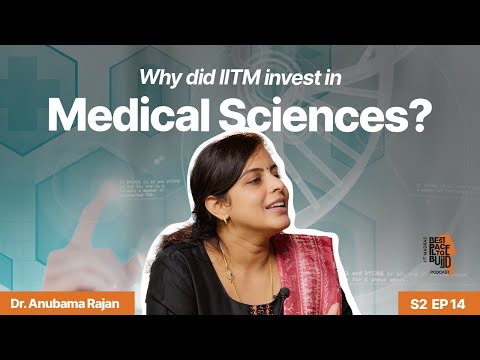
Growing Organs in a Petri Dish and Starting Labs in IIT Madras | Dr Anubama Rajan
Dr. Anubama Rajan (guest)
In this episode of Best Place To Build, featuring Dr. Anubama Rajan, Growing Organs in a Petri Dish and Starting Labs in IIT Madras | Dr Anubama Rajan explores organoids, drug discovery, and building IIT Madras’s new med-tech department Dr. Anubama Rajan describes organoids as 3D stem-cell-derived “mini organs” that replicate key human organ functions in a dish, enabling more human-relevant biology than cancer cell lines or many animal models.
Organoids, drug discovery, and building IIT Madras’s new med-tech department
Dr. Anubama Rajan describes organoids as 3D stem-cell-derived “mini organs” that replicate key human organ functions in a dish, enabling more human-relevant biology than cancer cell lines or many animal models.
She argues organoids can reduce costly drug-development failure by improving translational relevance, noting that over 90% of drugs fail at the clinical trial stage partly due to poor preclinical models.
Her research uses patient-derived airway/lung organoids to study respiratory disease mechanisms in Indian populations, including how viral infections can trigger or worsen asthma/COPD-like conditions.
She recounts spearheading COVID-era biosafety level-3 (BSL-3) protocol development for studying coronavirus infection in organoid models, highlighting the intensity and regulatory complexity of high-containment work.
The conversation also outlines IIT Madras’s new Medical Sciences & Technology department: interdisciplinary programs (BS, MS, PhD, MD-PhD), hospital immersions, clinician participation, and a translation-first Centre of Excellence for Diabetes Research focused on usable tools/technologies.
Rajan discusses science communication via social media and reflects on structural and personal factors affecting women’s mid-career progression in STEM, emphasizing self-prioritization, explicit communication, and support systems.
Key Takeaways
Organoids are a bridge between simplistic cell lines and imperfect animal models.
Because organoids are derived from organ-specific stem cells (not cancer cell lines), they can reproduce functional behaviors (e. ...
Get the full analysis with uListen AI
Better preclinical models can directly impact drug-development economics.
Rajan links the massive late-stage failure rate (>90% at clinical trials) to non-translational preclinical evidence; organoids are positioned as a way to test efficacy/toxicity in a more human-relevant system earlier.
Get the full analysis with uListen AI
Patient-derived organoids enable population- and phenotype-specific research.
By generating organoids from patient biopsies (plus healthy controls), labs can model diseases and triggers (e. ...
Get the full analysis with uListen AI
High-containment virology requires infrastructure and protocol leadership, not just lab skills.
During COVID, coronavirus research demanded BSL-3 conditions (negative pressure, permissions, surveillance), and Rajan’s role centered on creating workable organoid-based protocols within those constraints.
Get the full analysis with uListen AI
Returning to India can be strategically viable if you bring a distinctive capability.
She intentionally moved from gut to airway organoids because gut organoid work had already reached India; her plan was to “bring something new to the table” that matched India’s respiratory disease burden.
Get the full analysis with uListen AI
IIT Madras is institutionalizing clinician–engineer collaboration rather than treating it as ad hoc.
The MST department creates a formal space where physiology/biology, engineering/math, and practicing clinicians co-teach, co-define problems, and train students through structured hospital exposure.
Get the full analysis with uListen AI
A translation-first funding model can focus PhDs on deliverables without eliminating research depth.
The diabetes Centre of Excellence (SCODER) funds scholars with the explicit requirement to develop tools/technologies that solve real diabetic-community problems, reflecting a product-minded research culture.
Get the full analysis with uListen AI
Science communication is becoming a parallel “visibility” track in academia.
Rajan frames social media as “either you show up or you are in your own domain,” using it for storytelling, community-building after returning to India, and helping trainees navigate careers—while acknowledging its time cost and responsibility.
Get the full analysis with uListen AI
Women’s STEM attrition often spikes mid-career due to cumulative load and biased evaluation.
She highlights how caregiving responsibilities, harsher judgment during temporary performance dips, and uneven household expectations can reduce advancement opportunities—arguing that support plus self-prioritization and explicit help-seeking matter.
Get the full analysis with uListen AI
Notable Quotes
“Organoids… are nothing but three-dimensional bunch of stem cells that can be grown in a dish to mimic physiology of organs.”
— Dr. Anubama Rajan
“From the lab to the market, we spend billions of dollars… More than 90% of the drug fails at clinical trial.”
— Dr. Anubama Rajan
“You can’t study a human disease in a monkey or a rat because the symptoms are very different.”
— Dr. Anubama Rajan
“It’s not about how much you publish, where you publish. It’s always about what are you going to bring to the table.”
— Dr. Anubama Rajan (recounting Dr. Cherry Kang’s advice)
“When I started… there was no lab, no name board, no phone, no laptop, nothing… But… the path that they showed me was so striking that I wanted to do it.”
— Dr. Anubama Rajan
Questions Answered in This Episode
For someone new to the topic, what organ functions do organoids *not* reproduce well yet (e.g., immune system, vasculature, microbiome), and how do you compensate experimentally?
Dr. ...
Get the full analysis with uListen AI
You mention organoids can ‘poop out’ fluid and swell—what are the measurable readouts your lab uses to quantify these phenotypes for drug screening?
She argues organoids can reduce costly drug-development failure by improving translational relevance, noting that over 90% of drugs fail at the clinical trial stage partly due to poor preclinical models.
Get the full analysis with uListen AI
How do you create an ‘asthma/COPD-like’ state in airway organoids—what signals, exposures, or genetic perturbations model the disease most faithfully?
Her research uses patient-derived airway/lung organoids to study respiratory disease mechanisms in Indian populations, including how viral infections can trigger or worsen asthma/COPD-like conditions.
Get the full analysis with uListen AI
What are the biggest bottlenecks in India for scaling patient-derived organoid biobanks (ethics approvals, sample logistics, cost, standardization, or clinician partnerships)?
She recounts spearheading COVID-era biosafety level-3 (BSL-3) protocol development for studying coronavirus infection in organoid models, highlighting the intensity and regulatory complexity of high-containment work.
Get the full analysis with uListen AI
Since you’re on ISO/BIS panels, what standards do you think are most urgent for organoids (quality control metrics, reproducibility, cell-source traceability, or assay validation)?
The conversation also outlines IIT Madras’s new Medical Sciences & Technology department: interdisciplinary programs (BS, MS, PhD, MD-PhD), hospital immersions, clinician participation, and a translation-first Centre of Excellence for Diabetes Research focused on usable tools/technologies.
Get the full analysis with uListen AI
Transcript Preview
from Baylor College of Medicine. I was spearheading this research, and as a leader, to create protocols for studying coronavirus, technology called organoids, that can be grown in a dish to mimic physiology of organs. This enables scientists to do is better understand the human organ outside the human body without a need of doing clinical trial. From the lab to the market, we spend billions of dollars. More than 90% of the drug fails at clinical trial, and you're not allowed to study these pathogens in a normal lab. You need what's called as a biosafety level three. Including all this darkness, the light, the path that they showed me was so striking that I wanted to do it.
[upbeat music] Hi, this is Amrit. We are at IIT Madras, my alma mater, and India's top university for people who like to build. We are here to meet some builders, ask them: What are you building? What does it take to build? And what makes IIT Madras the best place to build? [upbeat music] Hello, and welcome to the Best Place to Build podcast. Today, we are sitting with Professor Anubama Rajan. She's a faculty in the Department of Medical Science and Technology. It's a new department at IIT Madras. She's also the principal investigator, the PI, for two of the labs in the department. I'm very eager to learn about them, uh, because this is not my field. I have no idea. Um, Professor, welcome to the podcast.
It's a pleasure to be here.
Professor, let's start with this thing that I learned from your website. You are the PI for Organ-on-Chip Lab, uh, which is experimenting with mini organs on a dish. Did I get that correct?
You got it right.
Okay, so can you tell us what this lab does and, uh, maybe a little bit about the field?
Sure. So OrgAMED is organoid assisted medicine. So I work in a specific field called, uh, organoid biology. In simple terms, these are, uh, miniature stem cell models that mimic an organ, so that's where you get the idea of organs in a dish. So in about 2010, there was a group from Netherlands, and Hans Clevers was the PI of the group, and, uh, he invented this technology called organoids, which are nothing but three-dimensional bunch of stem cells that can be grown in a dish to mimic physiology of organs. So to go into details about what is the physiology, if you take a gut, for example, we know gut is involved in absorbing nutrients. They make mucus to trap microorganisms. They excrete certain things. But, uh, traditionally, when we think in biology, there are something called cell culture model system and animal model. So the cell culture model system, for a very long time, people have used cancer cell lines to, uh, mimic a specific organ. But these organoids are different because they are not cancer cell. They are derived from stem cells of a specific organ, and these stem cells are like building blocks. So you can use this to go on to reproduce the similar system outside the human body. So the mini gut in a dish do make mucus. They actually can, uh, poop out, like diarrhea. They can release fluid and swell in real time. They can absorb nutrients. So what this enables scientists to do is better understand the human organ outside the human body without a need of doing clinical trials, et cetera. And, um, why was that important? Because for a long time, people have used animal models, and essentially, you can't study a human disease in a monkey or a rat because the symptoms are very different. So they needed a more appropriate model system to better understand human disease, so that's the fundamental principle behind OrgAMED.
Install uListen to search the full transcript and get AI-powered insights
Get Full TranscriptGet more from every podcast
AI summaries, searchable transcripts, and fact-checking. Free forever.
Add to Chrome