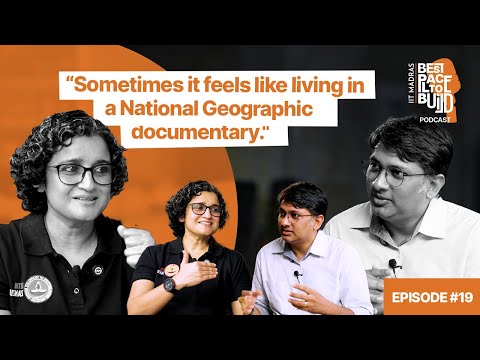
Prof. Preeti Aghalayam|"Sometimes it feels like living in a National Geographic documentary."| Ep.19
Preeti Aghalayam (guest)
In this episode of Best Place To Build, featuring Preeti Aghalayam, Prof. Preeti Aghalayam|"Sometimes it feels like living in a National Geographic documentary."| Ep.19 explores building IIT Madras Zanzibar: fast launch, global campus, community-first vision Prof. Preeti Aghalayam, Founding Director of IIT Madras Zanzibar and the first woman director of any IIT campus, describes what it took to establish IITM’s first offshore physical campus in record time—from a Feb 2023 visit to the first day of classes on 24 Oct 2023. She outlines the core building blocks: intergovernmental alignment, program/curriculum design, student selection, faculty staffing, and creating facilities and operations from scratch.
Building IIT Madras Zanzibar: fast launch, global campus, community-first vision
Prof. Preeti Aghalayam, Founding Director of IIT Madras Zanzibar and the first woman director of any IIT campus, describes what it took to establish IITM’s first offshore physical campus in record time—from a Feb 2023 visit to the first day of classes on 24 Oct 2023. She outlines the core building blocks: intergovernmental alignment, program/curriculum design, student selection, faculty staffing, and creating facilities and operations from scratch.
The Zanzibar campus began with BS and MTech programs in Data Science & AI, added an MTech in Ocean Structures, and is planning a BS in Chemical/Process Engineering. Positioned as an international campus, it already has a diverse cohort and aims to become a “melting pot” for students and faculty across Africa and beyond.
A major theme is culture: a small, high-access, community-driven “IITM Zanzibar family” combining IITM rigor with an island vibe, while intentionally fostering innovation through hackathons and a student showcase event that drew real-world interest and potential funding.
The conversation also covers admissions (screening test + interviews), governance (IITM senate-driven academics with a local governing council), the long-term vision (research park/entrepreneurship + skilling), and broader reflections on chemical engineering, teaching innovation, AI tools in research, and gender representation in academia.
Key Takeaways
Offshore IIT expansion starts with geopolitics, not just academics.
Aghalayam emphasizes that a strong bilateral relationship and explicit government backing are prerequisites; IIT autonomy alone isn’t sufficient for cross-border campuses.
Get the full analysis with uListen AI
IITM Zanzibar was built on an unusually fast execution cycle.
From Feb 2023 groundwork to a July 2023 tripartite MoU to classes beginning 24 Oct 2023, the campus compressed decisions on curriculum, staffing, facilities, and hostels into months.
Get the full analysis with uListen AI
Academic legitimacy is protected by keeping Zanzibar academics under IITM systems.
Curricula and admissions are IIT Madras senate-approved, enabling IITM degrees; local authorities do not control academic decisions even though the campus follows Zanzibar’s laws as a cross-border institution.
Get the full analysis with uListen AI
“International” is operationalized as mixed nationalities from day one.
With ~50% “international” by different definitions (non-Indian or non-local) and early representation from multiple African countries plus India/Middle East, the campus is designed as a global intake model rather than a later-stage add-on.
Get the full analysis with uListen AI
Small scale is being used as a strategic advantage for culture.
With ~105 students, the campus intentionally builds DNA-level community—shared meals, joint outings, and high faculty access—aiming to preserve closeness that larger campuses often lose.
Get the full analysis with uListen AI
Innovation is treated as a non-negotiable IITM signature—not optional enrichment.
The “Power of Data” showcase tested whether the entrepreneurial mindset is emerging; first-year students pitched ideas (edtech accessibility, tourism tech), and at least one audience member offered potential funding, validating early momentum.
Get the full analysis with uListen AI
Admissions design tries to balance rigor with confidence-building for non-India contexts.
The 5-part screening test (physics, chemistry, math, mental ability, English) plus interviews is paired with outreach and light-touch preparation support, acknowledging that many applicants are less accustomed to high-stakes testing culture.
Get the full analysis with uListen AI
The long-term bet is an IITM-style ecosystem in Africa, not just degree delivery.
The vision includes research-park-like entrepreneurship, solving Africa-relevant/global challenges, and scaling professional skilling/certificates—especially important given Africa’s youth bulge.
Get the full analysis with uListen AI
Chemical engineering is framed as a broad “making systems” discipline.
Aghalayam distinguishes it from chemistry by focusing on industrial-scale processes (reactors, flows, energy, materials, pharma, emissions, CO₂ capture) and highlights its natural fit with data/AI due to abundant process data.
Get the full analysis with uListen AI
Gender parity improvements require pipeline thinking and data-driven policy.
She notes stronger representation among PhD scholars (~1,000 women out of ~3,000) than undergrads/faculty, and describes IITM’s GATI exercise: track gender at each hiring stage, reflect, and implement realistic, discipline-aware interventions.
Get the full analysis with uListen AI
Notable Quotes
““Making a physical campus abroad is a very big step.””
— Prof. Preeti Aghalayam
““24th October 2023, first day of classes.””
— Prof. Preeti Aghalayam
““So we call ourselves the IITM Zanzibar family. The sense of community is really very important for us.””
— Prof. Preeti Aghalayam
““Sometimes it feels like living in a National Geographic documentary.””
— Prof. Preeti Aghalayam
““Out of the 3,000 PhD scholars you have on campus, you have 1,000 of them being women.””
— Prof. Preeti Aghalayam
Questions Answered in This Episode
What were the top 3 decisions that enabled the MoU-to-classes timeline (July to Oct 2023) without compromising IITM standards?
Prof. ...
Get the full analysis with uListen AI
How did IITM choose Data Science/AI as the first BS/MTech offering—what data or stakeholder inputs mattered most in Zanzibar/East Africa?
The Zanzibar campus began with BS and MTech programs in Data Science & AI, added an MTech in Ocean Structures, and is planning a BS in Chemical/Process Engineering. ...
Get the full analysis with uListen AI
For the planned BS in Chemical/Process Engineering, what local industries or regional needs are you explicitly designing toward (energy, pharma, materials, climate)?
A major theme is culture: a small, high-access, community-driven “IITM Zanzibar family” combining IITM rigor with an island vibe, while intentionally fostering innovation through hackathons and a student showcase event that drew real-world interest and potential funding.
Get the full analysis with uListen AI
You said IITM Zanzibar is IITM senate-driven academically—what are the hardest parts of translating IITM processes (senate, curriculum updates, assessment norms) to an offshore context?
The conversation also covers admissions (screening test + interviews), governance (IITM senate-driven academics with a local governing council), the long-term vision (research park/entrepreneurship + skilling), and broader reflections on chemical engineering, teaching innovation, AI tools in research, and gender representation in academia.
Get the full analysis with uListen AI
The campus is registered under Zanzibar laws with a joint governing council—where do tensions typically arise (procurement, staffing, finance, compliance), and how are they resolved?
Get the full analysis with uListen AI
Transcript Preview
making a physical campus abroad is a very big step. So we call ourselves the IITM Zanzibar family. The sense of community is really very important for us. Out of the 3,000 PhD scholars you have on campus, you have 1,000 of them being women. [upbeat music]
Hi, my name is Amrit. We've heard that IIT Madras is the best place to build. [upbeat music] So we've come down to the Sudha and Shankar Innovation Hub. We want to meet some people. These are builders. We want to talk to them about their work, and also ask them what makes IIT Madras the best place to build? [upbeat music] Hello, and welcome to The Best Place to Build Podcast. Today I'm sitting with Professor Preeti. Professor Preeti is the Founding Director of the IIT Madras Zanzibar campus. She's also the first woman director of any IIT campus. Uh, before this, she was a chemical engineering professor at IIT Madras, and then before that, at IIT Bombay. Welcome to the podcast, Professor.
Thank you so much, Amritash. A pleasure to be here.
Um, I also want to tell you that we, uh, took three months to schedule this because, of course, you are traveling between campuses, and today you are in Chennai. Um, Professor, you're the founding director of this new IIT campus outside India, and the first question that comes to mind is: What does it take to start a new IIT? [chuckles] Can you break it down into steps for us?
So I think we can write a book about this, uh, and we probably should. Uh, it's first of all, the initiation comes from the governments, although, uh, as an IIT, as IIT Madras, we are, uh, autonomous, uh, but we are still supported by the government. And a lot of this kind of activity that we do outside the country does need the blessing of, uh, the government of India. And I think as, uh, you know, a blue- Office of Global Engagement in IIT Madras, we've been, uh, sort of treading a lot of new ground already in this theme of internationalization. And, you know, we've done ton of things that are very new, very different in the realm of internationalization. But this is a big step. Making a physical-
Sure
... campus abroad is a very big step for any institution, but particularly for an institution like an IIT, which has a lot of 50, 60 years of a brand that is built. You go in a new region, will you enjoy the type of, uh, you know, autonomy, the enablement, just the recognition that you have in India, um, and how important is that to think about all these things? So you wanted me to break it down into steps. I think the first is for the two governments, wherever we are going, to have a very, uh, good, strong, possibly a strategic kind of bilateral relationship. That is, uh, very important. Nothing would happen without that. And the second would be that, uh... and of course, IIT Madras [chuckles] always raises its hand first for all these things, want to do this, want to pick up on this, uh, challenge and go over there, and you have to set up everything from scratch, right? Every chair, every blackboard, every single student, faculty that is a staff member, et cetera. So first, of course, some agreements between the government involving IIT Madras and what we need, what we, uh, imagine for something like this. A good academic, uh, s- being set up in terms of what are the programs that we are going to offer, what is the curriculum going to look like, what is the student selection process going to be like, and what is the market for these students? Where are they going to come from? How are we going to ensure that that aligns with, you know, with the type of student we're looking with- looking for, and the program that we're looking at? And then the big deal about faculty. Students also, of course, it's very difficult, but you can, uh, find students who want the IIT Madras experience, even in Zanzibar. But then the faculty who will teach the IIT Madras courses, so setting up that, I think, is, uh, definitely one of the top three or four steps. Building the physical campus, uh, making sure that it is, uh, commensurate with where IIT Madras is today, and we can do the type of classes we want, have the administrative faculty experiences, student experiences, that is deserved of an IIT Madras student. That is the fourth one. And the rest of it is all lots of everyday, uh, details for, uh, running this institution successfully, making sure that, um, you know, there is a long-term focus, uh, but also a, a short-term handling of details focus as well.
Install uListen to search the full transcript and get AI-powered insights
Get Full TranscriptGet more from every podcast
AI summaries, searchable transcripts, and fact-checking. Free forever.
Add to Chrome