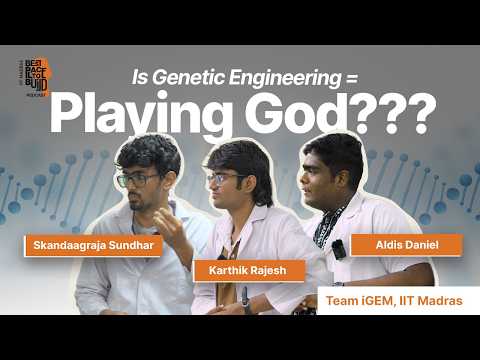
This team manipulates genes to create LIFE from SCRATCH!? | BP2B: Student Edition! Ep.02
In this episode of Best Place To Build, This team manipulates genes to create LIFE from SCRATCH!? | BP2B: Student Edition! Ep.02 explores inside IIT Madras iGEM: engineering organisms, teams, and ethics together The video introduces iGEM as an international synthetic biology competition where student teams design their own problem statements and build engineered biological systems to address real-world needs.
Inside IIT Madras iGEM: engineering organisms, teams, and ethics together
The video introduces iGEM as an international synthetic biology competition where student teams design their own problem statements and build engineered biological systems to address real-world needs.
Team iGEM IIT Madras explains synthetic biology as engineering-minded genetic manipulation—treating microbes like programmable systems to produce useful molecules such as insulin or drugs.
The team outlines past and current projects, including Mars/space biomanufacturing (paracetamol from algae) and a 2025 gene-regulation approach using epigenetic methylation guided by CRISPR-dCas to boost expression.
Viewers get a practical lab walkthrough of bacterial transformation, covering sterile technique, making cells competent, heat-shock uptake of plasmids, recovery in LB, and plating for single colonies.
The episode highlights iGEM’s interdisciplinary structure (wet lab, dry lab, WebOps, media, human practices), corporate sponsorship-driven funding, and ongoing emphasis on biosafety and dual-use ethics.
Key Takeaways
iGEM rewards self-directed, research-like problem solving—not fixed prompts.
Unlike many competitions, iGEM gives teams freedom to choose a problem each year, validate it with literature and stakeholders, and then build and present a working synthetic biology solution.
Get the full analysis with uListen AI
Synthetic biology reframes organisms as engineered systems for production.
The team emphasizes an “engineer’s mindset”: add genes/circuits to microbes so they reliably manufacture a target output (e. ...
Get the full analysis with uListen AI
Their 2025 focus targets gene expression via epigenetic control, not just sequence edits.
Instead of only swapping promoters or altering DNA sequences, they describe guiding methylation to specific genomic sites using a CRISPR-dCas-linked methylation tool to influence transcription and increase protein output.
Get the full analysis with uListen AI
Core wet-lab progress depends on repeatable fundamentals like transformation.
Competent cells, sterile handling in laminar flow, heat-shock uptake of plasmids, recovery in LB, and colony selection on agar are portrayed as the routine backbone enabling more advanced constructs.
Get the full analysis with uListen AI
Interdisciplinarity is built into iGEM deliverables, not an optional extra.
Beyond wet lab, the team explicitly needs modeling/software (dry lab), web development (wiki/WebOps), media, and human practices—so contributors can come from any department, not only biotech.
Get the full analysis with uListen AI
Corporate sponsorship is a major enabler of student research competitions.
They state that most lab expenses and competition fees come from corporate sponsorship, highlighting AstraZeneca as a title sponsor for the year.
Get the full analysis with uListen AI
Ethics is treated as an operational constraint: contain, assess dual-use, and sometimes don’t publish.
They stress biosafety/containment to prevent environmental impact and acknowledge dual-use risk where DNA sequences can be repurposed; if work could be misused, the team suggests stopping and withholding publication.
Get the full analysis with uListen AI
Notable Quotes
““We consider a bacteria as a system, and we want to make it produce something that we want.””
— Team lead (Aldes)
““When we have a colony on Mars, we want to make the medicines we need at Mars… produce paracetamol… using some algae… in the Martian environment.””
— Team member (Aldes)
““This process is called bacterial transformation, which is essentially introducing new… circular DNA into a bacteria.””
— Skanda (wet lab team)
““Most of our lab work and our competition fees comes from our corporate sponsorship… a title sponsor, AstraZeneca.””
— Aldes
““Whenever you're working on something, you always have to consider how someone might use it nefariously… you stop there, and then you just don't publish that work.””
— Aldes
Questions Answered in This Episode
On your 2025 epigenetics project, what exact readouts will you use to prove methylation changed expression (qPCR, reporter fluorescence, protein quantification, sequencing)?
The video introduces iGEM as an international synthetic biology competition where student teams design their own problem statements and build engineered biological systems to address real-world needs.
Get the full analysis with uListen AI
You describe methylation as helping transcription factors bind—are there cases where methylation represses genes, and how are you choosing sites to avoid downregulation?
Team iGEM IIT Madras explains synthetic biology as engineering-minded genetic manipulation—treating microbes like programmable systems to produce useful molecules such as insulin or drugs.
Get the full analysis with uListen AI
What organism/cell types are you using for the prokaryotic vs. mammalian arms of the project, and what are the different success criteria in each?
The team outlines past and current projects, including Mars/space biomanufacturing (paracetamol from algae) and a 2025 gene-regulation approach using epigenetic methylation guided by CRISPR-dCas to boost expression.
Get the full analysis with uListen AI
In the transformation workflow, what selection method are you using on plates (antibiotic marker), and how do you balance biosafety concerns around antibiotic resistance genes?
Viewers get a practical lab walkthrough of bacterial transformation, covering sterile technique, making cells competent, heat-shock uptake of plasmids, recovery in LB, and plating for single colonies.
Get the full analysis with uListen AI
How does the dry-lab modeling concretely influence wet-lab decisions (e.g., guide RNA selection, promoter choice, predicted fold-change targets)?
The episode highlights iGEM’s interdisciplinary structure (wet lab, dry lab, WebOps, media, human practices), corporate sponsorship-driven funding, and ongoing emphasis on biosafety and dual-use ethics.
Get the full analysis with uListen AI
Transcript Preview
When we have a colony on Mars, we want to make the medicines we need at Mars. Uh, so basically we try to produce paracetamol, uh, using some algae, uh, in the Martian environment.
We are one of the few institutes in India that actually has an iGEM team.
We were, uh, lucky enough to bag a, a title sponsor, uh, AstraZeneca.
Wow.
Uh, most of our lab work and our competition, uh, fees, uh, comes from our corporate sponsorship.
Hi, guys. Welcome to Best Place to Build, Student Edition. I'm Vidhi, a fifth-year student in IIT Madras. Have you ever been curious about the term synthetic biology or genetic engineering? We're here today with Team iGEM of IIT Madras. Their team leads are here with us minutes before the orientation to explain us more about this. [upbeat music] I'm here with the team lead from iGEM, Aldes, and we're here minutes before the in- orientation to know more. So first of all, what is iGEM?
So iGEM is a competition that happens every year in Paris, so it stands for International Genetically Engineered Machine. So it's basically a synthetic biology competition where, uh, undergraduate and postgraduate teams from across the world come and solve real-world problems every year.
Okay, wow, that's a lot to take in at one time. So, uh, first, what is synthetic biology?
All right. Uh, so yeah, synthetic biology is not that different from genetic engineering. So what we do is we apply genetic engineering principles, um, from an engineer's mindset. So we consider a bacteria as a system, and we want to make it produce something that we want, basically. So to, to, uh, do that, we introduce, uh, new genes and genetic circuits to make it do what we want it to do.
Okay, could you give me some example of this being used in the real world?
So be- one, I think very, um, widespread example would be insulin. So insulin is something that is normally produced in our own cells, and, uh, diabetes happens when you're not able to do it yourself. So what happens is, uh, scientists introduce the insulin, the gene that produces insulin, into E. coli, and then, uh, the cells then produce the insulin that we are able to then use, basically.
Just by introducing that, now your body is able to make use of that E. coli bac-
No, no, no.
No?
No, the bacteria is grown in a lab, uh, the insulin is extracted, and then it's post-processed, and then we get it as medicine.
Oh, okay, so you're using a bacteria as like a manufacturing hub now-
Yeah, yeah, yeah
... I understand. That's really cool. And have you guys done any such projects like this in the past?
Uh, yeah, actually, uh, last year our project was based on space biomanufacturing. So what we did is, uh, like basically, uh, transporting material in space is expensive. So when we have a colony on Mars, we want to make the medicines we need at Mars. Uh, so basically we try to produce paracetamol, uh, using some algae, uh, in the Martian environment.
Install uListen to search the full transcript and get AI-powered insights
Get Full TranscriptGet more from every podcast
AI summaries, searchable transcripts, and fact-checking. Free forever.
Add to Chrome