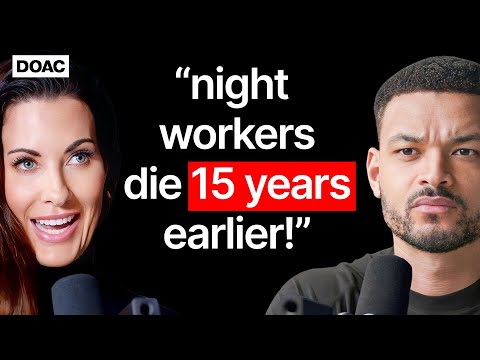
The Fitness Scientist: "Even A Little Alcohol Is Hurting Your Health!" Kristen Holmes
Kristen Holmes (guest), Steven Bartlett (host), Narrator
In this episode of The Diary of a CEO, featuring Kristen Holmes and Steven Bartlett, The Fitness Scientist: "Even A Little Alcohol Is Hurting Your Health!" Kristen Holmes explores sleep, Light, Alcohol: Data-Driven Rules For Human Flourishing Daily Kristen Holmes, VP of Performance Science at WHOOP, explains how circadian rhythms, sleep regularity, light exposure, meal timing, and substance use fundamentally shape health, performance, and mental wellbeing. Drawing on large-scale WHOOP datasets and external research, she argues that when you sleep and wake is more predictive of mortality and psychological functioning than how long you sleep. She highlights how modern behaviors—late-night light, food, alcohol, erratic schedules—severely disrupt biological clocks, elevating risks for cancer, cardiovascular disease, metabolic dysfunction, mental illness, and reduced cognitive performance. Interwoven with her personal story of growing up with an alcoholic mother, she frames behavior change as aligning daily habits with deeply held values and leveraging small, consistent circadian-aligned actions to exit downward spirals.
Sleep, Light, Alcohol: Data-Driven Rules For Human Flourishing Daily
Kristen Holmes, VP of Performance Science at WHOOP, explains how circadian rhythms, sleep regularity, light exposure, meal timing, and substance use fundamentally shape health, performance, and mental wellbeing. Drawing on large-scale WHOOP datasets and external research, she argues that when you sleep and wake is more predictive of mortality and psychological functioning than how long you sleep. She highlights how modern behaviors—late-night light, food, alcohol, erratic schedules—severely disrupt biological clocks, elevating risks for cancer, cardiovascular disease, metabolic dysfunction, mental illness, and reduced cognitive performance. Interwoven with her personal story of growing up with an alcoholic mother, she frames behavior change as aligning daily habits with deeply held values and leveraging small, consistent circadian-aligned actions to exit downward spirals.
Key Takeaways
Stabilize your sleep-wake time; regularity beats raw duration.
Across WHOOP data and external studies (e. ...
Get the full analysis with uListen AI
Protect your circadian rhythm by respecting the light-dark cycle.
The brain’s master clock in the suprachiasmatic nucleus uses light and darkness to synchronize every cell, tissue, and organ. ...
Get the full analysis with uListen AI
Consolidate your eating window and stop eating several hours before sleep.
Time-restricted eating (when you eat) improves metabolic health even without changing calories. ...
Get the full analysis with uListen AI
Even small amounts of alcohol meaningfully damage sleep, recovery, and health.
WHOOP data show that any alcohol produces a clinically significant drop in HRV and increase in resting HR, with a roughly linear decline in recovery with each drink; on average, recovery is ~6% worse after drinking. ...
Get the full analysis with uListen AI
HRV is a powerful, modifiable marker of global health and stress resilience.
Heart rate variability—beat-to-beat variation in heart rhythm—reflects how flexibly your autonomic nervous system can adapt to stress. ...
Get the full analysis with uListen AI
Sleep debt quietly degrades your thinking, leadership, mood, and safety.
Sleep debt is the gap between what your body needs and what you actually get. ...
Get the full analysis with uListen AI
Behavior change sticks when it’s anchored to your values and identity.
Many people “know” what to do but don’t do it because their habits aren’t connected to who they want to be. ...
Get the full analysis with uListen AI
Notable Quotes
“Sleep-wake timing, I think, is the mother of all performance optimization behaviors.”
— Kristen Holmes
“There isn’t a disease or disorder that circadian disruption doesn’t touch.”
— Kristen Holmes
“How much time you spend in bed doesn’t necessarily predict how long you live. It is the degree to which you stabilize when you go to bed and when you wake up that predicts mortality.”
— Kristen Holmes
“I literally have not been sick since 2017… That has been the single biggest change: just sleeping and waking up at the same time.”
— Kristen Holmes
“If you need alcohol to bond or to form a connection, there’s probably something else going on that is unaddressed.”
— Kristen Holmes
Questions Answered in This Episode
In your WHOOP datasets, how does improving sleep-wake regularity *without* increasing total sleep time change HRV and mental health markers over several months?
Kristen Holmes, VP of Performance Science at WHOOP, explains how circadian rhythms, sleep regularity, light exposure, meal timing, and substance use fundamentally shape health, performance, and mental wellbeing. ...
Get the full analysis with uListen AI
For people who must do rotating night shifts, what is the most realistic, high-impact protocol you’d prescribe for light, food, and sleep timing to minimize the estimated 15-year reduction in lifespan?
Get the full analysis with uListen AI
You argue strong chronotype differences are largely overstated; what specific chronobiology studies or datasets most convincingly challenge the popular ‘night owl vs. lark’ narrative?
Get the full analysis with uListen AI
Have you observed cases in WHOOP data where someone maintained excellent HRV and recovery metrics despite moderate alcohol use, and if so, what patterns or compensatory behaviors distinguished them?
Get the full analysis with uListen AI
When you coach high-performing leaders who resist changing their sleep or alcohol habits, how do you practically use their stated values to overcome that resistance and create durable behavior change?
Get the full analysis with uListen AI
Transcript Preview
What the research says is that people who are having sex within a few hours of when they sleep have better markers of sleep and recovery.
So, does masturbation not have the same implications?
Well, what was so interesting about this research is that-
Kristen Holmes is the vice president of Performance Science at WHOOP. ... who has access to health data from hundreds of thousands of people, and her groundbreaking research will tell you the secrets of achieving perfect health and performance.
The key to your health is your circadian rhythm, which are physical, mental, and behavioral changes that happen in a 24-hour cycle. One of the most known circadian rhythms is being asleep during the night, and it has massive health consequences. For example, we know that shift workers, on average, are going to die 15 years sooner, but if you're awake for two hours between 10:00 PM and 4:00 AM two days per week for 25 days of the year, you qualify as a shift worker. You are putting yourself at increased risk for cancer, cardiovascular disease. Mental health issues, can have trouble having children.
I mean, that's terrifying.
We know that we haven't adapted to blue light.
The light we get from screens?
Yes. If you're viewing light between the hours of 10:00 PM and 4:00 AM, it actually has a pro-depressive effect. The list goes on and on. And a lot of people are like, "I have to go to bed at 1:00 AM because I'm a night owl." Total BS. You're making a choice, and if you wanna perform consistently, increase your tolerance for stress and take control of your life, you need to-
We wanna eat.
And most importantly, we need to-
Quick one. This is really, really fascinating to me. On the backend of our YouTube channel, it says that 69.9% of you that watch this channel frequently over the lifetime of this channel haven't yet hit the subscribe button. I just wanted to ask you a favor. It helps this channel so much if you choose to d- subscribe. Helps us scale the guests, helps us scale the production, and it makes the show bigger. So if I could ask you for one favor, if you've watched this show before and you've enjoyed it and you like this episode that you're currently watching, could you please hit the subscribe button? Thank you so much, and I will repay that gesture by making sure that everything we do here gets better and better and better and better. That is a promise I'm willing to make you. Do we have a deal? Kristen, why do you do the work that you do?
I am, uh, irrationally passionate (laughs) about human flourishing and the frameworks, policies, basically determinants of, of human flourishing. And, um, yeah, I've kind of dedicated my life to understanding, um, how the physiology and, and psychology work together to help people take control of their health, um, so they can understand how to apply their e- energy and, and attention in a way that's truly rewarding.
Install uListen to search the full transcript and get AI-powered insights
Get Full TranscriptGet more from every podcast
AI summaries, searchable transcripts, and fact-checking. Free forever.
Add to Chrome