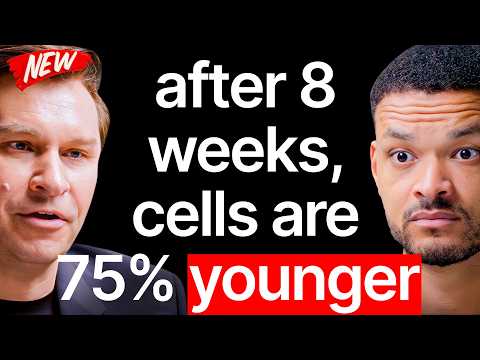
David Sinclair: Can Aging Be Reversed? After 8 Weeks, Cells Appeared 75% Younger In Tests!
Steven Bartlett (host), Dr. David Sinclair (guest)
In this episode of The Diary of a CEO, featuring Steven Bartlett and Dr. David Sinclair, David Sinclair: Can Aging Be Reversed? After 8 Weeks, Cells Appeared 75% Younger In Tests! explores harvard longevity scientist explains age reversal, risks, and lifestyle levers Sinclair claims aging is driven primarily by loss of epigenetic information (cells ‘forget’ their identity) and that restoring this information can rejuvenate tissues and potentially eliminate many age-related diseases.
Harvard longevity scientist explains age reversal, risks, and lifestyle levers
Sinclair claims aging is driven primarily by loss of epigenetic information (cells ‘forget’ their identity) and that restoring this information can rejuvenate tissues and potentially eliminate many age-related diseases.
He describes imminent first-in-human eye trials using three genes delivered via AAV to reset retinal/optic-nerve cell age, positioned as a safer entry point before whole-body rejuvenation.
He links lifestyle stressors (DNA damage, ultra-processed food, smoking, excess alcohol, frequent flying/radiation) to faster epigenetic drift and promotes hormesis—fasting, exercise, heat/cold—as a way to activate repair pathways.
He argues most chronic diseases (Alzheimer’s, cardiovascular disease, many cancers) are downstream of aging, so targeting aging could prevent or reverse multiple conditions simultaneously, including potential fertility/ovary rejuvenation based on mouse work.
He explores disruptive consequences of longevity tech (economics, work, social systems, geopolitics, ‘super-soldier’ concerns) and closes with speculative views on consciousness, simulation theory, and AI’s role in accelerating breakthroughs.
Key Takeaways
Sinclair frames aging as reversible ‘software’ corruption, not inevitable wear-and-tear.
He argues DNA largely remains intact while the epigenome (gene-control “labels” like methylation patterns) degrades after repeated stress responses, leading cells to lose identity; rejuvenation means restoring the original gene-expression program.
Get the full analysis with uListen AI
Breaking DNA accelerates aging by disrupting epigenetic control systems.
He emphasizes chromosome breaks trigger emergency repair responses that relocate regulatory proteins (including sirtuins) and don’t fully reset afterward; he cites “ICE mice” where induced, non-mutagenic DNA breaks produced ~50% accelerated aging phenotypes.
Get the full analysis with uListen AI
The first major human proof point is an eye-based gene therapy aimed at blindness.
Sinclair describes delivering three genes via an AAV2-like vector into the eye, then using doxycycline to activate them for ~6–8 weeks; the eye is chosen for containment/safety and clear functional endpoints (vision changes).
Get the full analysis with uListen AI
If age reversal works, many diseases may diminish because aging is the root driver.
He claims reversing biological age in animal models can make Alzheimer’s-like pathology, cardiovascular decline, and some cancers improve because young tissues repair damage and maintain immune surveillance more effectively.
Get the full analysis with uListen AI
Fasting is positioned as a high-leverage, accessible longevity intervention.
He recommends gradually extending overnight fasting (aim ~14+ hours, some individuals 16) and occasionally doing longer fasts (~3 days) to engage deeper protein-recycling mechanisms (autophagy), while avoiding malnutrition.
Get the full analysis with uListen AI
NAD availability is central to sirtuin activity; fasting can raise NAD.
Sinclair says NAD levels fall roughly by midlife and that sirtuins require NAD to regulate gene expression and repair DNA; he discusses NAD-precursor supplementation (e. ...
Get the full analysis with uListen AI
Dietary pattern matters more than trendy extremes; emphasize plants and polyphenols.
He’s skeptical of long-term keto for longevity, encourages “eat the rainbow,” and highlights polyphenol-rich foods (matcha, berries, olive oil, crucifers) as hormetic signals that activate stress-resistance pathways.
Get the full analysis with uListen AI
Notable Quotes
““I reject the idea that aging, just because it’s natural, is acceptable.””
— Dr. David Sinclair
““Aging is a cellular identity crisis.””
— Dr. David Sinclair
““When you reverse aging, diseases of aging go away or are cured.””
— Dr. David Sinclair
““Inside that person is a young person waiting to come out again.””
— Dr. David Sinclair
““Three meals a day is craziness.””
— Dr. David Sinclair
Questions Answered in This Episode
What exactly are the ‘three genes’ used for age reversal in the eye trial, and what safety tradeoffs led you to exclude the fourth Yamanaka factor?
Sinclair claims aging is driven primarily by loss of epigenetic information (cells ‘forget’ their identity) and that restoring this information can rejuvenate tissues and potentially eliminate many age-related diseases.
Get the full analysis with uListen AI
What objective measures besides vision tests will determine whether the human eye trial has truly ‘reversed age’ rather than just improved function?
He describes imminent first-in-human eye trials using three genes delivered via AAV to reset retinal/optic-nerve cell age, positioned as a safer entry point before whole-body rejuvenation.
Get the full analysis with uListen AI
In the ICE mouse model, how confident are you that accelerated aging is due to epigenetic drift rather than subtle mutations, inflammation, or selection effects?
He links lifestyle stressors (DNA damage, ultra-processed food, smoking, excess alcohol, frequent flying/radiation) to faster epigenetic drift and promotes hormesis—fasting, exercise, heat/cold—as a way to activate repair pathways.
Get the full analysis with uListen AI
You list flying/CT scans as aging accelerants—how large is the effect size in humans, and how should frequent flyers or medically-imaged patients mitigate it realistically?
He argues most chronic diseases (Alzheimer’s, cardiovascular disease, many cancers) are downstream of aging, so targeting aging could prevent or reverse multiple conditions simultaneously, including potential fertility/ovary rejuvenation based on mouse work.
Get the full analysis with uListen AI
If aging reversal broadly suppresses cancer risk, what prevents rejuvenation therapies from also helping existing tumor cells (i.e., could ‘making cells younger’ ever be pro-cancer in some contexts)?
He explores disruptive consequences of longevity tech (economics, work, social systems, geopolitics, ‘super-soldier’ concerns) and closes with speculative views on consciousness, simulation theory, and AI’s role in accelerating breakthroughs.
Get the full analysis with uListen AI
Transcript Preview
This is very, oh, [beep]
It's bad, right?
It's hard, yeah.
That's what it's like to be old. And for far too long, we've ignored it or accepted it as natural, and I reject the idea that aging, just because it's natural, is acceptable. Dying at 80 is not inevitable. Absolutely, that can be changed. So if you're skeptical, I am a Harvard professor who has been studying aging, longevity, and age reversal for 30 years, and I've seen enough from my lab showing that we can literally now reverse the aging process. And it's, it's not a question of if, it's a question of when this is gonna happen. And everyone should stick around because I'm gonna tell you some of the major things that people should be doing. They can lengthen their life by a decade. Hey, you're not taking that off, Steven.
Oh, yeah.
You got 10 minutes for that.
Sorry.
So you can accelerate aging by smoking, getting an X-ray, ultra-processed foods, excessive drinking, flying a lot.
I fly all the time.
That's probably accelerating your aging process. [keyboard clacking] [bell dings] Even going to a rock concert and blasting your eardrums because your ear hair cells are getting older faster. And so I look at the body like it's a computer, and we can reinstall the software. And what's interesting is, when you reverse aging, diseases like Alzheimer's, cancer, heart disease go away or are cured because what's driving a lot of those diseases is aging. And so my lab is like Willy Wonka's Chocolate Factory. They are making discoveries that blow me away every week. And I think we're at a turning point in human history where you're probably gonna live into the 22nd century if you do all the right things.
And we're gonna dig into all of those in great detail. But what are the unintended consequences of such a world where we all live longer? And also, do you think it's gonna be possible in the next 50 years for us to live forever? And then what's the best, uh, treatment you've discovered for hair loss?
This is why I love your podcast, Steven. You ask the right questions. So first-
This is super interesting to me. My team give me this report to show me how many of you that watch this show subscribe, and some of you have told us, according to this, that you are unsubscribed from the channel randomly. So favor to ask all of you, please could you check right now if you've hit the subscribe button if you are a regular viewer of the show and you like what we do here. We're approaching quite a significant landmark on this show in terms of a subscriber number. So if there was one simple free thing that you could do to help us, my team, everyone here, to keep this show free, to keep it improving year over year and week over week, it is just to hit that subscribe button and to double-check if you've hit it. Only thing I'll ever ask of you. Do we have a deal? If you do it, I'll tell you what I'll do. I'll make sure every single week, every single month, we fight harder and harder and harder and harder to bring you the guests and conversations that you wanna hear. I've stayed true to that promise since the very beginning of The Diary of a CEO, and I will not let you down. Please help us. Really appreciate it. Let's get on with the show. [upbeat music] Dr. David Sinclair, I have waited many years to speak to you, and I've been so keen to speak to you for so many years because so much of the research and the information I've consumed on the subjects we're gonna talk about today comes from you, directly from research you've done and from theories and ideas and hypotheses that you formed. I think the place that this conversation should start is, is probably with this picture because it appears to be incredibly formative in your journey.
Install uListen to search the full transcript and get AI-powered insights
Get Full TranscriptGet more from every podcast
AI summaries, searchable transcripts, and fact-checking. Free forever.
Add to Chrome