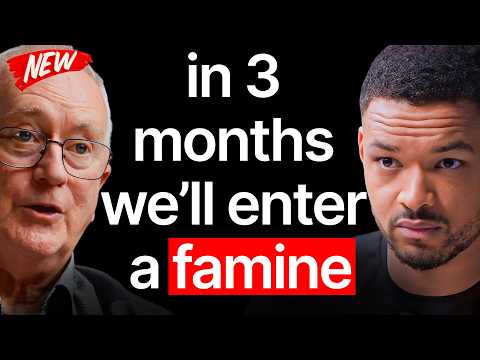
Financial Crash Expert: In 3 months We’ll Enter A Famine! If Iran Doesn’t Surrender It's The End!
Steve Keen (guest), Steven Bartlett (host), Steven Bartlett (host)
In this episode of The Diary of a CEO, featuring Steve Keen and Steven Bartlett, Financial Crash Expert: In 3 months We’ll Enter A Famine! If Iran Doesn’t Surrender It's The End! explores strait of Hormuz risks trigger energy, chip, and food crises worldwide Keen claims the Strait of Hormuz is the true global choke point because it routes not only oil but also major shares of fertilizer inputs and helium, making supply disruption a direct threat to food and semiconductor production.
Strait of Hormuz risks trigger energy, chip, and food crises worldwide
Keen claims the Strait of Hormuz is the true global choke point because it routes not only oil but also major shares of fertilizer inputs and helium, making supply disruption a direct threat to food and semiconductor production.
He predicts fertilizer shortages could translate into sharp falls in global food output within months, potentially creating a worldwide famine rather than localized crises.
He outlines five war-end scenarios ranging from catastrophic nuclear escalation (including Israel’s “Samson Doctrine”) to Iran neutralizing Israel’s nuclear capability, which he presents as the most likely and safest outcome.
The discussion broadens into macroeconomics: energy availability tightly tracks GDP, so sustained energy supply losses could cause a sizable global output contraction and worsen cost-of-living pressures and inequality.
Keen warns of a separate near-term financial downturn driven by an AI investment boom-bust cycle and argues policies like universal basic income may become necessary as AI/robots erode employment.
Key Takeaways
The Hormuz chokepoint is framed as a food-and-chips risk, not just an oil story.
Keen argues 20–30% of fertilizer-related flows and ~30% of helium supply are tied to the Gulf routing, so disruption threatens crop yields and semiconductor output alongside fuel prices.
Get the full analysis with uListen AI
Fertilizer constraints are presented as a fast-moving famine trigger.
He claims major import-dependent countries could exhaust fertilizer supplies within months, implying a rapid hit to planting, yields, and global food availability rather than a slow price-only effect.
Get the full analysis with uListen AI
Energy supply shocks propagate directly into global GDP contraction.
Using an energy vs. ...
Get the full analysis with uListen AI
Critical industrial inputs (helium) are treated as non-substitutable bottlenecks.
Because helium is difficult to stockpile and has no chemical substitute for certain chipmaking steps, Keen suggests a supply interruption could halt parts of semiconductor production, compounding tech and logistics disruptions.
Get the full analysis with uListen AI
The most catastrophic tail risk discussed is nuclear escalation via ‘Samson Doctrine.’
He argues that if Israel perceives existential defeat, it could consider extreme escalation; he assigns a non-trivial probability to nuclear-use scenarios and stresses disabling nuclear options as decisive for survival.
Get the full analysis with uListen AI
Keen’s ‘best case’ is geopolitical realignment away from US regional military presence.
He describes a negotiated outcome where the US exits and regional actors reorganize security arrangements, though the feasibility and desirability are debated in the conversation.
Get the full analysis with uListen AI
Personal resilience is framed as energy and food self-sufficiency, not portfolio timing.
Rather than giving investment picks, Keen recommends practical hedges—home solar and some capacity to grow food—because systemic breakdowns can make money less useful if goods become unavailable.
Get the full analysis with uListen AI
A separate crash risk is tied to AI’s classic Schumpeterian boom-bust dynamics.
He expects overinvestment and unrealistic valuations to unwind, and adds that AI’s labor-replacing potential makes the downturn socially destabilizing unless policies like UBI expand.
Get the full analysis with uListen AI
Notable Quotes
““People are focusing upon the price of this, but the really important point is this, the Strait of Hormuz.””
— Steve Keen
““If this is not available, the globe has a famine.””
— Steve Keen
““This war is threatening everybody on the planet.””
— Steve Keen
““If [nuclear escalation] happens, then we’re all dead.””
— Steve Keen
““We’ve basically elected a mafia don to President of the United States.””
— Steve Keen
Questions Answered in This Episode
You cite 20–30% of global fertilizer passing through Hormuz—what specific products (ammonia, urea, potash inputs) and data sources support that estimate?
Keen claims the Strait of Hormuz is the true global choke point because it routes not only oil but also major shares of fertilizer inputs and helium, making supply disruption a direct threat to food and semiconductor production.
Get the full analysis with uListen AI
On helium: which semiconductor manufacturing steps are most helium-dependent, and what realistic mitigation options exist (recycling systems, alternative gases, rerouting supply)?
He predicts fertilizer shortages could translate into sharp falls in global food output within months, potentially creating a worldwide famine rather than localized crises.
Get the full analysis with uListen AI
Your energy–GDP ‘lockstep’ chart implies near-proportional impacts; how does that relationship change during wartime rationing, efficiency gains, or demand destruction?
He outlines five war-end scenarios ranging from catastrophic nuclear escalation (including Israel’s “Samson Doctrine”) to Iran neutralizing Israel’s nuclear capability, which he presents as the most likely and safest outcome.
Get the full analysis with uListen AI
You estimate a ~5% chance of nuclear use to ‘destroy Iran’; what specific triggers or decision points would move that probability up or down?
The discussion broadens into macroeconomics: energy availability tightly tracks GDP, so sustained energy supply losses could cause a sizable global output contraction and worsen cost-of-living pressures and inequality.
Get the full analysis with uListen AI
Why do you think “Iran disables Israel’s nukes” is the most likely scenario—what capabilities and intelligence indicators would need to be true for that?
Keen warns of a separate near-term financial downturn driven by an AI investment boom-bust cycle and argues policies like universal basic income may become necessary as AI/robots erode employment.
Get the full analysis with uListen AI
Transcript Preview
So there are five scenarios in which the war could end, because Trump is stupid enough to take on what Israel wanted to do, which was destroy Iran, but they've bitten off far more than they can chew. So scenario one is Iran destroys the Gulf power infrastructure. I think that's highly likely, and if that happens, then Saudi Arabia, Qatar, Dubai, they all become uninhabitable. And then scenario two, Iran disables Israel's nukes. I hope that happens, but there's this one, and it scares the shit out of me.
Professor Steve, I have so many questions. What is going on?
So this war is threatening everybody on the planet, and what Trump is doing at the moment is a pump and dump scheme. He's trying to drive up the oil price and exploiting it for his friends and for his own wealth in the process. So people are focusing upon the price of this, but the really important point is this, the Strait of Hormuz. So oil, fertilizer, helium, all have to pass through the Strait of Hormuz.
And Iran have blocked that gap.
So they can say, "You do or do not pass," depending on what your country's attitude towards our country. So that's quite terrifying because twenty to thirty percent of our fertilizer comes through this point. But if this is not available, the globe has a famine.
Do you think he will send ground troops in?
Yes, I do, but I'd hate to be one of those troops because it's a suicide mission. They've got underground military units of weapons and troops, but we have no idea of the scale.
Trump keeps saying that the war has been won.
Yeah.
What's going on there, in your view?
I think he's been fed propaganda to tell him that he's winning the war by his immediate advisors because you cannot tell a person like that, that they've made a mistake.
We'll talk about that as well, but you've developed a bit of a reputation because you're very good at predicting things. So which of these five outcomes do you think is most probable to happen?
Oh, God. [sighs]
This is super interesting to me. My team give me this report to show me how many of you that watch this show subscribe, and some of you have told us, according to this, that you are unsubscribed from the channel randomly. So a favor to ask all of you, please could you check right now if you've hit the subscribe button, if you are a regular viewer of this show and you like what we do here. We're approaching quite a significant landmark on this show in terms of a subscriber number. So if there was one simple free thing that you could do to help us, my team, everyone here, to keep this show free, to keep it improving year over year and week over week, it is just to hit that subscribe button and to double-check if you've hit it. Only thing I'll ever ask of you. Do we have a deal? If you do it, I'll tell you what I'll do. I'll make sure every single week, every single month, we fight harder and harder and harder and harder to bring you the guests and conversations that you wanna hear. I've stayed true to that promise since the very beginning of The Diary of a CEO, and I will not let you down. Please help us. Really appreciate it. Let's get on with the show. [upbeat music] Professor Steven, who, who are you? If you had to sort of distill it down to three areas of specialism, what would those be?
Install uListen to search the full transcript and get AI-powered insights
Get Full TranscriptGet more from every podcast
AI summaries, searchable transcripts, and fact-checking. Free forever.
Add to Chrome