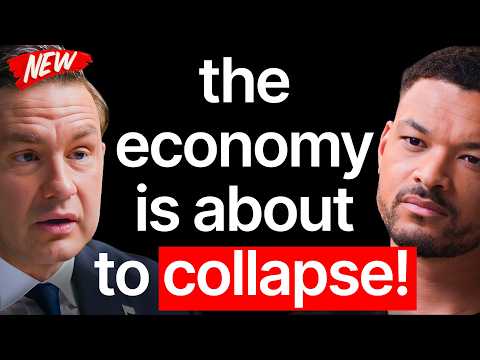
Pierre Poilievre, The Next Prime Minister of Canada?: The Economy Is About To Collapse!
Steven Bartlett (host), Pierre Poilievre (guest)
In this episode of The Diary of a CEO, featuring Steven Bartlett and Pierre Poilievre, Pierre Poilievre, The Next Prime Minister of Canada?: The Economy Is About To Collapse! explores pierre Poilievre on geopolitical risk, Canada’s economy, and personal leadership Poilievre argues the U.S. “going it alone” is a strategic error, and says Canada should leverage energy and critical minerals to secure tariff-free trade and strengthen Western alliances.
Pierre Poilievre on geopolitical risk, Canada’s economy, and personal leadership
Poilievre argues the U.S. “going it alone” is a strategic error, and says Canada should leverage energy and critical minerals to secure tariff-free trade and strengthen Western alliances.
He supports actions to prevent Iran from obtaining nuclear weapons, frames Tehran as uniquely dangerous due to ideology and regional aggression, and emphasizes avoiding a long-term military quagmire.
He claims Canada’s affordability crisis is driven by government intervention—slow permitting, high taxes/fees, and monetary expansion—creating “socialism for the very rich” that transfers wealth upward.
He advocates doubling homebuilding by speeding permits, cutting taxes on construction, and removing regulatory barriers, while also tightening immigration levels to match housing, jobs, and healthcare capacity.
Poilievre connects his political philosophy to formative life events—adoption, family hardship, and parenting an autistic non-verbal daughter—highlighting stoicism, compassion, and merit-based opportunity as guiding principles.
Key Takeaways
Canada’s strongest geopolitical bargaining chip is resources.
Poilievre repeatedly frames oil, gas, and critical minerals as strategic leverage to win concessions like tariff-free access for steel, aluminum, lumber, and autos, while also reducing Western dependence on unstable or hostile petro-states.
Get the full analysis with uListen AI
Preventing a nuclear-armed Iran is his non-negotiable objective.
He supports strikes aimed at degrading Iran’s nuclear capability, arguing Iran’s theocratic ideology makes it less deterrable than North Korea; however, he draws a line at open-ended ground-war commitments.
Get the full analysis with uListen AI
Affordability is, in his view, primarily a policy-made supply problem plus monetary inflation.
He argues housing and cost-of-living spikes reflect slow permits, high development charges, and expanding money supply—so the fix is faster approvals, lower taxes/fees, and producing more “things money buys” faster than money grows.
Get the full analysis with uListen AI
He claims today’s system is “upward redistribution,” not free-market capitalism.
Poilievre calls current conditions “socialism for the very rich,” saying government constraints (especially on housing and energy) enrich asset owners while younger and working-class Canadians face higher prices and stagnant real wages.
Get the full analysis with uListen AI
His housing plan hinges on speed and tax relief rather than land availability.
Using Canada’s vast land area as a contrast, he argues bureaucracy—not land/labor/materials—is the dominant cost driver; he targets OECD-slow permitting and proposes making homebuilding effectively “tax-free” to restore affordability.
Get the full analysis with uListen AI
Immigration should be tied to absorption capacity and wage dynamics.
He supports skilled immigration in principle but criticizes rapid expansion of temporary foreign worker/student streams as wage-suppressing and rent-inflating; he proposes caps so housing, healthcare, and jobs grow faster than population.
Get the full analysis with uListen AI
Credential gatekeeping undermines the economic promise of immigration.
He cites large numbers of immigrant doctors and nurses unable to practice, proposing merit-based testing and faster licensing pathways to align talent with shortages and raise productivity.
Get the full analysis with uListen AI
AI is treated as both productivity engine and social stability risk.
In response to the host’s concerns about rapid job displacement, Poilievre emphasizes “principles” over predictions: AI should increase agency and lower costs, but policy must preserve meaning/purpose and prevent inflation from erasing gains.
Get the full analysis with uListen AI
He rejects DEI as divisive while endorsing ‘strict equality’ and meritocracy.
Poilievre argues woke/DEI frameworks harden group divisions and expand state control; pressed on systemic bias, he shifts to removing government-created barriers (housing, licensing, crime policy) as the primary equity mechanism.
Get the full analysis with uListen AI
Personal hardship and fatherhood inform his leadership posture: stoic, control-focused, and more compassionate.
He links stoicism to handling political loss and uncertainty, and says parenting a non-verbal autistic daughter reinforced support for targeted safety nets and disability policies that encourage work without clawbacks.
Get the full analysis with uListen AI
Notable Quotes
““Canada should honestly become our fifty-first state… Which is never gonna happen.””
— Pierre Poilievre
““We are a resource superpower, and I want to leverage that to get what we want from the US and from other nations.””
— Pierre Poilievre
““There’s no solutions, just trade-offs in life.””
— Steven Bartlett (quoting Thomas Sowell)
““We have governments that are actively redistributing wealth from the working class to the very, very wealthy… What we have now is socialism for the very rich.””
— Pierre Poilievre
““Scars are the trophies of survival.””
— Pierre Poilievre
Questions Answered in This Episode
On Canada–U.S. trade: What specific ‘resource leverage’ mechanism would you use—export quotas, strategic reserves, pipeline approvals, or long-term supply contracts—and what are the risks?
Poilievre argues the U. ...
Get the full analysis with uListen AI
On Iran: What evidence threshold would justify further escalation after initial strikes, and what would be your red lines for Canadian military involvement?
He supports actions to prevent Iran from obtaining nuclear weapons, frames Tehran as uniquely dangerous due to ideology and regional aggression, and emphasizes avoiding a long-term military quagmire.
Get the full analysis with uListen AI
On housing: If permits are the main bottleneck, which level of government (municipal/provincial/federal) would you target first, and what enforcement tools would you actually have?
He claims Canada’s affordability crisis is driven by government intervention—slow permitting, high taxes/fees, and monetary expansion—creating “socialism for the very rich” that transfers wealth upward.
Get the full analysis with uListen AI
On inflation: You link deficits to money printing—what concrete fiscal rules (balanced budget mandate, spending cap, debt-to-GDP target) would you implement, and how fast?
He advocates doubling homebuilding by speeding permits, cutting taxes on construction, and removing regulatory barriers, while also tightening immigration levels to match housing, jobs, and healthcare capacity.
Get the full analysis with uListen AI
On immigration: How would you set a cap ‘so housing and healthcare grow faster than population’—what metrics and triggers would determine annual intake?
Poilievre connects his political philosophy to formative life events—adoption, family hardship, and parenting an autistic non-verbal daughter—highlighting stoicism, compassion, and merit-based opportunity as guiding principles.
Get the full analysis with uListen AI
Transcript Preview
Trump threw the election and then thereafter said that
Canada should honestly become our fifty-first state [laughs] Which is never gonna happen.
Pierre Poilievre, Leader of His Majesty's Loyal Opposition. There's a quite significant probability that you could be Canada's next leader, and your team said I can ask you whatever I want.
Okay.
So it appears that the United States have made the decision to kinda go it alone in the world.
And that is a very big strategic mistake. In Canada's case, we have everything the United States needs if they treat us like a friend. So, for example, we have the fourth-biggest supply of oil, and if you look at the leading five, which of these countries do you think the United States can most rely on?
And I'm looking at the third vial there in the row, Iran.
Mm-hmm.
Has Trump taken the right course of action?
The Iranian government has been extremely hostile and very dangerous to Canada. They are the leading world sponsor of terrorism, and there's no doubt in my mind that the only reason that they are enriching uranium is for the purpose of developing a weapon, and there's a far greater risk to them having a nuclear weapon than even North Korea. So the initial actions were definitely necessary.
But how do you think this plays out? And if Trump had called you and asked for your support, would you have given it?
Well, let, let's put it this way.
What is the thing that you're most concerned about?
We're overtaxing our population. We're punishing initiative. We have twenty thousand immigrant doctors who can't work in medicine. Wages have been destroyed. Young people can't start a family in this economy, and that is why the working class across the Western world is so angry. The good news is we can reverse all of that.
And the other thing that I actually was really keen to talk about is this.
Wow.
I can see the emotion in your face.
Yeah.
It's still there.
Yeah, I hadn't thought about that in a while.
This is super interesting to me. My team give me this report to show me how many of you that watch this show subscribe, and some of you have told us, according to this, that you are unsubscribed from the channel randomly. So favor to ask all of you, please could you check right now if you've hit the subscribe button if you are a regular viewer of the show and you like what we do here. We're approaching quite a significant landmark on this show in terms of a subscriber number, so if there was one simple free thing that you could do to help us, my team, everyone here, to keep this show free, to keep it improving year over year and week over week, it is just to hit that subscribe button and to double-check if you've hit it. Only thing I'll ever ask of you. Do we have a deal? If you do it, I'll tell you what I'll do. I'll make sure every single week, every single month, we fight harder and harder and harder and harder to bring you the guests and conversations that you wanna hear. I've stayed true to that promise since the very beginning of The Diary of a CEO, and I will not let you down. Please help us. Really appreciate it. Let's get on with the show. Pierre Poilievre, Leader of His Majesty's Loyal Opposition. There is so much I wanna talk to you about. I think you have a truly fascinating formative childhood, one of which I've, I've really seldom seen on this show, especially when the person rises so high in their political ambitions. But I think the most appropriate thing to start with, because it's just front of mind for me at the moment, is what the hell is going on in the world?
Install uListen to search the full transcript and get AI-powered insights
Get Full TranscriptGet more from every podcast
AI summaries, searchable transcripts, and fact-checking. Free forever.
Add to Chrome