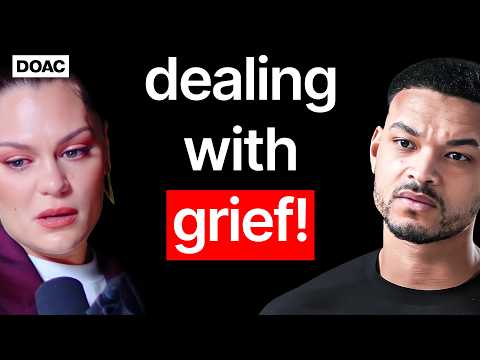
Jessie J: I Quit Music, Deleted An Album, Then Changed My Mind | E139
Steven Bartlett (host), Jessie J (guest), Narrator
In this episode of The Diary of a CEO, featuring Steven Bartlett and Jessie J, Jessie J: I Quit Music, Deleted An Album, Then Changed My Mind | E139 explores jessie J On Losing Everything, Finding Purpose, And Rewriting Her Future Jessie J sits down with Steven Bartlett to unpack the most pivotal and painful chapters of her life: chronic childhood illness, a teenage stroke, infertility and miscarriage, the deaths of close friends and her bodyguard, and the mental toll of global fame.
Jessie J On Losing Everything, Finding Purpose, And Rewriting Her Future
Jessie J sits down with Steven Bartlett to unpack the most pivotal and painful chapters of her life: chronic childhood illness, a teenage stroke, infertility and miscarriage, the deaths of close friends and her bodyguard, and the mental toll of global fame.
She explains how her upbringing, with emotionally open parents and a social-worker father, shaped her empathy and her ability to balance deep pain with humor on and off stage.
The conversation explores how fame eroded her sense of safety and self, why she nearly quit music and even asked to be dropped by her label, and how grief has clarified what she wants from her career, her team, and her personal life.
Emerging from loss, she’s deleting an entire finished album, rebuilding from instinct, and designing a new chapter centered on truth, emotional alignment, a one‑woman show, and becoming a mother with the right partner by her side.
Key Takeaways
Early adversity can seed lifelong empathy and perspective if you refuse to be defined by it.
As a child, Jessie spent long stretches in hospital with a serious heart condition, heavy medication, seizures, and later a stroke at 17. ...
Get the full analysis with uListen AI
Your body will often force the breaks you refuse to take with your mind.
Jessie reframes her recurring health crises—heart issues, stroke, Meniere’s disease, going deaf in one ear, throat damage, reproductive problems—not as curses but as a protective feedback loop. ...
Get the full analysis with uListen AI
Unchecked fame without emotional tools can create a prison of hyper‑vigilance and anxiety.
At the height of her fame (around 2014–2016), Jessie describes feeling constantly watched, criticized, and misrepresented, to the point she struggled to do basic tasks like filling her car with petrol. ...
Get the full analysis with uListen AI
Creative integrity sometimes means walking away from success, even after the work is done.
After a hectic third album where she wrote only two deeply personal tracks and felt misaligned with big pop hits she didn’t write, Jessie nearly quit music in 2016 and asked her label to drop her. ...
Get the full analysis with uListen AI
Grief can clarify non‑negotiables: who you keep, what you make, and where you sit.
The miscarriage, followed closely by the death of her close friend Jamal Edwards and earlier the death of her long‑time bodyguard Dave, ripped open layers of unprocessed grief. ...
Get the full analysis with uListen AI
Support systems must prioritize the human over the brand, especially in crisis.
When Jessie learned her baby had died, one of the first responses she received—from a team member—was, “What do you want to do about the show tomorrow? ...
Get the full analysis with uListen AI
Living in alignment means trusting your gut and acting on it, even when it’s costly.
Across the episode, Jessie returns to the same principle: her best decisions—the China TV show, the Rose album, firing managers, delaying an album, admitting she doesn’t love finished work—came from acting on instinct, not consensus or fear. ...
Get the full analysis with uListen AI
Notable Quotes
“I felt like I'd been given everything I've ever wanted and then someone had gone, 'But you can't have it.' I've never felt so lonely in my life.”
— Jessie J
“You grow in moments of sadness and pain. My body has always kept my feet on the ground, even when it was shutting down.”
— Jessie J
“I just felt like I had no one I could talk to that had experienced it to guide me, to go, 'You're okay. You're safe.'”
— Jessie J
“Life is too short to sit anywhere other than where you're supposed to be. If you're sitting at a table where you don't feel like you're being fed, even if you're bringing a plate of food, you politely just leave.”
— Jessie J
“The only thing in life that is important is to act on your instincts. If something doesn’t feel right, it’s because it’s not.”
— Jessie J
Questions Answered in This Episode
You described your body as ‘protecting’ you by shutting down at key career moments; what specific changes did you make the last time that happened, and what would you do differently if it happened again?
Jessie J sits down with Steven Bartlett to unpack the most pivotal and painful chapters of her life: chronic childhood illness, a teenage stroke, infertility and miscarriage, the deaths of close friends and her bodyguard, and the mental toll of global fame.
Get the full analysis with uListen AI
When you listen back to the unreleased pandemic album, can you point to a particular song or lyric that perfectly illustrates why it doesn’t feel like ‘only you’ could sing it?
She explains how her upbringing, with emotionally open parents and a social-worker father, shaped her empathy and her ability to balance deep pain with humor on and off stage.
Get the full analysis with uListen AI
You said most of your best decisions came from acting on instinct even when everyone around you disagreed—can you walk through one instance where following that instinct cost you something big in the short term but paid off later?
The conversation explores how fame eroded her sense of safety and self, why she nearly quit music and even asked to be dropped by her label, and how grief has clarified what she wants from her career, her team, and her personal life.
Get the full analysis with uListen AI
If you were designing an ideal mental‑health and support framework for a 19‑year‑old artist about to explode in the way you did, what concrete safeguards, people, and rules would you put around them based on your own experience?
Emerging from loss, she’s deleting an entire finished album, rebuilding from instinct, and designing a new chapter centered on truth, emotional alignment, a one‑woman show, and becoming a mother with the right partner by her side.
Get the full analysis with uListen AI
You’ve realized you were outsourcing ‘safety’ to Dave and ‘self‑belief’ to Jamal; what are the daily or practical ways you’re now trying to cultivate those two qualities within yourself so they’re not dependent on anyone else?
Get the full analysis with uListen AI
Transcript Preview
Could you do me a quick favor if you're listening to this? Please hit the follow or subscribe button. It helps more than you know, and we invite subscribers in every month to watch the show in person.
I felt like I'd been given everything I've ever wanted and then someone had gone, "But you can't have it." I've never felt so lonely in my life. Jessie J. ... went to the room. Forget about the price tag. 2015, '16, it was really the first time that I'd had fame. I didn't know how to cope with it, so I just panicked all the time. I just want to sing. The day that I found out that the baby had died, I didn't have anyone to just fall apart on, and- and that's what I needed, that's what I wanted.
When I sent you that voice note, it was around the time when you'd done a big post about Dave.
He was my guy, and I wish I could've protected him from himself like he protected me from myself. That's the bit that hurts me the most. Between Dave and Jamal, the things that those people gave me in my life are things that I know I have to find in myself. You got this bougie-ass place and you've got kitchen roll. I love it.
(laughs)
(laughs)
So without further ado, I'm Steven Bartlett, and this is the Diary of a CEO USA edition. I hope nobody's listening, but if you are, then please keep this to yourself. I tend to believe that people's family are their foundation, and when I was reading through the story of your family in your early years, it actually seemed pretty idyllic.
Yeah, I mean, we weren't... My mom and dad... I didn't grow up with loads of money. Like, we weren't hard, hard up, but we weren't rich. Um, but when I think about it again, like, the one thing that I've learned from my parents the most is it doesn't matter about the things and the specifics, it's about the energy you create within what you have. So like, we would go camping in the garden and my dad would pretend to be a bear in the middle of the night, and we b-... I believe to this day it was a bear. Like, you know, my mom's like looking out the window 'cause she's gone in 'cause she's like, "I ain't doing this," and my dad's-
To this day?
Yeah, and my dad's peeing in a bucket. Yeah, they're still doing it. Like, not in front of us, 'cause that would be weird, but like, just they used to just create these experiences, and it was all about feeling and that's what I remember the most from my childhood. Like, more so than anything else. Like, it's weird, like, I was in hospital a lot of my childhood and I never ever thought I was sick 'cause my mom and dad never treated me as if I was. Like, they would... It was, it would never, it never became a definitive of who I was which is, I think even why now I don't define myself on that. I don't want to even when other people try. But there was just always this air of making the best of whatever the moment was, even if it was tough.
Install uListen to search the full transcript and get AI-powered insights
Get Full TranscriptGet more from every podcast
AI summaries, searchable transcripts, and fact-checking. Free forever.
Add to Chrome