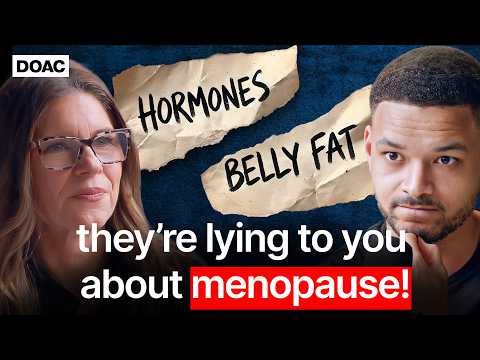
Hormone Expert: Control Your Hormones Control Your Belly Fat! Cortisol, oestrogen, testosterone.
Dr. Sara Szal (guest), Steven Bartlett (host), Narrator
In this episode of The Diary of a CEO, featuring Dr. Sara Szal and Steven Bartlett, Hormone Expert: Control Your Hormones Control Your Belly Fat! Cortisol, oestrogen, testosterone. explores harness Hormones, Heal Trauma, Lose Belly Fat, And Reclaim Vitality Harvard-trained physician and hormone expert Dr. Sara Szal explains how cortisol, sex hormones, trauma, and lifestyle interact to shape belly fat, brain health, mood, and aging—especially for women in perimenopause and menopause.
Harness Hormones, Heal Trauma, Lose Belly Fat, And Reclaim Vitality
Harvard-trained physician and hormone expert Dr. Sara Szal explains how cortisol, sex hormones, trauma, and lifestyle interact to shape belly fat, brain health, mood, and aging—especially for women in perimenopause and menopause.
She argues that mainstream medicine is “medicine for the average,” over-relies on drugs, underuses lifestyle medicine, and largely fails women: up to 75% don’t receive appropriate perimenopause/menopause care, and the pill is overprescribed without full informed consent.
Drawing on data from ~40,000 patients, she details how chronic stress, adverse childhood experiences, endocrine disruptors, poor sleep, and dysregulated blood sugar drive hormone imbalances, while targeted nutrition, strength training, breathwork, and precise testing can reverse many problems.
Szal also addresses the gendered health gap—higher female rates of depression, PTSD, insomnia, and autoimmune disease—and calls for systemic and personal changes to reduce women’s stress, honor their biology, and support their health across the lifespan.
Key Takeaways
Cortisol balance is the master lever for hormones, belly fat, and brain health.
Cortisol is not just a “stress hormone”; it’s essential for survival and dominates other hormones. ...
Get the full analysis with uListen AI
Adverse childhood experiences (ACEs) lodge in the body and drive chronic disease—but can be addressed.
The ACE questionnaire (10 items) predicts risk of 45 chronic conditions; even a score ≥1 increases risk, and Szal’s own score is 6. ...
Get the full analysis with uListen AI
Conventional medicine is “broken” for chronic disease; precision lifestyle medicine is more effective.
Randomized drug trials create “medicine for the average,” not optimized care for individuals. ...
Get the full analysis with uListen AI
Women’s hormonal transitions—especially perimenopause—are grossly misunderstood, under-treated, and highly modifiable.
Perimenopause typically begins between 35–45 as ovarian mitochondria and egg supply decline; it’s not just fluctuating estrogen and progesterone, but also changes in metabolism, brain glucose use, and immunity, with skyrocketing autoimmunity risk. ...
Get the full analysis with uListen AI
Testosterone and estrogen matter hugely for both sexes, and food, stress, and toxins strongly influence them.
Men have ~10× more testosterone, but it’s the most abundant hormone in women as well and underpins vitality, confidence, risk tolerance, libido, muscle response to training, and mood in both sexes. ...
Get the full analysis with uListen AI
Metabolic health (especially blood sugar and fiber intake) is inseparable from hormone balance and energy.
Szal heavily uses continuous glucose monitors (CGMs) because nothing else changes food behavior as quickly: people see in real time how meals affect glucose and energy. ...
Get the full analysis with uListen AI
Behavior change is difficult but possible when pain is high enough, boundaries are clear, and feedback is immediate.
Szal views behavior change as “the hardest thing we do as humans,” especially when ACE-driven patterns (e. ...
Get the full analysis with uListen AI
Notable Quotes
“Conventional, mainstream, modern medicine, I believe, is broken.”
— Dr. Sara Szal
“Cortisol is more like a dictator. You can live without testosterone, estrogen, progesterone—you cannot live without cortisol.”
— Dr. Sara Szal
“Seventy to seventy‑five percent of women do not get the treatment for perimenopause and menopause that they deserve.”
— Dr. Sara Szal
“It has become a health hazard to be female.”
— Dr. Sara Szal
“Orgasm is one of the most effective strategies for creating nervous system regulation.”
— Dr. Sara Szal
Questions Answered in This Episode
You mentioned that high cortisol in midlife women shrinks brain volume and impairs glucose use—what specific interventions (doses, durations, modalities) have you found most effective at actually reversing or stabilizing these brain changes on imaging or cognitive testing?
Harvard-trained physician and hormone expert Dr. ...
Get the full analysis with uListen AI
When you say many perimenopause and menopause symptoms are avoidable with hormone therapy and lifestyle, what concrete protocol (hormone types, delivery routes, timing relative to last period) do you consider safest and most evidence-based for a healthy 42‑year‑old starting to notice symptoms?
She argues that mainstream medicine is “medicine for the average,” over-relies on drugs, underuses lifestyle medicine, and largely fails women: up to 75% don’t receive appropriate perimenopause/menopause care, and the pill is overprescribed without full informed consent.
Get the full analysis with uListen AI
You were very critical of the birth control pill’s risks and informed consent—what, in your view, would a truly balanced, data-driven informed consent conversation about the pill sound like for a 17‑year‑old considering it for acne or contraception?
Drawing on data from ~40,000 patients, she details how chronic stress, adverse childhood experiences, endocrine disruptors, poor sleep, and dysregulated blood sugar drive hormone imbalances, while targeted nutrition, strength training, breathwork, and precise testing can reverse many problems.
Get the full analysis with uListen AI
Given the strong link you draw between ACEs, cortisol patterns, and metabolic disease, how would you design a practical, stepwise trauma‑informed lifestyle program for someone who has a high ACE score but limited time, money, and access to psychedelic-assisted therapy?
Szal also addresses the gendered health gap—higher female rates of depression, PTSD, insomnia, and autoimmune disease—and calls for systemic and personal changes to reduce women’s stress, honor their biology, and support their health across the lifespan.
Get the full analysis with uListen AI
You argue that gendered social roles and emotional labor burdens make it a ‘health hazard to be female’—what specific policy or workplace changes (e.g., parental leave, scheduling norms, healthcare coverage) do you believe would measurably reduce women’s rates of depression, autoimmunity, and burnout over the next decade?
Get the full analysis with uListen AI
Transcript Preview
73 to 75% of women do not get the treatment for perimenopause and menopause that they deserve. And women are asking, "Why is it that I can't manage stress the way I once did? Why do I have this belly fat that appeared out of nowhere, and my usual techniques for how to deal with that aren't working? Why would I rather mop the floor than have sex with my husband?" But there's more than 100 plus symptoms that women aren't aware of.
But you believe many of the symptoms of menopause are avoidable?
Yes. And let's get into that. Dr. Sara Sahl is the Harvard-trained physician and hormone expert...
Who's unlocking the science and simple tricks behind feeling your best, no matter your age.
Most people have imbalanced hormones. Think of them as text messages that your body sends to keep everything functioning optimally. For example, out of the 40,000 people I've tested and treated, around 90% of them have a problem with their cortisol hormones.
And if my body's making too much cortisol, what is the harm?
It's associated with more belly fat. We know that it shrinks the brain in women, but not men. It's associated with depression, but also if you're someone who's making a lot of cortisol, you're gonna make less testosterone, and that leads to a whole host of serious problems.
And what about trauma? Does that impact your hormones?
Oh, yes. And one of the ways to measure trauma is the ACE test. It's a validated questionnaire, and they found that people who had one or higher ACE scores had a greater risk of 45 different chronic diseases. And my score is six out of ten. But those ACEs are living on in your body.
And you went on a journey to heal yourself?
Yes, with lifestyle medicine, not a pharmaceutical.
Tell me about that journey. This has always blown my mind a little bit, 53% of you that listen to this show regularly haven't yet subscribed to this show. So could I ask you for a favor before we start? If you like this show and you like what we do here and you wanna support us, the free, simple way that you can do just that is by hitting the subscribe button. And my commitment to you is if you do that, then I'll do everything in my power, me and my team, to make sure that this show is better for you every single week. We'll listen to your feedback, we'll find the guests that you want me to speak to, and we'll continue to do what we do. Thank you so much. Dr. Sara Sahl. What is it that you do for people?
I'm a physician, so I work in academic medicine. I do research for people, I teach, and I take care of patients. So that's the official BBC answer, and the unofficial answer is, I'm a healer.
Install uListen to search the full transcript and get AI-powered insights
Get Full TranscriptGet more from every podcast
AI summaries, searchable transcripts, and fact-checking. Free forever.
Add to Chrome