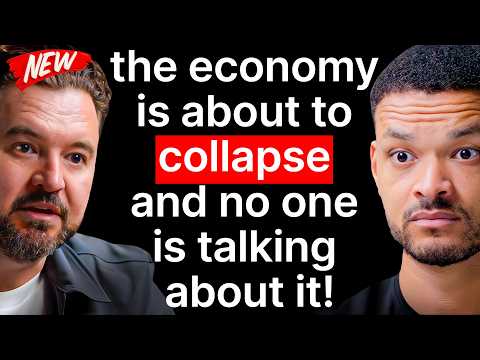
Daniel Priestley: AI Will Make Plumbers Earn More Than Lawyers! (2029 PREDICTION)
Steven Bartlett (host), Daniel Priestley (guest)
In this episode of The Diary of a CEO, featuring Steven Bartlett and Daniel Priestley, Daniel Priestley: AI Will Make Plumbers Earn More Than Lawyers! (2029 PREDICTION) explores aI, work upheaval, and entrepreneurial survival in a post-job economy Priestley argues AI plus robotics will trigger a rapid labor-market reset where many white-collar tasks become commoditized while scarce hands-on trades may rise in pay and status.
AI, work upheaval, and entrepreneurial survival in a post-job economy
Priestley argues AI plus robotics will trigger a rapid labor-market reset where many white-collar tasks become commoditized while scarce hands-on trades may rise in pay and status.
They describe a shift from “social media” to “algorithmic media,” where attention is fixed but content supply explodes, pushing creators toward defensible ecosystems built on community and real-world experiences.
Priestley’s main risk case is financial: massive, short-lived data-center capex with weak revenue models could create an infrastructure bubble and potential crash around 2029.
The discussion frames “entrepreneurial thinking” as the core survival skill, outlining a repeatable six-step value-creation loop from opportunity fit through validation, product-market fit, go-to-market, scaling, and exit.
They conclude that the durable human edge is lived experience, trust, and relationships—best monetized through personal playbooks, personal brand, and a portfolio of products/services rather than a single job title.
Key Takeaways
Expect a status reversal: some trades may out-earn legacy professions.
Priestley predicts plumbers/electricians could earn more than lawyers as AI automates document-heavy white-collar work while physical, on-site labor remains scarce and harder to robotize quickly.
Get the full analysis with uListen AI
The rollout speed is unprecedented because AI propagates instantly over networks.
Once an AI model learns a task (law, diagnosis, support), it can be deployed everywhere at once—compressing disruption cycles from decades to months.
Get the full analysis with uListen AI
Content and software are becoming cheaper to produce, so differentiation shifts to ecosystems.
As tools commoditize, defensibility comes from bundling software with education, community, events, retreats, and “VIP” human access—things that are harder to copy than a feature list.
Get the full analysis with uListen AI
Your strongest moat is what only you can say from lived experience.
They argue informational output will be saturated by AI, while personal stories, hard-earned playbooks, and relationship-driven content create trust and durable audience connection.
Get the full analysis with uListen AI
Use entrepreneurial validation to avoid “falling in love” with untested ideas.
Priestley advocates fast, cheap experiments (e. ...
Get the full analysis with uListen AI
The biggest AI risk may be financial, not technical.
He warns that data centers have a 3–4 year replacement cycle and capex may exceed realistic subscription revenues, potentially creating a private-credit/pension exposure bubble.
Get the full analysis with uListen AI
To stay employable, demonstrate curiosity and “figure-out ability” with AI tools.
Bartlett describes hiring signals: candidates who actively experiment with tools (e. ...
Get the full analysis with uListen AI
Notable Quotes
“Blue-collar work has been devalued… it could be… plumbers regularly earn more than lawyers.”
— Daniel Priestley
“The end of social media and the birth of algorithmic media.”
— Daniel Priestley
“Every time you go on AI, your request is going off to a big computer in a Walmart-sized building somewhere.”
— Daniel Priestley
“Relatable beats impressive.”
— Steven Bartlett
“AI has all the data… but it’s got no lived experience.”
— Daniel Priestley
Questions Answered in This Episode
You argue plumbers may out-earn lawyers—what assumptions (robotics adoption, training pipelines, regulation) have to be true for that to happen by 2029?
Priestley argues AI plus robotics will trigger a rapid labor-market reset where many white-collar tasks become commoditized while scarce hands-on trades may rise in pay and status.
Get the full analysis with uListen AI
If algorithmic media kills “one-dimensional” creators, what’s the minimum viable ecosystem a new creator should build today (community, products, IRL events) to be defensible?
They describe a shift from “social media” to “algorithmic media,” where attention is fixed but content supply explodes, pushing creators toward defensible ecosystems built on community and real-world experiences.
Get the full analysis with uListen AI
On the data-center bubble thesis: what specific indicators would confirm we’re nearing a 2029-style crash (capex/revenue ratios, private-credit spreads, default rates)?
Priestley’s main risk case is financial: massive, short-lived data-center capex with weak revenue models could create an infrastructure bubble and potential crash around 2029.
Get the full analysis with uListen AI
You describe six entrepreneurial steps—what are practical examples of “validation” experiments for non-tech people with limited time and money?
The discussion frames “entrepreneurial thinking” as the core survival skill, outlining a repeatable six-step value-creation loop from opportunity fit through validation, product-market fit, go-to-market, scaling, and exit.
Get the full analysis with uListen AI
If software becomes a commodity, how should SaaS pricing and retention strategies change when customers can build internal tools in a week?
They conclude that the durable human edge is lived experience, trust, and relationships—best monetized through personal playbooks, personal brand, and a portfolio of products/services rather than a single job title.
Get the full analysis with uListen AI
Transcript Preview
I was looking at the top ten jobs that are most likely to be disrupted by AI, and I really do worry about this.
So the nature of the economy is changing. For a long time, blue-collar work like plumbers, electricians, bricklayers has been devalued. But it could be in the next couple of years, these are the roles that are elevated the most, and that plumbers regularly earn more than lawyers. And for the last twenty-five years, I've been building companies from scratch, and I've been through the global financial crisis and COVID, but I have never experienced what we're experiencing right now. I've never seen more fear for the disruption that is coming. And my real bear case for AI is that every time you go on AI, your request is going off to a big computer in a Walmart-sized building somewhere, and those big ginormous computers, they last three to four years before they need to be replaced. And this year ahead, we're gonna spend six hundred and fifty billion, and that could cause a massive financial collapse. That's the thing that I'm worried most about. However, I've never seen more excitement for the opportunities that are in front of us.
So let's talk about in a world of AI, what are the skills that survive?
So I really believe that everyone should build a little bit of a personal brand. Not like to become an influencer, but position yourself with a group of people who know who you are and know what you do and could enroll you in their opportunity. Second one, if there's one skill set that everyone should be learning at the moment, it's how do entrepreneurs think, how do entrepreneurs behave, what are the skills that make an entrepreneur successful? And entrepreneurs just simply follow six steps, and we do it over and over and over again, and we'll go through the six steps.
So are there any particular opportunities that you think that anybody listening right now could pursue to make money?
So I think one of the best opportunities is-
That is such good advice that we don't hear enough. This is super interesting to me. My team give me this report to show me how many of you that watch this show subscribe. Sixty-nine percent of you that watch this show frequently haven't yet hit the subscribe button, and some of you have told us, according to this, that you are unsubscribed from the channel randomly. So favor to ask all of you, please could you check right now if you've hit the subscribe button, if you are a regular viewer of the show and you like what we do here. We're approaching quite a significant landmark on this show in terms of a subscriber number. So if there was one simple free thing that you could do to help us, my team, everyone here, to keep this show free, to keep it improving year over year and week over week, it is just to hit that subscribe button and to double-check if you've hit it. Only thing I'll ever ask of you. Do we have a deal? If you do it, I'll tell you what I'll do. I'll make sure every single week, every single month, we fight harder and harder and harder and harder to bring you the guests and conversations that you wanna hear. I've stayed true to that promise since the very beginning of The Diary of a CEO, and I will not let you down. Please help us. Really appreciate it. Let's get on with the show. [upbeat music] Daniel, I think we're living in the most interesting, opportunistic, terrifying time to be an entrepreneur, a professional, to really be anybody, because this is a moment of such fundamental change. And I really wanted to have this conversation with you today because I wanna understand how you're thinking about AI from an opportunity standpoint as an entrepreneur, but also just for everybody that's working in a normal job and who is at risk of having their, their career, their livelihood, their identity, their qualifications made redundant because there is now an alien amongst us that can do so much. So this conversation really is about giving people answers. It's about being honest with them about what's coming, and it's about preparing them, setting them up so that they have an advantage in the face of the future we face. So give me the thirty thousand feet view.
Install uListen to search the full transcript and get AI-powered insights
Get Full TranscriptGet more from every podcast
AI summaries, searchable transcripts, and fact-checking. Free forever.
Add to Chrome